
Pankaj Kumar v. State of Bihar & Ors., 2026
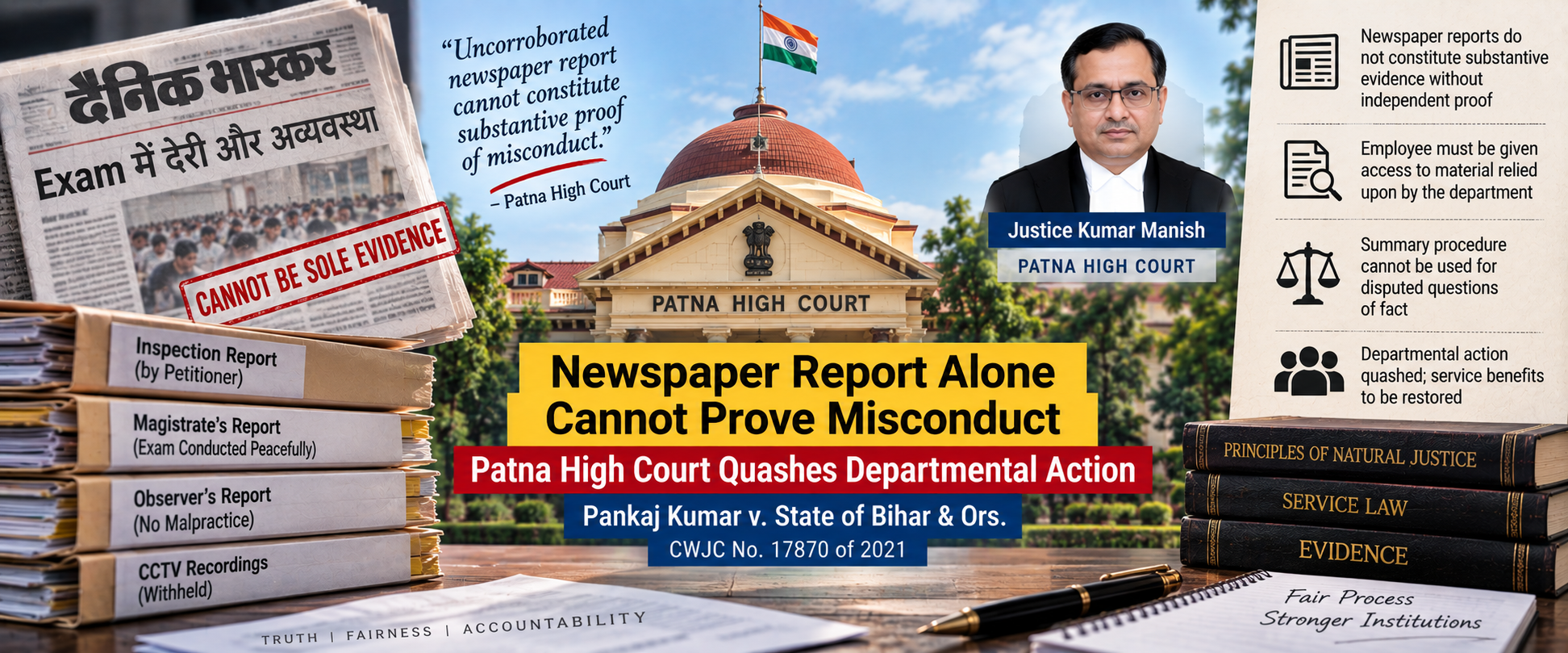
Newspaper contents require independent proof and appropriate witness testimony when the facts stated therein are disputed.
Judgement Details
Court
Patna High Court
Date of Decision
22 September 2026
Judges
Justice Kumar Manish
Citation
Acts / Provisions
Facts of the Case
-
The petitioner, Pankaj Kumar, was posted as Principal-cum-Centre Superintendent at Government ITI Mahkaar, Gaya.
-
An All-India Trade Test (AITT) was scheduled to be conducted at the centre in July 2018.
-
Before the examination, the petitioner submitted an inspection report and requisitions informing the authorities about the infrastructural deficiencies at the examination centre.
-
He specifically informed the authorities that the centre had seating capacity for only 110 candidates, whereas approximately 350 candidates were appearing each day.
-
The petitioner sought necessary logistical support from the authorities.
-
The examination was conducted on 24.07.2018.
-
The Magistrate and Observer deputed at the centre submitted reports stating that the examination had been conducted peacefully and fairly.
-
On the following day, a report was published in Dainik Bhaskar alleging delay and mismanagement during the examination.
-
The departmental authorities relied upon the newspaper report and issued a show-cause notice to the petitioner.
-
The petitioner replied that the photograph published with the newspaper report related to another institution.
-
Departmental proceedings were subsequently initiated against the petitioner under Rule 19 of the Bihar Government Servants (Classification, Control and Appeal) Rules, 2005.
-
During the proceedings, the petitioner sought technical parameters, video recordings, inspection details and other material which he considered necessary for preparing his defence.
-
The department rejected his request as “not reasonable.”
-
The disciplinary authority subsequently imposed the punishment of censure and withholding of three increments without cumulative effect.
-
The petitioner challenged the departmental proceedings, punishment order and subsequent review rejection before the Patna High Court.
-
He contended that the proceedings were substantially based upon an uncorroborated newspaper report, despite the existence of contemporaneous official reports stating that the examination had proceeded peacefully.
-
He further contended that the department had failed to provide relevant material necessary for his defence.
Issues
-
Whether an uncorroborated newspaper report can constitute substantive evidence of misconduct in a departmental proceeding?
-
Whether a newspaper report can be relied upon as proof of misconduct when its contents are disputed and unsupported by independent witness testimony?
-
Whether the departmental authorities could rely upon the newspaper report while ignoring the contemporaneous official reports stating that the examination had been conducted peacefully?
-
Whether refusal to provide the employee with technical material, CCTV recordings and other documents relied upon by the disciplinary authority violates the principles of natural justice?
-
Whether Rule 19 of the Bihar Government Servants (Classification, Control and Appeal) Rules, 2005 permits summary disciplinary action where the allegations involve disputed questions of fact requiring proof?
-
Whether the departmental authorities were justified in imposing punishment without examining witnesses and while relying primarily upon an unproved newspaper report?
Judgement
-
The Patna High Court allowed the petition filed by Pankaj Kumar.
-
The Court held that an uncorroborated newspaper report cannot constitute substantive evidence of misconduct in a departmental proceeding.
-
The Court relied upon the Supreme Court's decision in Laxmi Raj Shetty, holding that newspaper reports do not constitute substantive evidence in the absence of independent proof and witness testimony.
-
The Court observed that merely producing a newspaper report before the disciplinary authority does not establish the truth of the facts stated in that report.
-
Where the contents of a newspaper report are disputed, the person who actually perceived the events forming the basis of the report would ordinarily need to be examined.
-
The Court found that the newspaper report relied upon by the department was contradicted by the contemporaneous official report of the Magistrate and Observer.
-
Those officials had reported that the examination conducted on 24 July 2018 was peaceful and free from malpractice.
-
The Court also found that the petitioner had specifically requested access to technical parameters, CCTV recordings and other relevant material.
-
The department had rejected the request without adequately furnishing the material.
-
The Court held that natural justice requires disclosure of material relied upon by the disciplinary authority so that the employee can examine, explain, contradict or challenge it.
-
The Court further held that the availability of a summary procedure under Rule 19 does not permit the department to dispense with fairness where the allegations involve disputed questions of fact.
-
The Court noted that the departmental proceedings cited “Nil” witnesses, despite the petitioner's specific denial of the allegations.
-
The Court concluded that the punishment could not legally be sustained on the basis of an unproved newspaper report while ignoring contrary official material.
-
The Court quashed the departmental charge memo dated 08.03.2019.
-
The punishment order dated 11.11.2019 was also quashed.
-
The review rejection order dated 06.09.2021 was likewise quashed.
-
The respondents were directed to restore the petitioner's service benefits.
-
The respondents were further directed to release the arrears of salary and withheld increments within three months.
Held
-
An uncorroborated newspaper report cannot, by itself, constitute substantive proof of misconduct in a departmental proceeding.
-
Contemporaneous official records contradicting a newspaper report must be properly considered by the disciplinary authority.
-
An employee facing disciplinary proceedings must be provided access to the material relied upon against him so that he can effectively defend himself.
-
Denial of relevant material necessary to challenge the allegations constitutes a violation of natural justice.
-
A summary procedure cannot be used to determine disputed questions of fact without adequate proof.
-
The disciplinary authority could not impose punishment while relying upon a newspaper clipping and citing no witnesses to establish the alleged misconduct.
-
The departmental charge memo, punishment order and review rejection order were therefore quashed.
-
The petitioner was entitled to restoration of his service benefits, salary arrears and withheld increments.
Analysis
-
Newspaper report as evidence: The Court reaffirmed that a newspaper report is not, by itself, substantive evidence of the facts stated in it.
-
Need for independent proof: When the allegations contained in a newspaper report are disputed, the underlying facts must be established through legally acceptable evidence.
-
Witness testimony: The Court emphasized the importance of examining persons who actually witnessed or perceived the events forming the basis of the allegations.
-
Contradictory official records: The contemporaneous reports prepared by the Magistrate and Observer were particularly significant because they recorded that the examination had been conducted peacefully.
-
Natural justice: The employee must have a meaningful opportunity to understand and challenge the material being used against him.
-
Disclosure of relied-upon material: Technical documents, CCTV recordings and other investigative or departmental material forming the foundation of the charge cannot simply be withheld from the employee.
-
Summary procedure: The judgment makes clear that a summary disciplinary procedure cannot become a substitute for an inquiry where the allegations themselves are seriously disputed.
-
Absence of witnesses: The fact that the departmental proceedings cited “Nil” witnesses was significant because the allegations were based on disputed factual assertions.
-
Burden of establishing misconduct: The disciplinary authority cannot treat an unverified newspaper report as proof merely because it has been formally placed on record.
-
Service consequences: Since the underlying disciplinary action was found unsustainable, the Court directed restoration of the consequential service and monetary benefits.