
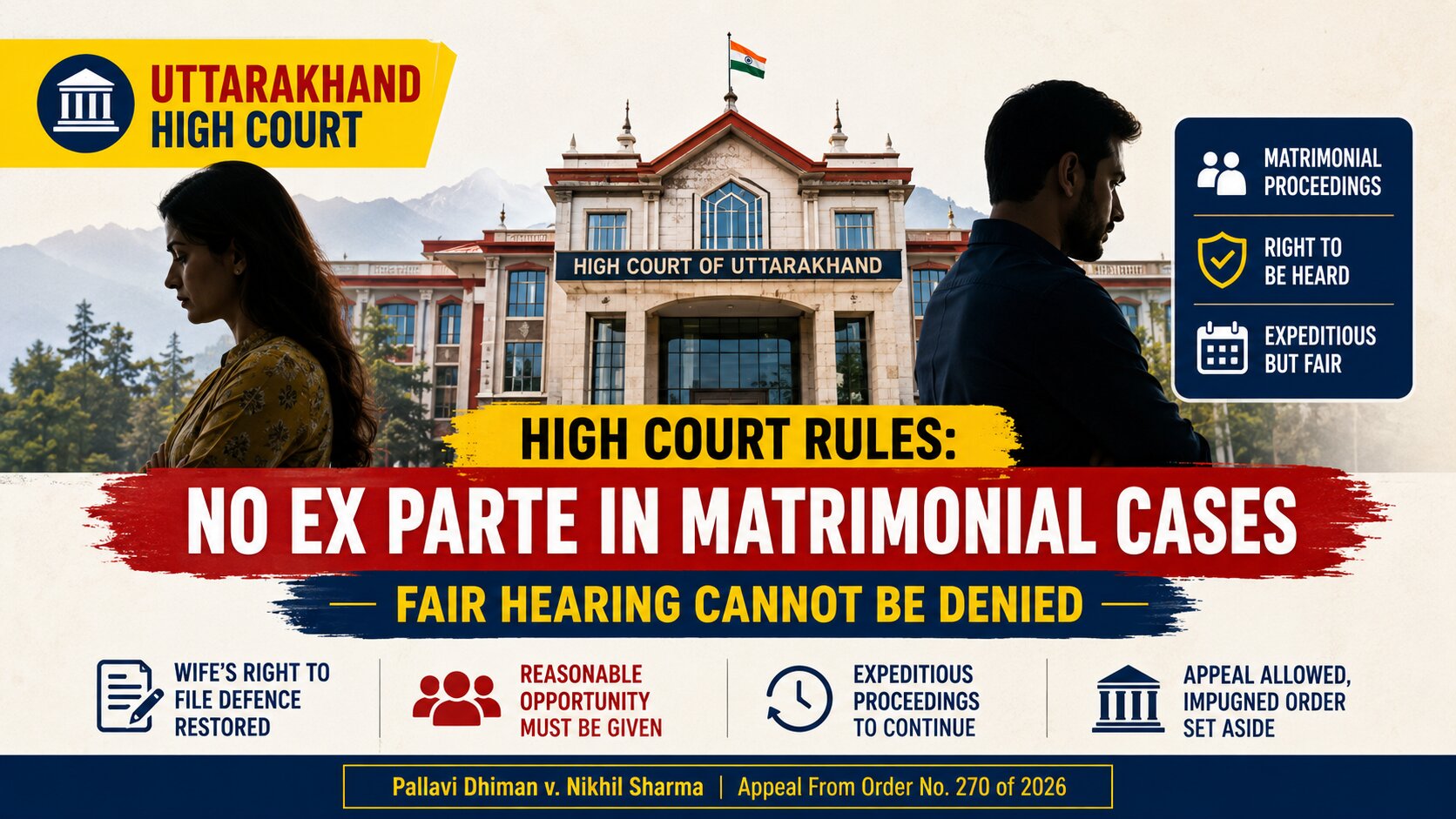
Pallavi Dhiman v. Nikhil Sharma, 2026
The judgment reinforces the principles of natural justice, particularly the right of every litigant to receive a reasonable opportunity to present their case.
Judgement Details
Court
Uttarakhand High Court
Date of Decision
29 July 2026
Judges
Justice Manoj Kumar Tiwari and Justice Pankaj Purohit
Citation
Acts / Provisions
Facts of the Case
-
The respondent-husband instituted matrimonial proceedings before the Family Court, Haridwar, seeking dissolution of marriage under Sections 13(1)(ia) and 13(1)(ib) of the Hindu Marriage Act, 1955 on the grounds of cruelty and desertion.
-
During the proceedings, the appellant-wife appeared before the Family Court on the date fixed for filing her written statement.
-
The wife sought additional time to file her written statement on the ground that the litigation expenses earlier awarded in her favour had not been paid by the husband.
-
The Family Court rejected her request, closed her right to file a written statement, and directed that the matrimonial proceedings would continue ex parte against her.
-
Aggrieved by the order, the wife preferred an appeal before the Uttarakhand High Court under Section 19 of the Family Courts Act, 1984.
-
Before the High Court, the wife contended that she was willing to contest the proceedings and had appeared before the Family Court but could not effectively defend herself because the litigation expenses had not been paid.
-
The husband argued that litigation expenses of ₹5,000 and travelling expenses of ₹200 had been tendered on 1 July 2026, and therefore the Family Court had rightly proceeded against the wife.
-
The High Court examined whether the Family Court was justified in denying the wife an opportunity to file her defence merely to ensure expeditious disposal of matrimonial proceedings.
Issues
-
Whether the Family Court was justified in closing the appellant-wife's right to file her written statement despite her appearance before the Court?
-
Whether the Family Court was justified in directing the matrimonial proceedings to continue ex parte against the appellant-wife?
-
Whether the objective of expeditious disposal of matrimonial disputes can override a party's right to a reasonable opportunity of hearing?
-
Whether the appellant-wife's request for additional time to file her written statement was bona fide in the facts and circumstances of the case?
-
Whether the impugned order violated the principles of natural justice by denying the appellant-wife a fair opportunity to defend the matrimonial proceedings?
Judgement
-
The High Court held that the appellant-wife had appeared before the Family Court and had specifically sought time to file her written statement.
-
The Court observed that the wife's appearance clearly demonstrated her willingness to participate in the proceedings and contest the case.
-
The Bench held that even if the litigation expenses and travelling expenses were tendered on 1 July 2026, the wife ought to have been granted a reasonable opportunity thereafter to file her written statement.
-
The Court emphasized that the direction for expeditious disposal of matrimonial proceedings cannot be interpreted to deprive either party of a fair opportunity of hearing.
-
The High Court observed that denial of a reasonable opportunity to file a defence amounted to an unjust exercise of judicial discretion.
-
The Bench concluded that the Family Court had erred in closing the appellant's right of defence and proceeding ex parte against her.
-
Accordingly, the High Court set aside the impugned order passed by the Family Court.
-
The appellant-wife was granted sufficient opportunity to file her written statement.
-
The Family Court was directed to proceed with the matrimonial case expeditiously thereafter without granting unnecessary adjournments.
Held
-
The appeal was allowed.
-
The order of the Family Court closing the appellant-wife's right to file her written statement was set aside.
-
The direction to proceed ex parte against the appellant-wife was quashed.
-
The appellant-wife was granted reasonable time to file her written statement.
-
The Family Court was directed to continue the matrimonial proceedings expeditiously while ensuring that both parties receive a fair opportunity of hearing.
Analysis
-
The Court clarified that judicial directions for speedy disposal of matrimonial disputes should not be implemented at the cost of procedural fairness.
-
The decision strikes an appropriate balance between judicial efficiency and fair trial rights, ensuring that neither objective defeats the other.
-
The ruling recognizes that mere delay in filing a written statement does not automatically establish unwillingness to participate in judicial proceedings.
-
The High Court correctly distinguished between preventing unnecessary adjournments and denying a genuine opportunity to defend a case.
-
The judgment protects litigants from arbitrary ex parte proceedings where they have demonstrated their intention to contest the matter.
-
The decision strengthens procedural safeguards before Family Courts by emphasizing that discretion must be exercised reasonably and judiciously.
-
The ruling serves as an important reminder that expeditious disposal is a means of achieving justice and not an end that overrides the right to a fair hearing.
-
The judgment is likely to guide Family Courts in ensuring that procedural timelines are enforced without compromising the fundamental principles of fairness and due process.