
P v. V, 2026
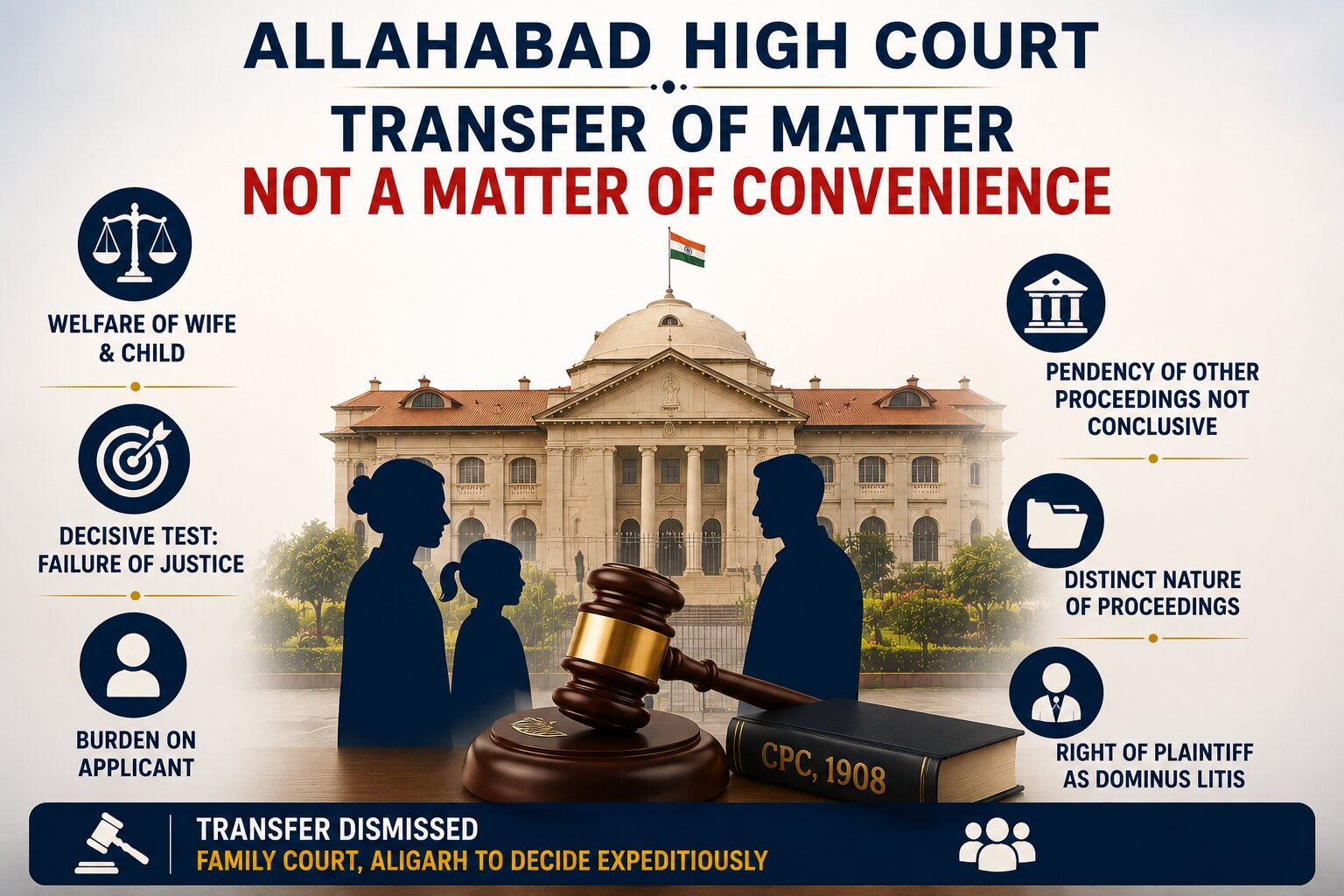
The convenience of the wife and welfare of a minor child are important considerations but do not create an inflexible rule requiring transfer.
Judgement Details
Court
Allahabad High Court
Date of Decision
3 August 2026
Judges
Dr. Justice Yogendra Kumar Srivastava
Citation
Acts / Provisions
Facts of the Case
-
The applicant-wife sought transfer of a matrimonial proceeding instituted by her husband.
-
The husband had filed a petition under Section 9 of the Hindu Marriage Act, 1955, seeking restitution of conjugal rights.
-
The proceeding was pending before the Family Court at Aligarh.
-
The wife sought transfer of the proceeding to the Family Court at Gautam Budh Nagar.
-
She submitted that she was residing at Gautam Budh Nagar.
-
She stated that she was the primary caregiver of her minor daughter.
-
The daughter was studying at Gautam Budh Nagar.
-
According to the wife, repeated travel to Aligarh would cause her inconvenience and financial burden.
-
She also contended that frequent travel could adversely affect the child's education and welfare.
-
The wife relied upon the fact that a separate maintenance proceeding under Section 144 BNSS was pending before the Family Court at Gautam Budh Nagar.
-
She argued that having related proceedings before a single forum would avoid multiplicity of litigation and make the proceedings more convenient.
-
The husband opposed the transfer application.
-
He submitted that both the applicant's parental home and maternal home were situated in Aligarh.
-
He alleged that the transfer application had been filed primarily to delay the restitution proceedings.
-
The husband also contended that Aligarh was an established educational centre and that the wife's decision to educate the child elsewhere could not by itself determine the appropriate judicial forum.
-
It was further submitted that the Section 9 proceedings had already been delayed because of the transfer application and interim protection operating in the matter.
-
The husband relied upon the principle that jurisdiction under Section 24 CPC is discretionary and should be exercised sparingly.
-
He also relied upon the concept of dominus litis, arguing that the plaintiff is ordinarily entitled to prosecute proceedings before a forum that has lawful jurisdiction.
-
The High Court examined whether the circumstances demonstrated sufficient hardship or a likelihood of failure of justice warranting transfer.
-
The Court found that the applicant had not produced sufficient material showing that attending the Family Court at Aligarh was genuinely impracticable.
-
The Court therefore concluded that mere inconvenience and additional travel were insufficient to justify transfer.
Issues
-
Whether the convenience of the wife and welfare of a minor child constitute overriding grounds requiring transfer of matrimonial proceedings under Section 24 CPC?
-
Whether mere inconvenience and additional travel faced by the wife are sufficient grounds for transferring matrimonial proceedings from one competent Family Court to another?
-
Whether the applicant seeking transfer under Section 24 CPC bears the burden of establishing genuine hardship or a likelihood of failure of justice through cogent and convincing material?
-
Whether the pendency of connected maintenance proceedings before another Family Court, by itself, warrants transfer of matrimonial proceedings to that forum?
-
Whether Section 24 CPC can be invoked merely to secure a comparatively convenient forum or to facilitate forum selection by a litigant?
-
Whether the right of the plaintiff, as dominus litis, to prosecute proceedings before a competent forum should be given due weight while considering a transfer application?
-
Whether refusal to transfer the Section 9 proceedings from Aligarh to Gautam Budh Nagar would result in a failure of justice in the circumstances of the case?
Judgement
-
The Allahabad High Court dismissed the transfer application.
-
The Court held that the convenience of the wife and welfare of a minor child are relevant considerations, but they are not automatic or overriding grounds for transfer.
-
The decisive consideration under Section 24 CPC is whether refusal to transfer the proceedings is likely to result in a failure of justice.
-
The Court placed the burden on the applicant to establish genuine hardship through cogent and convincing material.
-
The Court found that the applicant had not demonstrated that attending the Family Court at Aligarh was impracticable.
-
There was no sufficient material showing that the applicant would be deprived of a meaningful opportunity to contest the proceedings.
-
The Court therefore held that mere inconvenience or additional travel could not justify transfer in the absence of compelling circumstances.
-
The Court considered the pending maintenance proceedings at Gautam Budh Nagar.
-
It held that avoiding multiplicity of proceedings is a relevant consideration but is not conclusive or determinative.
-
The Court observed that proceedings under Section 9 of the Hindu Marriage Act and Section 144 BNSS are different in their nature, scope and object.
-
The mere fact that such proceedings are pending before different courts does not automatically require their transfer or consolidation.
-
The Court also emphasized the right of the plaintiff, as dominus litis, to prosecute proceedings before a competent forum.
-
The Court held that Section 24 CPC is intended to advance the ends of justice, not merely to provide a forum of personal convenience.
-
The transfer application was therefore dismissed.
-
The Principal Judge, Family Court, Aligarh was directed to proceed with the matter expeditiously and endeavour to conclude it in accordance with law.
Held
-
The applicant must establish genuine hardship or a likelihood of failure of justice with cogent and convincing material.
-
Mere additional travel or inconvenience is insufficient without compelling circumstances.
-
The primary test under Section 24 CPC is whether refusal of transfer would occasion a failure of justice.
-
The pendency of connected proceedings before another court is relevant but does not automatically require transfer.
-
Proceedings under Section 9 of the Hindu Marriage Act and Section 144 BNSS are distinct in nature and purpose.
-
Section 24 CPC cannot be used simply to obtain a more convenient forum or facilitate forum shopping.
-
Due weight must be given to the plaintiff's position as dominus litis where the chosen court is otherwise competent.
-
The transfer application was therefore dismissed.
-
The matrimonial proceeding was directed to be decided expeditiously by the Family Court at Aligarh.
Analysis
-
Failure of justice is the decisive test: The judgment makes clear that Section 24 CPC is not primarily concerned with which forum is more convenient. The central question is whether refusal to transfer would result in a failure of justice.
-
Convenience of wife is not absolute: Courts frequently consider the wife's convenience in matrimonial transfer applications, but this judgment clarifies that such consideration cannot operate as an automatic rule.
-
Welfare of the child: The welfare of a minor remains relevant, but it must be assessed along with the circumstances of both parties and the practical effect of the transfer.
-
Burden on applicant: The person seeking transfer must place sufficient material before the Court demonstrating genuine hardship. A general assertion of inconvenience is insufficient.
-
Forum shopping: The Court emphasized that Section 24 CPC should not become a mechanism for choosing whichever forum appears personally more advantageous or convenient.
-
Dominus litis: The judgment gives due recognition to the plaintiff's right to prosecute proceedings before a court that has lawful jurisdiction. This right is not absolute but is an important consideration in the transfer analysis.
-
Connected proceedings: The existence of another proceeding between the same parties does not automatically justify consolidation or transfer. The Court must examine whether separate proceedings actually create a risk of conflicting decisions or demonstrable prejudice.
-
Different statutory proceedings: The Court distinguished proceedings for restitution of conjugal rights from maintenance proceedings. Their different statutory purposes mean that their mere pendency before different courts does not necessarily create a compelling reason for transfer.
-
Holistic assessment: The Court stressed that transfer applications require consideration of several factors, including the convenience of both parties, nature and stage of proceedings, availability of evidence, potential prejudice and overall administration of justice.
-
Expeditious disposal: Since the transfer application had contributed to delay in the underlying proceedings, the Court directed the Family Court to proceed expeditiously.
-
Overall significance: The decision reinforces that Section 24 CPC does not guarantee transfer merely because one party, particularly a wife, finds another forum more convenient. Transfer must be justified by circumstances showing genuine hardship or a real possibility of failure of justice.