
Nitin v. State of U.P., 2026
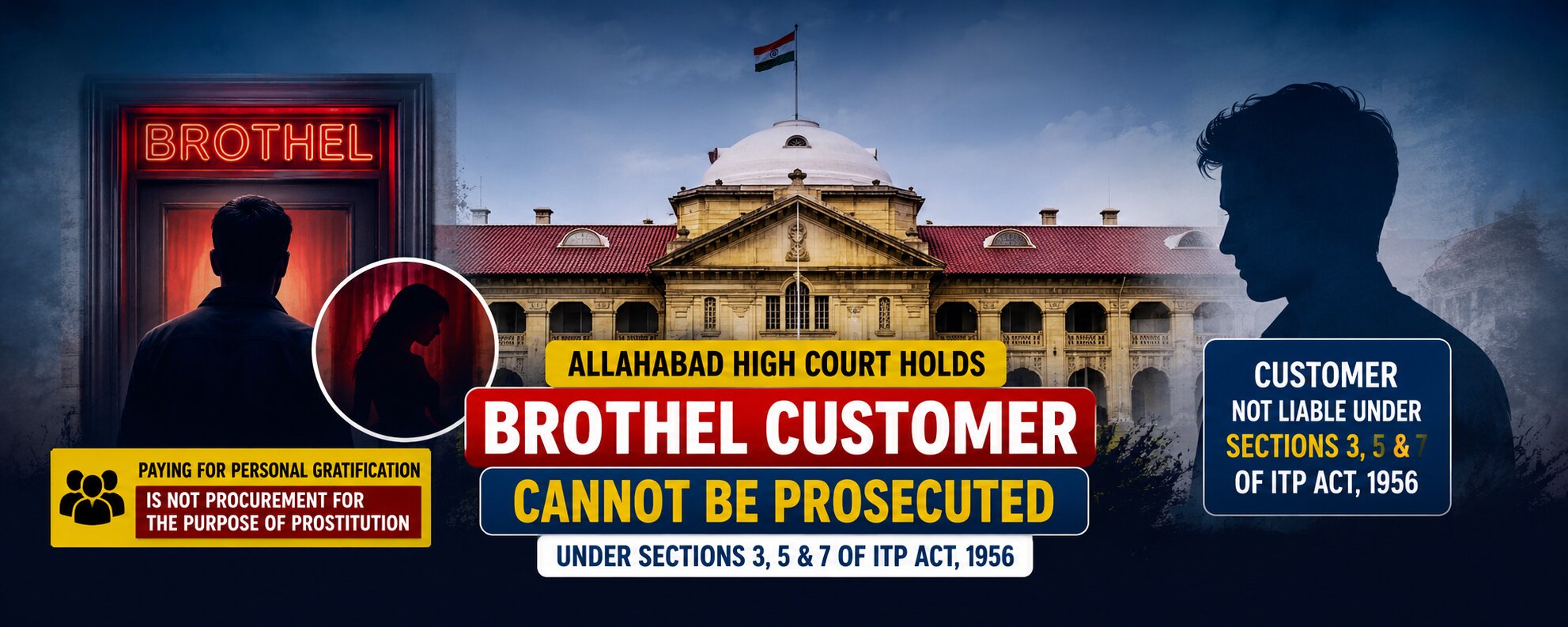
The Court held that the applicant's conduct, as recorded on the facts before it, did not constitute procurement for the purpose of prostitution contemplated by the Act.
Judgement Details
Court
Allahabad High Court
Date of Decision
20 August 2026
Judges
Justice Dr. Gautam Chowdhary
Citation
Acts / Provisions
Facts of the Case
- The police received information that women were allegedly engaged in the sex trade at a house situated near the DLF police chowki at Bhojpura crossing in Ghaziabad.
-
Acting upon the information, the police conducted a raid at the premises.
-
Sixteen persons were apprehended during the raid, comprising nine women and seven men.
-
The women allegedly stated that they were engaged in the sex trade and paid a portion of their earnings to the man in whose house they were found.
-
An FIR was registered on the same day under the relevant provisions of the Immoral Traffic (Prevention) Act, 1956.
-
A charge sheet was subsequently submitted, invoking Sections 3, 4, 5 and 7 of the Act.
-
The Magistrate took cognizance of the alleged offences and issued the summoning order.
-
The applicant, Nitin, was one of the persons charge-sheeted in the case.
-
The applicant approached the Allahabad High Court under Section 482 Cr.P.C., seeking quashing of the criminal proceedings, charge sheet and summoning order.
-
The applicant contended that the mandatory requirement under Section 15(2) of the Act concerning the presence of two independent local witnesses during the search had not been complied with.
-
It was further argued that, even if the allegations in the FIR were accepted as true, the applicant was merely a customer who had visited the premises for personal gratification and had not committed an offence under Sections 3, 5 or 7 of the Act.
-
Reliance was placed on the earlier Allahabad High Court decision in Dinesh Tiwari @ Dhirendra Kumar Tiwari v. State of U.P. and another, in which a customer was held not to be a person who keeps or manages a brothel, or assists in keeping or managing a brothel, merely because he visits the premises and pays money for gratification.
-
The State opposed the application, arguing that the applicant had been caught during a raid at premises allegedly being operated as a brothel and had procured prostitution by paying money.
-
Upon examination of the record, the High Court found that the applicant's role was that of a customer.
Issues
-
Whether a person who visits a brothel as a customer and pays money for personal gratification can be prosecuted under Section 3 of the Immoral Traffic (Prevention) Act, 1956?
-
Whether a customer who pays money for personal gratification can be said to have procured a person for the purpose of prostitution within the meaning of Section 5 of the Immoral Traffic (Prevention) Act, 1956?
-
Whether the allegations against the applicant disclosed an offence under Section 7 of the Immoral Traffic (Prevention) Act, 1956 merely because he was found at premises being used as a brothel?
-
Whether the alleged non-compliance with Section 15(2) of the Immoral Traffic (Prevention) Act, 1956 affected the validity of the search and the subsequent criminal proceedings?
-
Whether continuation of the criminal proceedings against the applicant, who was found to be merely a customer, amounted to an abuse of the process of the court?
Judgement
-
The Allahabad High Court examined the material on record and found the applicant to be merely a customer who had visited the premises to satisfy his personal lust after paying money.
-
The Court distinguished the act of paying for one's own personal gratification from procuring a person for the “purpose of prostitution” contemplated by the Act.
-
The Court observed that a customer may procure a prostitute for his personal gratification, but that does not, by itself, amount to procurement for the purpose of prostitution as contemplated by the statutory scheme.
-
The Court relied upon the principle expressed in Dinesh Tiwari @ Dhirendra Kumar Tiwari v. State of U.P. and another, concerning the liability of a customer under Section 3 of the Act.
-
On the facts recorded before it, the Court concluded that the ingredients necessary to attract Sections 3, 4, 5 and 7 of the Immoral Traffic (Prevention) Act, 1956 were not established against the applicant merely because he was present as a customer.
-
The Court held that continuation of the proceedings against the applicant would amount to a misuse of the process of the court.
-
The application under Section 482 Cr.P.C. was accordingly allowed.
-
The criminal proceedings pending before the Civil Judge (Junior Division)/F.T.C. Judicial Magistrate, Ghaziabad, together with the charge sheet and summoning order, were quashed insofar as they concerned the applicant.
Held
-
The Court held that a person visiting a brothel merely as a customer, for the purpose of obtaining personal gratification upon payment of money, cannot on that basis alone be prosecuted under Sections 3, 5 or 7 of the Immoral Traffic (Prevention) Act, 1956.
-
The Court further held that the applicant could not be treated as a person keeping, managing or assisting in the management of a brothel merely because he visited the premises as a customer.
-
The proceedings against the applicant were therefore found to constitute misuse of the process of the court and were quashed.
Analysis
-
Court's reasoning: The central reasoning was based on the distinction between a person participating in the commercial operation of prostitution and a customer who merely pays for personal gratification. The Court considered the applicant's role to be limited to that of a customer rather than that of a person managing or facilitating the commercial enterprise.
-
Interpretation of Section 3: Section 3 is directed principally towards persons involved in keeping, managing or knowingly permitting premises to be used as a brothel. The Court relied on the earlier decision in Dinesh Tiwari to conclude that the mere presence of a customer does not automatically satisfy these statutory ingredients.
-
Interpretation of Section 5: The Court drew a distinction between procuring a person for one's own gratification and procuring a person for the purpose of prostitution. On the facts before it, the applicant's payment was treated as being for his personal gratification rather than as participation in the commercial procurement contemplated by the provision.
-
Section 7: The Court found that the mere fact that the applicant was present at premises being used for prostitution was insufficient, on the facts recorded, to establish the ingredients of Section 7 against him.
-
Procedural objection: The applicant had also challenged the search on the ground of alleged non-compliance with Section 15(2), particularly the requirement concerning independent local witnesses. The Court's substantive finding regarding the absence of an offence against the applicant was sufficient to justify quashing the proceedings.
-
Use of Section 482 Cr.P.C.: The case demonstrates the High Court's power to intervene where continuation of criminal proceedings would amount to an abuse of the process of the court or where the allegations, even if accepted at face value, do not disclose the necessary ingredients of an offence.
-
Impact on existing law: The decision reinforces the distinction between a customer and persons who operate, manage or commercially facilitate prostitution. It follows the reasoning of the earlier Dinesh Tiwari decision rather than treating every person found in a brothel as automatically criminally liable under the Act.
-
Limit of the ruling: The decision should not be read as creating a blanket immunity for every person found at a brothel. Criminal liability would depend upon the specific statutory ingredients and the facts established against the individual, including conduct showing management, procurement, facilitation or another offence expressly covered by the Act.