
Nitin Mishra v. Union of India and 6 Others, 2026
Adult individuals have the freedom to choose their marital partner.
Judgement Details
Court
Allahabad High Court
Date of Decision
28 September 2026
Judges
Justice Rajesh Singh Chauhan and Justice Ram Manohar Narayan Mishra
Citation
Acts / Provisions
Facts of the Case
-
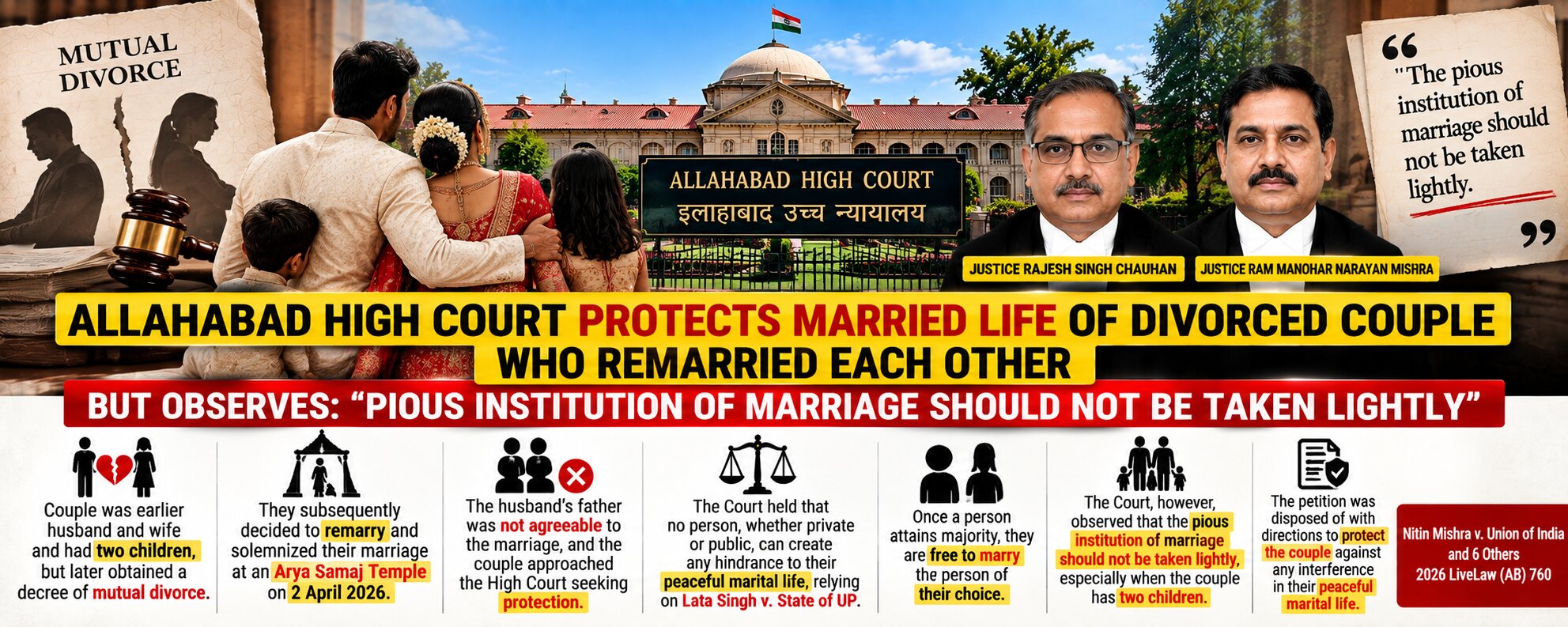
The petitioners were previously husband and wife and had two children from their earlier marriage.
-
Subsequently, the couple obtained a decree of mutual divorce.
-
After the divorce, the parties reconsidered their decision and decided to remarry in the interest of their family and children.
-
The petitioners subsequently solemnized their marriage at an Arya Samaj Temple on 2 April 2026.
-
The father of petitioner no. 2, the husband, was allegedly not agreeable to the subsequent marriage.
-
The couple apprehended interference with their peaceful marital life.
-
They therefore approached the Allahabad High Court seeking protection of their peaceful matrimonial life and assistance concerning registration of their marriage.
-
The Court noted that the parties had previously been married and had two children together before obtaining mutual divorce.
-
The Court relied upon the principle recognized by the Supreme Court in Lata Singh v. State of Uttar Pradesh, that an adult person is entitled to marry a person of his or her choice.
-
At the same time, the High Court expressed concern over the manner in which the parties had first obtained a mutual divorce and thereafter remarried.
-
The Court observed that the institution of marriage should not be taken lightly, particularly where the parties have children.
Issues
-
Whether adult individuals who have remarried each other after obtaining a decree of mutual divorce are entitled to protection against interference with their peaceful marital life?
-
Whether family members can lawfully interfere with the decision of two consenting adults to marry or remarry each other?
-
Whether the petitioners were entitled to protection of their matrimonial relationship in view of the principle laid down in Lata Singh v. State of Uttar Pradesh?
-
Whether the circumstances in which the parties obtained divorce and subsequently remarried justified judicial observations concerning the sanctity of the institution of marriage?
Judgement
-
The Allahabad High Court disposed of the writ petition after granting protection to the couple against interference with their peaceful marital life.
-
The Court recognized that the petitioners were adults and had voluntarily decided to remarry each other after their earlier mutual divorce.
-
The Court held that once an individual has attained majority, he or she is generally free to marry a person of his or her choice.
-
The Court relied upon the Supreme Court's decision in Lata Singh v. State of Uttar Pradesh in recognizing the right of consenting adults to choose their marital partner.
-
The Court observed that no private or public person could create an unlawful hindrance to the petitioners' peaceful matrimonial life.
-
The fact that the couple had previously been married and had two children was noted by the Court while considering the circumstances of the case.
-
The Court nevertheless expressed concern that the institution of marriage should not be taken lightly.
-
The Bench observed that obtaining a mutual divorce over a trivial dispute and subsequently remarrying despite having two children represented a matter of concern.
-
However, these observations did not take away the petitioners' legal right to seek protection for their voluntary marital relationship.
-
The protection recognized in Lata Singh continued to remain available to the petitioners.
-
The High Court accordingly directed that the petitioners' peaceful marital life should not be interfered with unlawfully.
Held
-
A person who has attained majority is entitled to make an independent decision concerning marriage without unlawful interference from family members.
-
A couple who voluntarily decides to marry or remarry is entitled to protection against unlawful interference with their peaceful matrimonial life.
-
The petitioners' previous divorce did not, by itself, prevent them from subsequently deciding to marry each other again.
-
The Court relied upon the constitutional and legal principle recognized in Lata Singh v. State of Uttar Pradesh.
-
Family opposition to the marriage cannot, by itself, justify interference with the peaceful life of consenting adults.
-
The Court observed that the institution of marriage should not be treated casually, particularly where the parties have children.
-
The Court's observations regarding the parties' earlier divorce and subsequent remarriage were advisory and cautionary, while the legal protection of their marital choice remained intact.
-
The petition was therefore disposed of with protection against interference with the petitioners' peaceful marital life.
Analysis
-
The central principle of the judgment is the recognition of individual autonomy in matters of marriage.
-
Marriage is a deeply personal decision, and once two consenting adults choose to marry, mere opposition from family members does not provide a lawful basis for interfering with their peaceful life.
-
The Court's reliance on Lata Singh v. State of Uttar Pradesh reinforces the established principle that an adult has the freedom to choose his or her spouse.
-
The protection granted by the High Court is therefore directed primarily against unlawful interference, rather than against legitimate legal proceedings that may arise independently.
-
An important aspect of the case is that the petitioners were not strangers entering into their first marriage. They had previously been married, had two children and had subsequently obtained a mutual divorce.
-
Their decision to remarry demonstrated that matrimonial decisions may change over time and that consenting adults retain autonomy to make personal decisions concerning their family life.
-
The Court nevertheless expressed concern about the parties' earlier decision to obtain a mutual divorce and later remarry, particularly because they had two children.
-
The observation that the “pious institution of marriage should not be taken lightly” reflects the Court's emphasis on the seriousness and responsibilities associated with marriage.
-
The Court's criticism, however, did not override the petitioners' legal autonomy. The Bench simultaneously made it clear that the protection available to adult couples under the principle laid down in Lata Singh remained applicable.
-
The judgment therefore draws a distinction between judicial observations concerning responsible marital conduct and the enforceable right of consenting adults to choose their marital relationship.
-
The case also demonstrates the protective role of the High Court under Article 226, particularly where individuals approach the Court apprehending unlawful interference with their personal liberty and family life.
-
The judgment reinforces that family disagreement cannot automatically become a legal restriction upon the marital choices of adults.
-
At the same time, the Court's observations emphasize that marriage carries responsibilities and should not be entered into or dissolved casually, especially where the decisions affect children and the broader family structure.
-
The judgment reinforces the principle that adult individuals have autonomy in choosing their spouse.
-
It confirms that courts can provide protection against unlawful interference with the peaceful marital life of consenting adults.
-
A family's objection to an adult couple's marriage does not, by itself, justify interference with their relationship.
-
The decision also highlights the distinction between the right to choose a spouse and the Court's observations regarding the responsibilities and seriousness associated with marriage.
-
The judgment thus balances individual marital autonomy with a judicial caution that the institution of marriage carries significant responsibilities and should not be treated casually.