
Nirmala Bai Devidas Chavhan v. State of Maharashtra & Others Etc., 2026
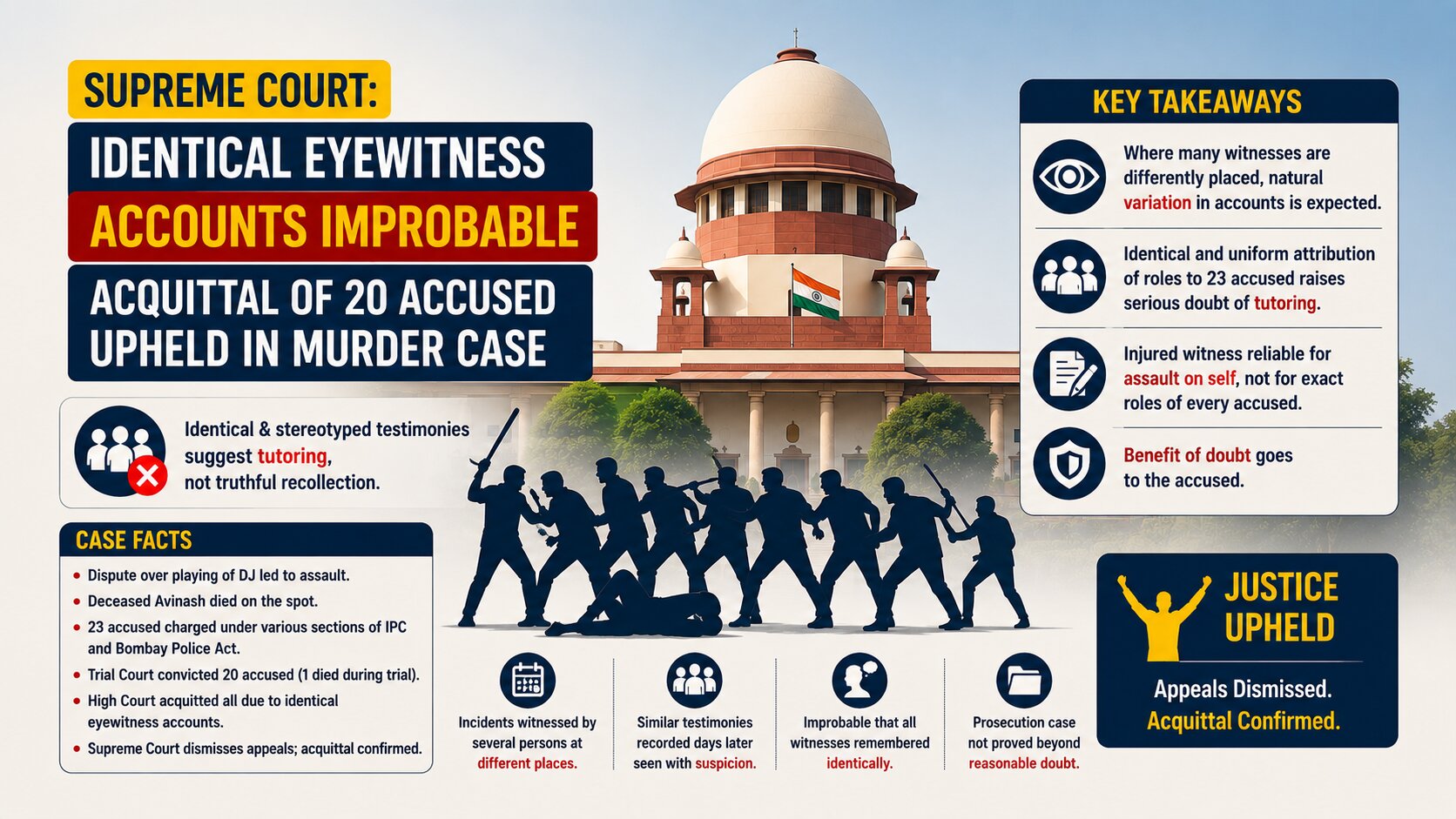
Identical and stereotyped eyewitness testimony may raise serious doubts about its reliability, particularly where the circumstances would naturally produce individual differences in perception.
Judgement Details
Court
Supreme Court of India
Date of Decision
10 August 2026
Judges
Justice Sanjay Karol & Justice Augustine George Masih
Citation
Acts / Provisions
Facts of the Case
-
The prosecution case arose from an altercation concerning the playing of a DJ.
-
It was alleged that a large group of accused persons dragged and assaulted the deceased and other persons.
-
The deceased, Avinash, was allegedly assaulted along with other victims.
-
The prosecution alleged that the accused used iron pipes, an iron bar and wooden planks during the assault.
-
Some accused persons were alleged to have physically held the victims, while others allegedly exhorted the assailants.
-
Avinash died at the spot following the assault.
-
An FIR was registered following the death.
-
Charges were framed under Sections 147, 148, 149, 302 read with 149, 307 read with 149 and 120-B IPC, along with Section 135 of the Bombay Police Act, 1951.
-
There were 23 accused persons initially facing the proceedings.
-
One accused died during the course of the trial.
-
The Trial Court convicted 20 accused persons for murder and acquitted two accused persons of all charges.
-
The High Court subsequently reversed the Trial Court's decision and acquitted the accused persons.
-
The High Court found the prosecution case suspicious, particularly because the eyewitnesses gave almost identical accounts concerning the individual roles of the accused.
-
The informant and the State challenged the High Court's acquittal before the Supreme Court.
-
The Supreme Court examined whether the highly similar eyewitness accounts could safely be relied upon to sustain the convictions.
-
The Court noted that the alleged incident involved a large number of persons, while the eyewitnesses were differently positioned and some were themselves allegedly under assault.
-
In such circumstances, the Court considered it natural that witnesses would ordinarily describe the incident from their own individual perspectives.
-
The Court found that the witnesses had attributed the roles of all the accused in an almost identical and minute manner.
-
The Court considered such uniformity improbable and capable of indicating tutoring rather than genuine recollection.
-
The Court also considered the fact that the eyewitness statements were recorded some days after the incident.
-
The prosecution relied upon injured witnesses to support the case.
-
The Supreme Court held that although an injured witness may be reliable concerning the assault suffered by that witness, such status does not automatically make the witness's account a reliable and precise description of the individual role of every accused person.
-
The Supreme Court ultimately found that the High Court had legitimate grounds to entertain serious doubt regarding the prosecution case.
Issues
-
Whether strikingly identical and stereotyped eyewitness accounts concerning the individual roles of numerous accused persons can safely be relied upon to sustain a criminal conviction?
-
Whether substantial uniformity in eyewitness testimony, despite witnesses being differently positioned during a large group assault, can constitute a circumstance indicating tutoring?
-
Whether the testimony of an injured witness automatically becomes reliable evidence concerning the precise role played by every accused person merely because the witness suffered injuries during the incident?
-
Whether the High Court was justified in treating the minute and uniform attribution of roles to all accused persons as creating serious doubt regarding the truthfulness of the eyewitness accounts?
-
Whether the prosecution established the guilt of the accused persons beyond reasonable doubt on the basis of the eyewitness evidence and other material on record?
-
Whether the High Court was justified in reversing the Trial Court's conviction and acquitting the accused persons?
Judgement
-
The Supreme Court dismissed the appeals challenging the acquittal.
-
The Court upheld the Bombay High Court's Nagpur Bench judgment acquitting the accused persons.
-
The Court found the eyewitness accounts to be strikingly similar and stereotyped.
-
The Court held that such identical testimony was improbable in the circumstances of the incident.
-
The Court observed that where a large number of people participate in an occurrence and witnesses are positioned differently, their accounts would naturally contain differences reflecting their individual perceptions.
-
According to the Court, differences in detail can actually provide assurance that witnesses are recounting their own observations rather than reproducing a common version.
-
The Court found that the near-identical descriptions of the roles of numerous accused persons raised a serious doubt about whether the witnesses were recounting what they had actually seen or had been tutored.
-
The Court endorsed the High Court's finding that the minute and uniform attribution of roles to all the accused was unsafe as a basis for conviction.
-
The Court rejected the argument that the presence of injured witnesses automatically established the reliability of the entire prosecution account.
-
The Court held that an injured witness may be reliable regarding the assault suffered personally but that does not necessarily make the witness a reliable source for an exact inventory of the individual roles of 23 accused persons.
-
The Court therefore found that the prosecution evidence did not safely establish the guilt of the accused beyond reasonable doubt.
-
The Supreme Court consequently confirmed the acquittal of the accused persons.
Held
-
Where several witnesses occupy different positions during a large incident, some variation in their accounts is ordinarily expected.
-
An unusually precise and uniform attribution of roles to numerous accused persons may indicate tutoring rather than genuine recollection.
-
The fact that a witness is injured does not automatically make every part of that witness's testimony reliable.
-
An injured witness may be reliable concerning the assault personally suffered but may not necessarily provide a reliable account of the precise role played by every other accused.
-
The High Court was justified in treating the uniform eyewitness accounts as a circumstance creating serious doubt regarding the prosecution case.
-
The prosecution evidence was insufficient to safely sustain the convictions.
-
The benefit of the doubt therefore operated in favour of the accused.
-
The Supreme Court dismissed the appeals and upheld the acquittal.
Analysis
-
Natural variation in eyewitness testimony: The Court recognized that witnesses observing the same incident from different positions will ordinarily notice different details. Such variations are not necessarily weaknesses; they may demonstrate that witnesses are independently recalling what they observed.
-
Identical testimony as a warning sign: The judgment emphasizes that excessively similar accounts can sometimes undermine rather than strengthen a prosecution case. Where witnesses reproduce virtually the same description of numerous individual roles, the possibility of tutoring becomes relevant.
-
Large number of accused: The Court attached particular significance to the fact that the witnesses attributed detailed roles to a very large number of accused persons. The greater the number of participants and different vantage points, the less natural an identical account becomes.
-
Delayed recording of statements: The Court also considered that the eyewitness statements were recorded several days after the occurrence. The unusually complete correspondence in the accounts after such a delay contributed to the Court's concern about possible tutoring.
-
Injured witness principle: The Court carefully qualified the evidentiary value of an injured witness. Being injured can support credibility concerning the witness's own assault, but it does not automatically establish the reliability of every assertion concerning the actions of numerous other persons.
-
Distinction between occurrence and individual roles: The judgment makes an important distinction between proving that an incident occurred and proving exactly what each accused person did. A witness may reliably establish that an assault took place without necessarily being reliable about the precise role of every participant.
-
Benefit of doubt: Because the prosecution evidence contained serious reasons for doubt, the Court upheld the acquittal rather than allowing a conviction based upon evidence it considered unsafe.
-
Appellate approach to acquittal: The Supreme Court accepted the High Court's reasoning that the prosecution evidence did not safely support conviction. The Court found the High Court's distinction between the general reliability of the witnesses and the specific attribution of roles to all accused persons to be legitimate.
-
No automatic rule against uniform testimony: The judgment does not mean that similar testimony is always false. Rather, the Court's concern arose from the degree of uniformity, the large number of accused, different positions of witnesses, delayed recording and detailed attribution of individual roles.
-
Importance of individual perception: The Court's reasoning recognizes the psychological reality that witnesses perceive an event from their own location and circumstances. Genuine accounts may therefore differ in detail.
-
Impact on group-crime prosecutions: The judgment is particularly relevant in cases involving large unlawful assemblies or group assaults, where the prosecution seeks to establish the individual role of numerous accused persons through eyewitness accounts.
-
Overall significance: The decision reinforces the principle that criminal conviction must rest on reliable and credible evidence, not merely on the number of witnesses or the apparent consistency of their statements. In some circumstances, excessive uniformity can itself become a reason for reasonable doubt.