
Nilima Dilip Kannurwar v. Child Welfare Committee, 2026
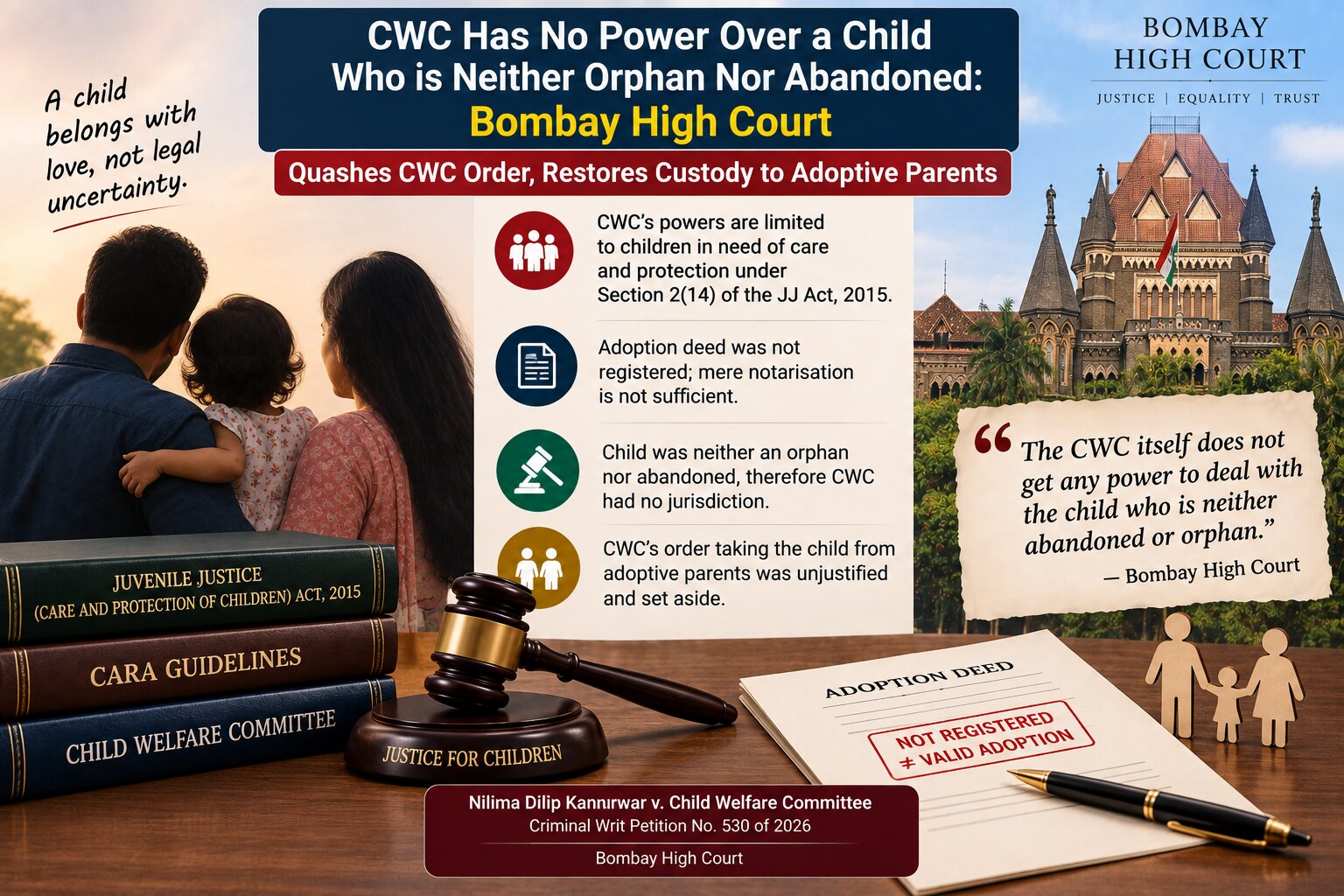
The CWC's jurisdiction is confined to children falling within the statutory category of “children in need of care and protection.”
Judgement Details
Court
Bombay High Court
Date of Decision
18 September 2026
Judges
Justice Urmila Joshi-Phalke and Justice Nivedita P. Mehta
Citation
Acts / Provisions
Facts of the Case
-
The petitioners had obtained custody of a minor child from the child's biological parents.
-
The biological parents allegedly voluntarily gave their third child in adoption to the petitioners.
-
An adoption ceremony was performed at a temple in April 2026.
-
Following the ceremony, the parties executed an adoption deed, which was signed by the biological parents and the petitioners and notarised.
-
Subsequently, the Child Welfare Committee (CWC), Chandrapur, passed an order dated 25 May 2026, taking custody of the child from the petitioners.
-
The CWC directed that the child be handed back to the biological parents.
-
The petitioners challenged the CWC's order before the Bombay High Court.
-
The petitioners argued that the child was neither orphan nor abandoned and therefore did not fall within the category of children over whom the CWC could exercise its statutory jurisdiction.
-
The State opposed the petition, contending that the adoption had not been carried out in accordance with the procedure prescribed by law.
-
The petitioners conceded that the prescribed adoption procedure had not been fully followed but argued that the biological parents had voluntarily consented to the adoption.
-
The High Court verified the adoption deed with both the biological parents and the petitioners.
-
The biological parents confirmed before the Court that they had voluntarily given the child in adoption.
-
The Court nevertheless found that the adoption deed was not registered and held that mere notarisation could not amount to a legally valid adoption.
-
The Court also noted that the adoption procedure under CARA, which has statutory recognition under the Juvenile Justice Act, 2015, had not been followed.
-
Despite finding procedural defects in the adoption, the Court separately examined whether the CWC had jurisdiction to take custody of the child and return the child to the biological parents.
Issues
-
Whether the adoption of the minor child was legally valid when the parties had executed and notarised an adoption deed without following the prescribed statutory adoption procedure?
-
Whether mere notarisation of an adoption deed is sufficient to constitute a valid adoption when the deed has not been registered as required by law?
-
Whether the Child Welfare Committee has jurisdiction under the Juvenile Justice (Care and Protection of Children) Act, 2015, over a child who is neither orphan nor abandoned?
-
Whether the CWC was justified in taking custody of the child from the petitioners and handing the child back to the biological parents despite the child not falling within the statutory category of a “child in need of care and protection”?
Judgement
-
The Bombay High Court allowed the criminal writ petition filed by the petitioners.
-
The Court found that the adoption procedure prescribed under the applicable legal framework had not been followed.
-
It specifically held that the adoption deed was not registered and that merely notarising the document was insufficient to establish a valid adoption.
-
The Court also noted that the CARA procedure had not been followed, despite its statutory recognition under the Juvenile Justice Act.
-
However, the Court distinguished the validity of the adoption from the jurisdiction of the CWC.
-
The Court held that the CWC's powers under Chapter V of the JJ Act extend to children who fall within the statutory definition of “children in need of care and protection” under Section 2(14).
-
The Court found that the child in the present case did not fall within that category.
-
Consequently, the CWC did not acquire jurisdiction merely because the adoption procedure had not been properly followed.
-
The Court therefore held that the CWC's decision to take custody of the child and return the child to the biological parents was not justified.
-
The CWC order dated 25 May 2026 was accordingly quashed and set aside.
-
The biological parents were directed to hand over custody of the child to the petitioners.
Held
-
A child who is neither orphan nor abandoned, and who does not otherwise fall within Section 2(14) of the JJ Act, cannot automatically be brought within the CWC's jurisdiction.
-
Mere notarisation of an adoption deed is insufficient where the law requires compliance with the prescribed adoption procedure and registration.
-
The Court acknowledged that the petitioners had not followed the proper adoption procedure.
-
However, that procedural defect did not, by itself, confer jurisdiction upon the CWC to take custody of the child.
-
The CWC therefore acted without sufficient statutory basis in taking custody and directing that the child be returned to the biological parents.
-
The CWC's order dated 25 May 2026 was consequently quashed.
Analysis
-
Jurisdiction and adoption validity are distinct questions: The judgment is significant because the Court did not treat the defective adoption procedure as automatically conferring jurisdiction on the CWC. It separately examined whether the statutory conditions for CWC intervention existed.
-
CWC's statutory limits: The Court emphasised that the CWC is a statutory body whose powers must be exercised within the limits prescribed by the JJ Act. Its jurisdiction is connected to children who satisfy the statutory definition of children in need of care and protection.
-
Adoption procedure remains mandatory: The Court did not approve the manner in which the petitioners obtained custody. By holding that an unregistered, merely notarised deed was insufficient and that the CARA procedure had not been followed, the Court reinforced the importance of complying with the prescribed adoption framework.
-
Consent does not cure every procedural defect: Although the biological parents confirmed their voluntary consent, that consent did not by itself transform the informal arrangement into a legally compliant adoption.
-
CWC cannot assume jurisdiction merely because an adoption is defective: The Court's reasoning indicates that an irregular adoption and a child falling within the CWC's statutory jurisdiction are not synonymous.
-
Custody cannot be disturbed without statutory authority: Even where concerns exist regarding the legality of an adoption arrangement, the authority seeking to alter custody must possess the necessary statutory jurisdiction to do so.
-
Practical significance: The ruling draws an important boundary between compliance with adoption law and the statutory jurisdiction of child-protection authorities.
-
Effect of the ruling: The immediate consequence was restoration of custody to the petitioners, while the judgment simultaneously made clear that the original adoption arrangement itself had suffered from significant legal and procedural defects.