
Nilima Baishya & Anr. v. State of Assam & Ors., 2026
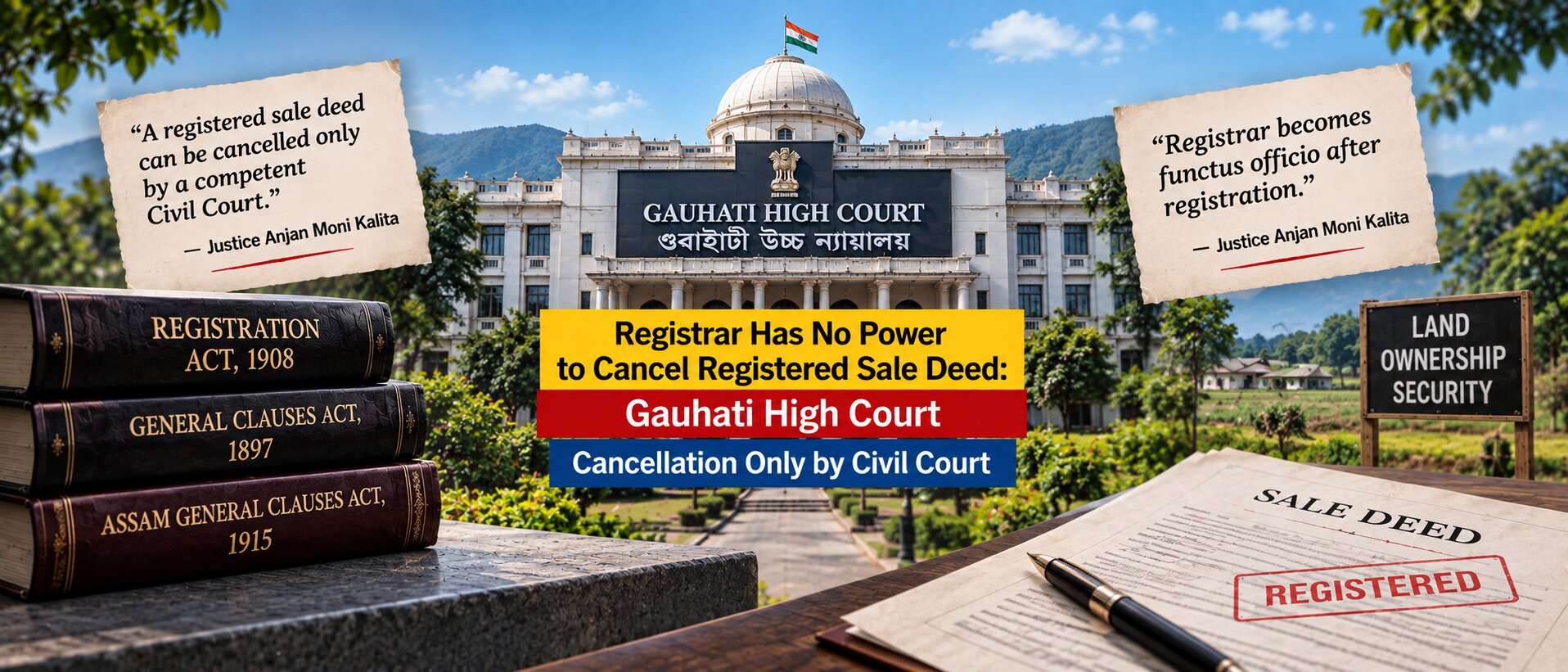
Once a sale deed is registered, the Registrar or Sub-Registrar cannot subsequently cancel it.
Judgement Details
Court
Gauhati High Court
Date of Decision
26 August 2026
Judges
Justice Anjan Moni Kalita
Citation
Acts / Provisions
Facts of the Case
-
The first petitioner was the owner and possessor of three Kathas of land at Barsajai, Beltola, Assam.
-
She decided to sell a portion of the land to her son, who was the second petitioner.
-
A sale deed was executed and registered in September 2022 before the competent registration authority.
-
After registration, mutation was granted in favour of the second petitioner.
-
Approximately two years later, an objection was raised through the land record portal concerning the property.
-
The District Commissioner, Kamrup, subsequently declared the registered sale deed legally unsustainable.
-
The District Commissioner also cancelled the mutation that had been granted in favour of the second petitioner.
-
The petitioners challenged the action, contending that the District Commissioner had no statutory power to cancel a registered sale deed.
-
A review petition filed against the order was also dismissed.
-
One of the grounds relied upon for rejecting the review was that the required NOC had not been obtained at the time of registration.
-
The petitioners argued that once the sale deed had been registered by the competent authority, the registration could not subsequently be cancelled administratively.
-
The State defended the impugned action and relied upon Section 21 of the General Clauses Act, 1897, read with Section 23 of the Assam General Clauses Act, 1915.
-
The High Court examined whether the registration authorities or the District Commissioner possessed statutory authority to cancel or reopen a registered sale deed after its registration.
-
The Court also considered whether Section 21 of the General Clauses Act could be relied upon to undo rights that had already accrued from a registered instrument.
Issues
-
Whether the Registrar or Sub-Registrar has the power to cancel a sale deed after it has already been registered under the Registration Act, 1908?
-
Whether a registered sale deed can be cancelled by an administrative authority without approaching a competent Civil Court?
-
Whether the District Commissioner could declare the registered sale deed invalid and cancel the mutation after registration of the sale deed?
-
Whether Section 21 of the General Clauses Act, 1897 can be used to cancel or reopen a registered sale deed when the Registration Act does not provide such power?
-
Whether the impugned cancellation orders passed by the District Commissioner were legally sustainable?
Judgement
-
The Gauhati High Court allowed the writ petition and set aside the impugned orders.
-
The Court held that once a sale deed is registered by the competent authority, the Sub-Registrar or Registrar becomes functus officio in respect of that registration.
-
The Registration Act, 1908 permits the registration authority to scrutinise a document before registration.
-
However, the Act does not confer power upon the Registrar or Sub-Registrar to cancel a document after it has already been registered.
-
The Court specifically held that the Registration Act does not empower the Registrar to reopen a registered deed for an enquiry regarding its validity after registration.
-
Any challenge to the validity or cancellation of a registered sale deed must be pursued before a competent Civil Court.
-
The Court rejected the State's reliance on Section 21 of the General Clauses Act.
-
It observed that upon registration, legal rights had already accrued under the registered instrument.
-
Such rights could not be taken away merely by invoking Section 21 when there was no specific statutory authority permitting cancellation.
-
The Court therefore found that the District Commissioner's orders cancelling the sale deed and mutation could not be sustained in law.
-
The impugned orders were accordingly set aside.
Held
-
The Registration Act, 1908 does not provide the Registrar with post-registration cancellation power.
-
A registered sale deed can be cancelled only through a competent Civil Court.
-
Registration authorities cannot reopen a registered deed merely because a complaint or information regarding its validity is subsequently received.
-
Section 21 of the General Clauses Act cannot be used to take away rights created by a registered instrument without a specific statutory basis.
-
The District Commissioner's cancellation orders were unsustainable and were set aside.
Analysis
-
Functus officio: The decision reinforces the principle that after completing the registration of a document, the registering authority has exhausted its statutory function and cannot subsequently exercise a power of cancellation that the statute does not confer.
-
Limited power of Registrar: The Registration Act provides a framework for scrutiny and registration, but the High Court found no statutory provision authorising the Registrar to cancel a document after registration.
-
Civil Court's jurisdiction: Where the validity of a registered sale deed is disputed, the appropriate remedy is to approach the competent Civil Court for cancellation or other appropriate relief.
-
Protection of vested rights: Registration creates legal consequences and rights in favour of the parties. Such rights cannot be removed by an administrative order without clear statutory authority.
-
No cancellation through administrative review: The judgment prevents administrative authorities from effectively exercising a power of cancellation merely by reopening an already completed registration process.
-
General Clauses Act cannot fill statutory gaps: The Court rejected the attempt to use Section 21 of the General Clauses Act as an independent source of power to cancel the registered instrument.
-
Statutory authority is essential: An administrative authority can exercise only those powers that are conferred upon it by law. Where the relevant statute does not provide cancellation power, such power cannot simply be assumed.
-
Registration versus validity: The judgment also highlights the distinction between the act of registration and a dispute concerning the underlying validity or title of the transaction. Such disputes may require adjudication by a Civil Court.
-
Impact on property transactions: The ruling provides greater certainty to parties who rely upon registered conveyances by making clear that an administrative authority cannot simply cancel a completed registration without statutory authority.
-
Judicial remedy: Persons challenging a registered sale deed must ordinarily pursue the appropriate civil remedy, rather than seeking administrative cancellation from the registering authority.