
Naveen Kumar Verma & Anr. v. State, 2026
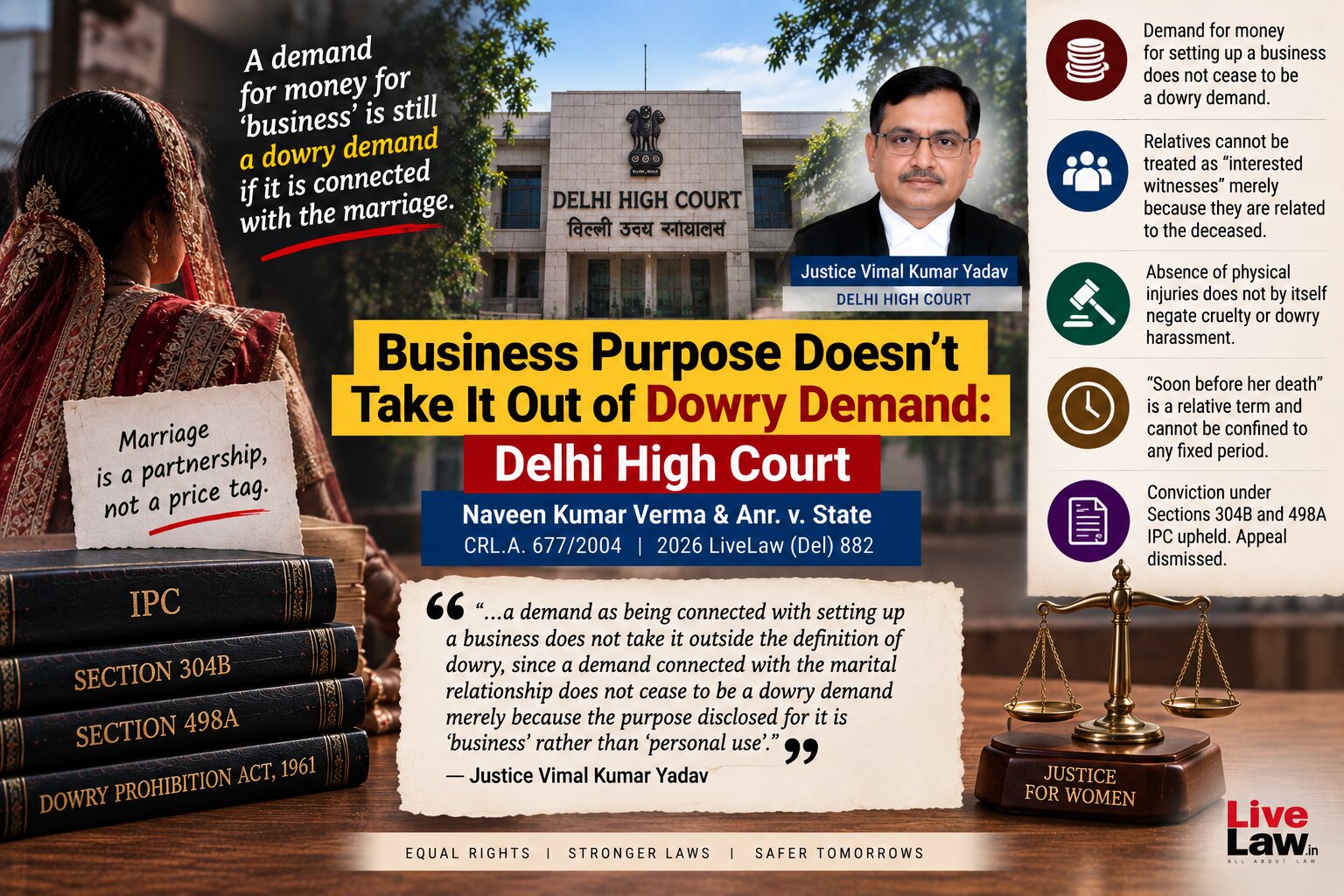
A demand for money connected with the marital relationship may constitute a dowry demand even where the stated purpose is to establish a business.
Judgement Details
Court
Delhi High Court
Date of Decision
18 September 2026
Judges
Justice Vimal Kumar Yadav
Citation
Acts / Provisions
Facts of the Case
-
The deceased woman was married to the accused approximately four-and-a-half months before her death.
-
She died by hanging on 10.04.2003.
-
An FIR was registered under Sections 498A, 304B and 34 IPC.
-
The prosecution alleged that the deceased had been subjected to cruelty and harassment in connection with a dowry demand of ₹50,000.
-
The Trial Court convicted two family members under Sections 304B and 498A IPC and acquitted another accused.
-
The convicted accused challenged their conviction before the Delhi High Court.
-
The defence questioned the credibility of the prosecution witnesses on the ground that they were relatives of the deceased.
-
The prosecution witnesses had consistently stated that there was a specific demand for ₹50,000 in cash.
-
The defence argued that the money was allegedly sought for establishing a business, and therefore the demand could not constitute a dowry demand.
-
The High Court considered whether the purpose for which money was demanded could take the demand outside the concept of dowry.
-
The defence also argued that there were no physical injuries on the deceased.
-
The Court examined whether the absence of physical injuries excluded the possibility of cruelty or dowry harassment.
-
The Court also considered the requirement under Section 304B concerning harassment or cruelty “soon before her death.”
-
The appellants challenged the prosecution evidence and sought interference with their conviction.
Issues
-
Whether a demand for money connected with the marital relationship constitutes a dowry demand when the money is sought for establishing a business?
-
Whether prosecution witnesses can be treated as interested witnesses merely because they are relatives of the deceased?
-
Whether the absence of physical injuries on the deceased is sufficient to rule out cruelty or dowry-related harassment?
-
Whether the expression “soon before her death” under Section 304B IPC requires a fixed or specific period between the alleged dowry harassment and the death?
-
Whether the prosecution established a proximate and live link between the alleged dowry-related harassment and the death of the deceased?
-
Whether the prosecution evidence was sufficient to sustain the conviction under Sections 304B and 498A IPC?
Judgement
-
The Delhi High Court dismissed the appeal filed by the appellants.
-
The Court upheld the convictions recorded under Sections 304B and 498A IPC.
-
The Court held that a demand for money does not cease to be a dowry demand merely because the money is intended for business purposes rather than personal use.
-
The Court observed that a demand connected with the marital relationship may fall within the scope of dowry even where the stated purpose is establishing a business.
-
The Court rejected the argument that the prosecution witnesses were unreliable merely because they were relatives of the deceased.
-
The Court observed that matrimonial cruelty and dowry harassment generally occur within the matrimonial home, making relatives potentially natural witnesses to the circumstances.
-
The Court found that the prosecution witnesses had consistently spoken about the specific demand of ₹50,000.
-
The Court held that the absence of physical injuries does not, by itself, negate allegations of cruelty or dowry harassment.
-
The Court reiterated that “soon before her death” is a relative expression and cannot be confined to a fixed period.
-
What is required is a proximate and live link between the dowry-related cruelty or harassment and the death.
-
The Court found the prosecution evidence sufficient to sustain the convictions.
-
The appellants were directed to surrender to undergo the remaining sentence.
Held
-
Relatives of a deceased person are not automatically interested witnesses merely because of their relationship with the deceased.
-
The absence of physical injuries does not, by itself, establish that there was no cruelty or dowry harassment.
-
“Soon before her death” under Section 304B IPC is a relative expression and does not prescribe a fixed period.
-
There must be a proximate and live link between the dowry-related harassment and the death.
-
The prosecution evidence in the present case was sufficient to sustain the convictions under Sections 304B and 498A IPC.
-
The appeal was therefore dismissed.
Analysis
-
Meaning of dowry demand: The Court adopted a substance-oriented approach to the alleged monetary demand. The stated purpose of the money—such as starting a business—does not automatically remove the demand from the scope of dowry when it is connected with the marital relationship.
-
Evidence of relatives: The Court rejected the assumption that a relative's testimony is inherently unreliable. The credibility of such evidence must be assessed on its consistency and surrounding circumstances.
-
Matrimonial setting: The Court recognized that allegations of matrimonial cruelty and dowry harassment frequently arise within the private matrimonial setting, where family members may naturally be among the persons having knowledge of the circumstances.
-
Absence of physical injuries: Cruelty under Section 498A is not confined to physical violence. The absence of visible injuries therefore cannot, by itself, disprove allegations of mental or other forms of cruelty.
-
“Soon before death”: The Court reiterated that this expression does not establish a rigid numerical period. The evidence must demonstrate a sufficiently close and continuing connection between the dowry-related conduct and the death.
-
Specific monetary demand: The consistency of the prosecution witnesses regarding the alleged ₹50,000 demand was relevant to the Court's assessment of the prosecution case.
-
Section 304B: The judgment reinforces the importance of establishing the statutory ingredients of dowry death, including the connection between dowry-related cruelty or harassment and the death occurring in the relevant circumstances.
-
Section 498A: The Court separately considered the allegation of cruelty and did not treat the absence of physical injuries as automatically defeating the charge.
-
Overall assessment: The Court considered the prosecution evidence collectively and found sufficient material to sustain the convictions rather than treating individual circumstances in isolation.