
Naval Kishore & Anr. v. State of Punjab, 2026
A Sessions Court can impose life imprisonment where the governing penal provision authorises such punishment.
Judgement Details
Court
Supreme Court of India
Date of Decision
24 September 2026
Judges
Justice Aravind Kumar and Justice Vipul M. Pancholi
Citation
Acts / Provisions
Facts of the Case
-
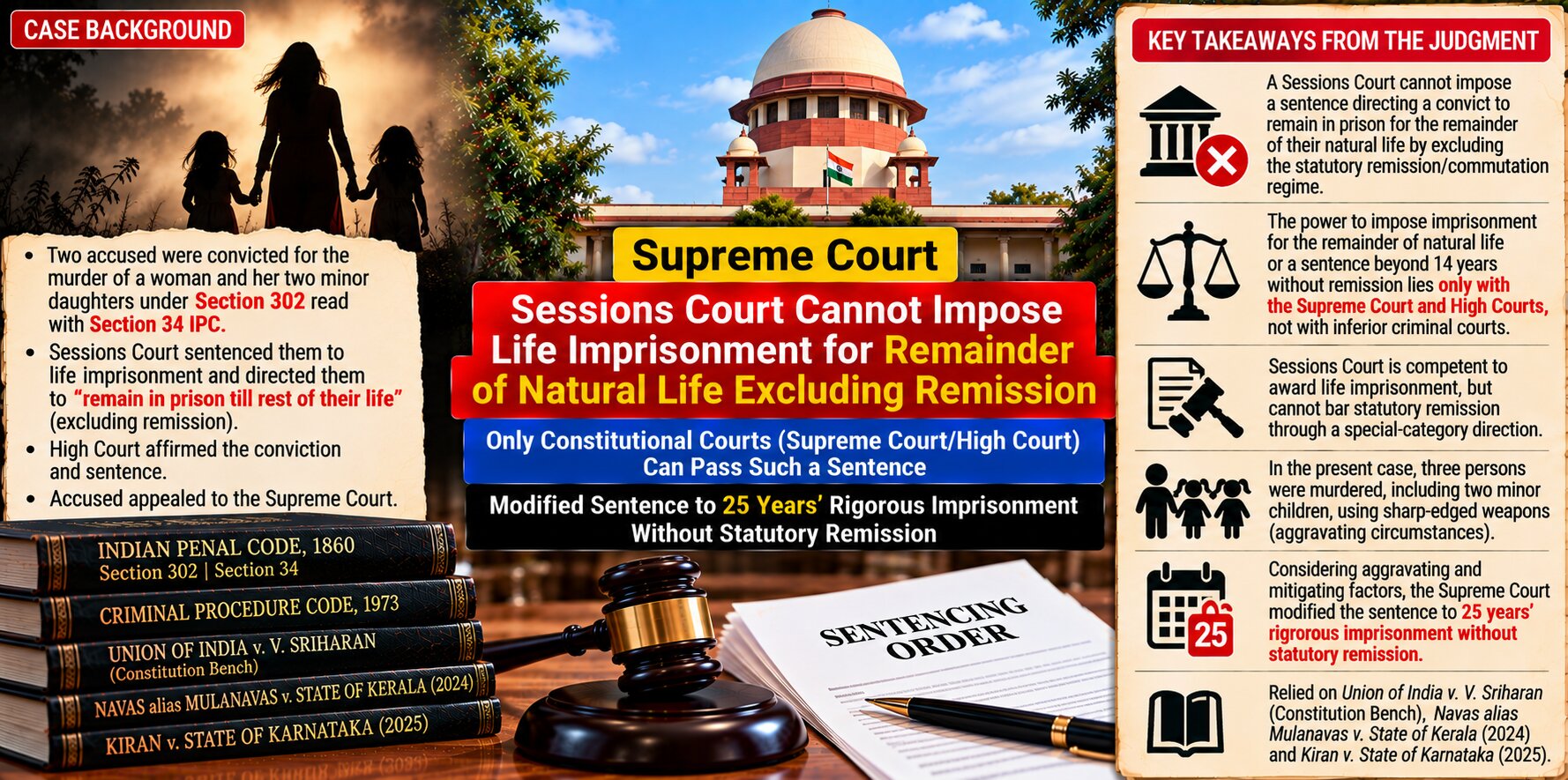
The appellants were convicted in connection with the murder of three persons, including a woman and her two minor daughters.
-
The prosecution case resulted in their conviction for murder under Section 302 read with Section 34 IPC, reflecting the finding of common intention.
-
The Sessions Court imposed rigorous imprisonment for life upon the accused.
-
In addition to life imprisonment, the Sessions Court directed that the appellants should “remain in prison till rest of their life.”
-
The effect of this additional direction was to place the sentence outside the ordinary statutory remission and commutation framework.
-
The Punjab and Haryana High Court affirmed the conviction and sentence imposed by the Sessions Court.
-
The appellants thereafter approached the Supreme Court challenging the judgment, particularly the legality of the sentence directing imprisonment for the remainder of their natural lives.
-
The Supreme Court did not find grounds to interfere with the conviction under Section 302 read with Section 34 IPC.
-
The principal question before the Supreme Court was therefore confined to the legality and proportionality of the sentence, particularly whether a Sessions Court possesses jurisdiction to impose a special-category sentence that effectively excludes statutory remission or commutation.
-
The Court also considered the appellants' period of incarceration and their conduct while in custody. As of 8 July 2026, Naval Kishore had undergone approximately 12 years, 5 months and 20 days of actual custody, while the other appellant had undergone approximately 11 years, 6 months and 9 days.
-
Their custody records indicated satisfactory conduct, discipline and compliance with prison rules.
Issues
-
Whether a Sessions Court is competent to impose imprisonment for life under Section 302 read with Section 34 IPC?
-
Whether a Sessions Court is competent to direct that a convict shall remain in prison for the remainder of their natural life in a manner that excludes statutory remission or commutation?
-
Whether the power to impose a special-category sentence excluding statutory remission is confined to the Supreme Court and High Courts exercising their constitutional jurisdiction?
-
Whether, having regard to the aggravating and mitigating circumstances, the sentence imposed upon the appellants required modification by the Supreme Court?
-
Whether the appellants should be sentenced to a fixed period of rigorous imprisonment without the benefit of statutory remission in the circumstances of the case?
Judgement
-
The Supreme Court affirmed the conviction of the appellants under Section 302 read with Section 34 IPC and found no reason to interfere with the finding of guilt.
-
The Court, however, distinguished between the power of a Sessions Court to impose ordinary life imprisonment and the power to impose a special-category sentence requiring imprisonment for the remainder of natural life without statutory remission.
-
The Court held that the Sessions Court was competent to impose life imprisonment but was not competent to add a direction requiring the accused to remain in prison for the rest of their natural lives, because such a direction effectively excludes the statutory regime governing remission and commutation.
-
Relying upon the Constitution Bench decision in Union of India v. V. Sriharan alias Murugan, the Court reiterated that Constitutional Courts can, in appropriate cases, impose a special-category sentence prescribing incarceration for a specified period or for the remainder of natural life as an alternative to the death penalty.
-
The Supreme Court also referred to Kiran v. State of Karnataka, which reaffirmed that such a power is not available to a Sessions Court merely because it is dealing with an offence punishable with life imprisonment.
-
The Court therefore set aside the direction requiring the appellants to remain imprisoned for the rest of their lives.
-
While determining the appropriate substituted sentence, the Supreme Court considered the sentencing principles explained in Navas alias Mulanavas v. State of Kerala, including both aggravating and mitigating circumstances.
-
The Court treated the killing of three persons, including two minor children, and the use of sharp-edged weapons as significant aggravating circumstances.
-
At the same time, the Court considered the substantial incarceration already undergone by the appellants and their satisfactory conduct in custody as mitigating circumstances relevant to sentencing.
-
The Court concluded that ordinary life imprisonment subject to the statutory remission regime would not adequately meet the ends of justice in the particular circumstances, but imprisonment for the entire remainder of natural life would be disproportionate.
-
Exercising its powers as a Constitutional Court, the Supreme Court consequently modified the sentence to rigorous imprisonment for 25 years without the benefit of statutory remission.
-
The appeal was therefore allowed in part: the conviction was affirmed, while the sentence was modified.
Held
-
A Sessions Court, however, cannot impose a special-category sentence requiring imprisonment for the remainder of natural life by excluding the statutory remission or commutation regime.
-
The power to impose such a special-category sentence belongs to the Constitutional Courts, namely the High Courts and the Supreme Court, in accordance with the principles laid down by the Supreme Court.
-
A direction such as “remain in prison till rest of their life” is legally different from an ordinary sentence of life imprisonment because, in substance, it seeks to remove the operation of the statutory remission/commutation framework.
-
Sentencing must remain within the punishment authorised by law and within the institutional limits of the court imposing the sentence.
-
The seriousness of the offence is an important sentencing consideration, but the Court must also consider relevant mitigating circumstances, including the period of incarceration already undergone and conduct in custody.
-
In this case, the appropriate sentence was held to be 25 years of rigorous imprisonment without statutory remission, while the conviction under Section 302 read with Section 34 IPC remained undisturbed.
Analysis
-
The judgment draws an important jurisdictional distinction between ordinary life imprisonment and a special-category life sentence. A Sessions Court possesses statutory authority to impose life imprisonment for murder, but that authority does not automatically include the power to eliminate the statutory remission and commutation framework.
-
The Supreme Court's reasoning is rooted in the principle that sentencing powers must be exercised within the legal limits prescribed by legislation and constitutional doctrine. A trial court cannot enlarge its sentencing jurisdiction merely by adding words that effectively convert ordinary life imprisonment into imprisonment for the remainder of natural life.
-
The decision reinforces the significance of Union of India v. V. Sriharan alias Murugan, under which Constitutional Courts may, in appropriate circumstances, impose a special-category sentence involving incarceration beyond the ordinary remission framework.
-
The judgment also reinforces the later clarification in Kiran v. State of Karnataka that this exceptional sentencing power is not available to Sessions Courts.
-
The ruling does not mean that every life sentence imposed by a Sessions Court automatically results in release after a particular number of years. The statutory remission framework, restrictions applicable to particular categories of offences, executive powers and other governing legal provisions continue to operate according to law.
-
The distinction is instead between an ordinary life sentence that remains subject to the applicable statutory regime and a judicial direction that itself attempts to bar remission or commutation altogether.
-
The sentencing exercise also demonstrates the Supreme Court's application of the proportionality principle. The Court recognised the exceptional gravity of the crime because three people were killed and two of them were minors.
-
At the same time, the Court considered the appellants' substantial period of incarceration and satisfactory prison conduct, preventing the sentencing exercise from being based exclusively on the gravity of the offence.
-
The Court therefore adopted a middle position: it did not restore ordinary life imprisonment subject to the statutory remission regime, but it also did not retain the natural-life sentence imposed by the Sessions Court.
-
The resulting sentence of 25 years without statutory remission was fashioned by the Supreme Court in its capacity as a Constitutional Court. It should therefore not be understood as a sentencing option that a Sessions Court can independently impose merely by using similar language.
-
The judgment is significant for trial courts because it clarifies the institutional limits of sentencing jurisdiction and prevents subordinate criminal courts from creating a special category of punishment that effectively overrides statutory remission powers.
-
It is also significant for appellate sentencing because it illustrates that, once conviction is upheld, a Constitutional Court may independently reassess the legality and proportionality of the sentence by examining both aggravating and mitigating circumstances.
-
Overall, the decision separates three questions that are sometimes conflated: whether life imprisonment can be imposed, whether remission can operate on that sentence, and which court has authority to impose a sentence that excludes remission.