
National Skill Development Corporation v. Surya Wires Private Limited & Ors., 2026
The Supreme Court held that an arbitration clause contained in one agreement can be incorporated into another agreement by reference under Section 7(5) of the Arbitration and Conciliation Act, 1996.
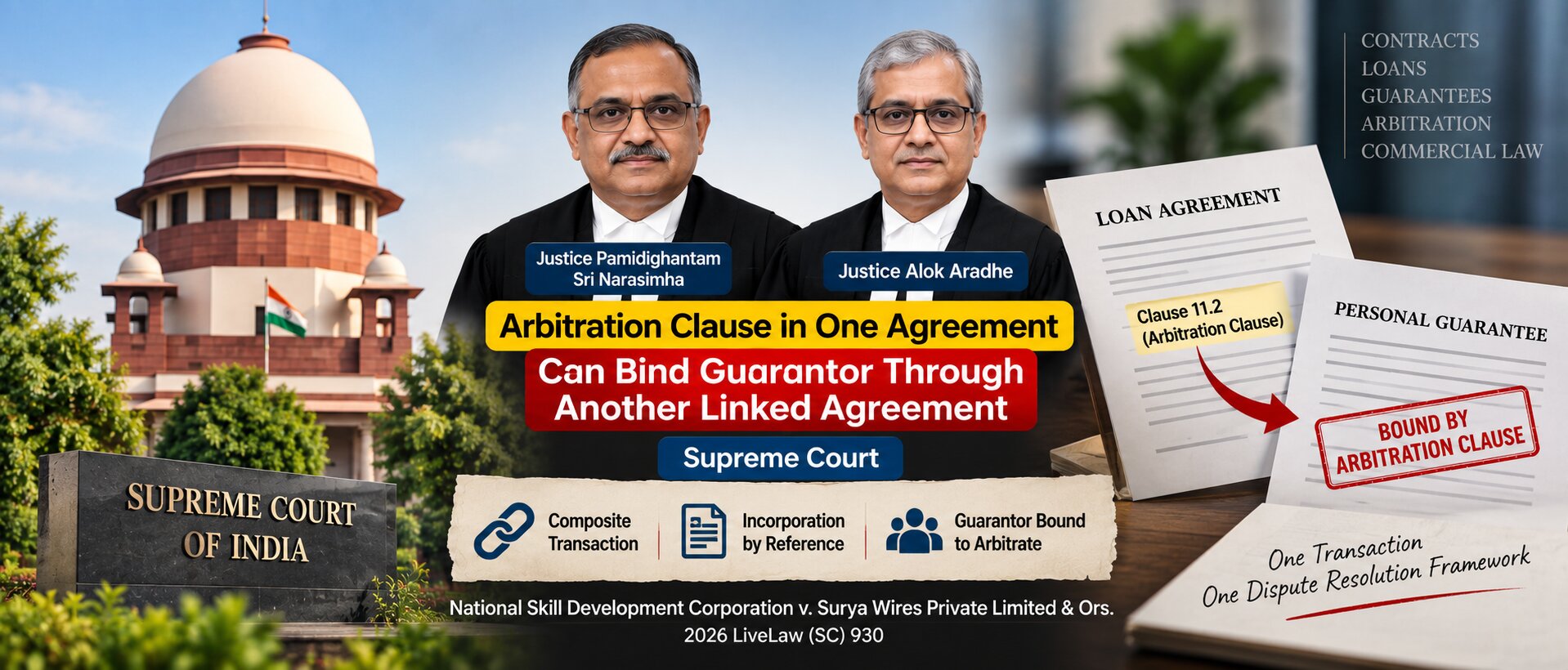
Judgement Details
Court
Supreme Court of India
Date of Decision
11 September 2026
Judges
Justice Pamidighantam Sri Narasimha & Justice Alok Aradhe
Citation
Acts / Provisions
Facts of the Case
-
The National Skill Development Corporation (NSDC) was the implementing agency for establishing Pradhan Mantri Kaushal Kendra (PMKK) training centres.
-
NSDC provided financial assistance to entities involved in establishing and operating skill-training centres.
-
The respondents included Surya Wires Private Limited and other connected borrower entities involved in the project.
-
On 20 December 2016, the parties entered into a set of contemporaneous agreements, including a Service Level Agreement, Loan Agreement and various ancillary Facility Agreements.
-
The first Loan Agreement provided financial assistance of approximately ₹7.17 crore.
-
As part of the security arrangements, respondent No. 2 executed a Personal Guarantee dated 27 December 2016 in favour of NSDC in his individual capacity.
-
A second set of agreements was executed on 18 August 2017, under which an additional loan of approximately ₹2.13 crore was provided.
-
Respondent No. 2 also executed a second Personal Guarantee dated 18 August 2017 in connection with the second Loan Agreement.
-
The Loan Agreements contained an arbitration clause under Clause 11.2.
-
The Personal Guarantees themselves did not contain a separate arbitration clause.
-
The Loan Agreements, however, expressly incorporated and treated the related Facility Agreements, including the Personal Guarantees, as part of the overall contractual arrangement.
-
Subsequently, the borrowers defaulted in repayment of the loans.
-
NSDC issued Loan Recall Notices and initiated arbitration proceedings before the Indian Council of Arbitration.
-
NSDC sought to proceed against respondent No. 2, the personal guarantor, on the basis that the arbitration clause contained in the Loan Agreements also applied to the Personal Guarantees.
-
Respondent No. 2 objected to the arbitration proceedings against him, arguing that he had not signed the Loan Agreements in his individual capacity.
-
He contended that the Personal Guarantees were separate contracts and did not themselves contain an arbitration clause.
-
The Sole Arbitrator accepted the objection under Section 16 of the Arbitration and Conciliation Act, 1996 and directed the deletion of respondent No. 2 from the arbitral proceedings.
-
NSDC challenged the decision before the Delhi High Court under Section 37 of the 1996 Act.
-
The Delhi High Court upheld the Arbitrator's decision, holding that respondent No. 2, being a non-signatory to the Loan Agreements in his personal capacity, could not be bound by the arbitration clause contained in those agreements.
-
NSDC thereafter approached the Supreme Court of India.
Issues
-
Whether an arbitration clause contained in a Loan Agreement can be incorporated into a Personal Guarantee that does not itself contain an arbitration clause?
-
Whether Section 7(5) of the Arbitration and Conciliation Act, 1996 permits incorporation of an arbitration clause where the Personal Guarantee is expressly integrated with the principal Loan Agreement?
-
Whether the Personal Guarantees executed by respondent No. 2 constituted separate and independent transactions or formed part of a single composite commercial transaction with the Loan Agreements?
-
Whether respondent No. 2, despite not signing the Loan Agreements in his individual capacity, can be bound by the arbitration clause incorporated into the Personal Guarantees?
-
Whether the Delhi High Court was correct in upholding the Arbitral Tribunal's decision to exclude respondent No. 2 from the arbitral proceedings?
Judgement
-
The Supreme Court allowed the appeal filed by the National Skill Development Corporation.
-
The Court set aside the judgment of the Delhi High Court dated 28 January 2026.
-
The Court also set aside the Arbitral Tribunal's order insofar as it had allowed respondent No. 2's objection under Section 16 and removed him from the arbitral proceedings.
-
The Court examined the contractual structure and found that the Loan Agreements and Personal Guarantees were not isolated or independent arrangements.
-
The Court observed that the parties had structured their relationship through several interconnected and contemporaneous instruments forming one composite commercial transaction.
-
The Personal Guarantees were executed as a condition precedent to the disbursement of the loans and were therefore integral to the Loan Agreements.
-
The Court relied upon the principles laid down in M.R. Engineers and Contractors Pvt. Ltd. v. Som Datt Builders Ltd. and Cox and Kings Ltd. v. SAP India Pvt. Ltd.
-
The Court held that in a composite transaction involving multiple agreements, courts and tribunals must examine whether the related agreements are consequential to, or follow up on, the principal agreement.
-
The Loan Agreements contained language providing that the related Facility Agreements, including the Personal Guarantees, would operate “as if the provisions thereof were set out herein in extension” of the Loan Agreements.
-
The Court treated this language as a deeming fiction that brought the Personal Guarantees within the same contractual and arbitral framework as the Loan Agreements.
-
The Court held that the Personal Guarantees were therefore woven into the very fabric of the Loan Agreements and could not be treated as completely separate for purposes of dispute resolution.
-
Since Clause 11.2 of the Loan Agreements contained the arbitration agreement, the Court held that the clause was incorporated into the Personal Guarantees under Section 7(5) of the 1996 Act.
-
The Court rejected the argument that respondent No. 2 could rely solely on the fact that he had not signed the Loan Agreements in his personal capacity.
-
The Court held that the express contractual integration of the Personal Guarantees with the Loan Agreements was sufficient to bind respondent No. 2 to the arbitration agreement.
-
The Court ultimately held that respondent No. 2 was required to submit to arbitration in respect of disputes arising from the Personal Guarantees.
Held
-
Where multiple agreements form part of a single composite transaction, the agreements must be read together to determine the parties' intention regarding dispute resolution.
-
A Personal Guarantee that is expressly and contractually integrated with a Loan Agreement containing an arbitration clause may be bound by that arbitration clause even if the guarantee itself does not separately contain one.
-
The Personal Guarantees executed by respondent No. 2 were found to be inseparable from the Loan Agreements.
-
Respondent No. 2 was therefore held to be bound by the arbitration clause in Clause 11.2 of the Loan Agreements.
-
The Supreme Court directed that respondent No. 2 could not be excluded from the arbitral proceedings merely because he was a non-signatory to the Loan Agreements in his individual capacity.
Analysis
-
The judgment reinforces the principle that arbitration agreements must be examined in the context of the entire contractual arrangement, particularly where several documents are executed as part of one commercial transaction.
-
The Court focused on the intention of the parties and the language of the contracts, rather than mechanically applying the principle that only a signatory can be bound by an arbitration clause.
-
Section 7(5) is important because it permits an arbitration agreement to be incorporated through reference to another document, provided the statutory requirements are satisfied.
-
The decision demonstrates that incorporation by reference can operate even where the document being incorporated does not independently reproduce the arbitration clause.
-
The Court distinguished between a genuinely independent contract of guarantee and a guarantee that has been expressly integrated into a larger contractual framework.
-
The fact that the Personal Guarantees were executed contemporaneously with the Loan Agreements and as a condition precedent to the loan disbursement was significant in determining their legal relationship.
-
The contractual phrase treating the Facility Agreements as if their provisions were set out in the Loan Agreements was particularly important because it demonstrated the parties' intention to treat the documents as part of a single contractual framework.
-
The judgment prevents a party from treating an integrated guarantee as part of the principal agreement for purposes of liability while simultaneously treating it as completely separate when the question of arbitration arises.
-
The decision builds upon the Supreme Court's earlier jurisprudence concerning composite transactions and non-signatories to arbitration agreements.
-
The ruling also emphasises that the determination of whether a non-signatory is bound by arbitration depends on the contractual relationship, incorporation by reference, intention of the parties and overall structure of the transaction.
-
The judgment is significant for commercial lending transactions because financial arrangements commonly involve loan agreements, guarantees, security documents, facility agreements and other interconnected instruments.
-
The decision provides greater clarity that an arbitration clause can travel across interconnected contractual documents where the parties have expressly integrated those documents into a single commercial arrangement.
-
At the same time, the ruling does not mean that every guarantor automatically becomes bound by an arbitration clause in the underlying loan agreement. The contractual documents must demonstrate the necessary connection and intention for incorporation.
-
The judgment therefore strengthens the principle that substance and contractual intention, rather than the mere form or title of an individual document, are crucial in determining the scope of an arbitration agreement.