
National Seeds Corporation Ltd. v. National Agro Seed Corporation (India), 2026
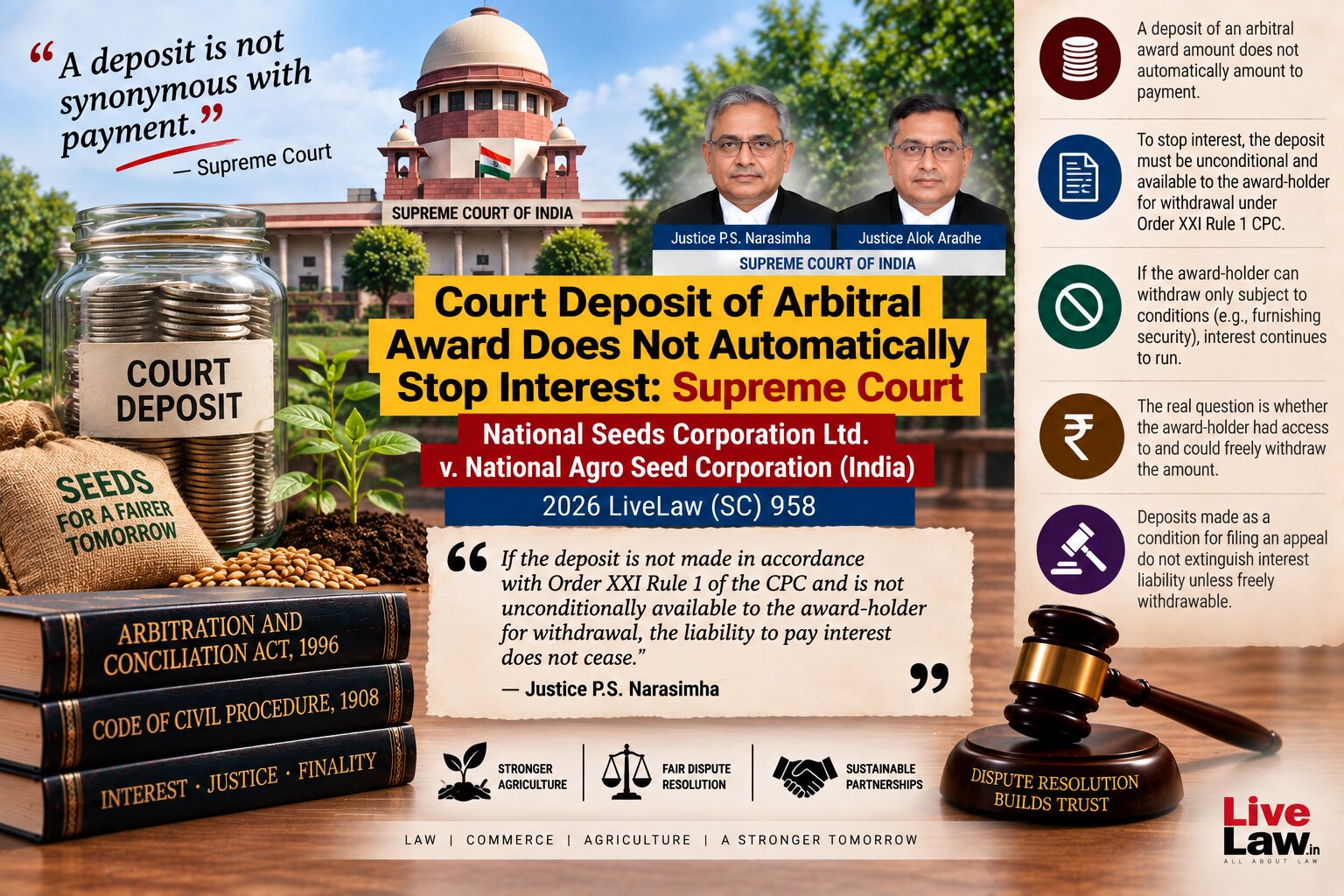
A deposit made in court extinguishes interest liability only when it complies with Order XXI Rule 1 CPC.
Judgement Details
Court
Supreme Court of India
Date of Decision
15 September 2026
Judges
Justice Pamidighantam Sri Narasimha and Justice Alok Aradhe
Citation
Acts / Provisions
Facts of the Case
-
An arbitral award dated 13 June 2019 directed National Seeds Corporation Ltd. to pay ₹1,46,40,005.02, together with interest at 12% per annum, aggregating to approximately ₹1,77,97,434.
-
The award-debtor challenged the award under Section 34 of the Arbitration and Conciliation Act, 1996.
-
The Delhi High Court stayed enforcement of the award subject to deposit of 50% of the principal amount.
-
The appellant deposited ₹73,20,003 pursuant to the stay condition.
-
After dismissal of the Section 34 challenge, the award-holder initiated execution proceedings.
-
The appellant subsequently deposited the balance amount of approximately ₹1,53,17,792 in April 2022.
-
The executing court initially permitted release of ₹1 crore to the award-holder against security.
-
The award-holder subsequently withdrew its request because it was unable to furnish the required security by depositing title deeds.
-
The Supreme Court dismissed the appellant's SLP on 26 August 2022, making the arbitral award final.
-
On 8 September 2022, the executing court directed release of the deposited amount.
-
The principal dispute before the Supreme Court concerned whether the appellant remained liable to pay interest for the period during which the money remained deposited in court but was not unconditionally available for withdrawal by the award-holder.
-
The executing court held that mere deposit did not amount to payment because the award-holder could not freely use or withdraw the money and therefore directed payment of interest for the relevant period.
Issues
-
Whether a deposit of an arbitral award amount in court automatically amounts to payment and extinguishes the award-debtor's liability to pay interest?
-
Whether a court deposit must be unconditional and freely withdrawable by the award-holder to constitute payment under Order XXI Rule 1 CPC?
-
Whether interest continues to accrue when the award-holder can withdraw the deposited amount only subject to furnishing security?
-
Whether the award-debtor's liability to pay interest ceases from the date of deposit when the amount is not deposited in accordance with Order XXI Rule 1 CPC?
Judgement
-
The Supreme Court disposed of the appeal while affirming the findings that the award-debtor's interest liability had not ceased merely because the award amount had been deposited in court.
-
The Court held that a deposit is not synonymous with payment.
-
For a court deposit to qualify as payment under Order XXI Rule 1 CPC, it must be unconditional and the decree-holder or award-holder must be free to withdraw the amount.
-
Where withdrawal is subject to furnishing security or other conditions, the amount is not freely available to the award-holder.
-
Consequently, the deposit does not satisfy Order XXI Rule 1 CPC and interest continues to run on the amount.
-
The Court clarified that where the award-holder itself fails to take steps to withdraw an amount that was unconditionally available, such inaction may amount to deemed refusal of the tender.
-
The Court relied upon P.S.L. Ramanathan Chettiar v. O.R.M.P.R.M. Ramanathan Chettiar, along with subsequent decisions including Delhi Development Authority v. Bhai Sardar Singh & Sons and Nepa Ltd. v. Manoj Kumar Agrawal.
Held
-
A deposit is not automatically equivalent to payment.
-
The deposit must be unconditional and must be available to the award-holder for withdrawal without requiring additional security or other conditions.
-
If the award-holder can withdraw the deposited amount only after furnishing security, the deposit does not constitute payment in satisfaction of the award.
-
In such circumstances, interest continues to accrue on the deposited amount until it becomes unconditionally available to the award-holder.
-
If only part of the outstanding amount is unconditionally deposited and made available for withdrawal, interest ceases only on that deposited portion, while the remaining amount continues to carry interest.
-
Where the award-holder fails to withdraw money that was already unconditionally available, such inaction may amount to deemed refusal of the tender, and interest cannot subsequently be claimed on that amount.
-
Where a fixed deposit is created at the award-holder's own request, the award-holder is entitled only to the interest actually accrued on that fixed deposit.
Analysis
-
The judgment draws an important distinction between deposit of money in court and actual payment to the decree-holder or award-holder.
-
The Court focused on the practical question of whether the award-holder had effective and unconditional access to the money.
-
Merely placing money beyond the control of the award-debtor does not, by itself, discharge the underlying monetary liability.
-
The Court applied Order XXI Rule 1 CPC to determine when a deposit can be treated as satisfaction of a monetary award or decree.
-
The requirement of unconditional availability protects the award-holder from being deprived of the use of money while the award-debtor simultaneously claims cessation of interest.
-
The judgment is particularly significant in arbitration matters because Section 36 of the Arbitration and Conciliation Act makes an arbitral award executable as if it were a decree of the court.
-
The Court emphasized that where a deposit is made merely as a condition for obtaining a stay of enforcement and withdrawal remains conditional upon furnishing security, it does not necessarily constitute payment.
-
At the same time, the Court recognized that an award-holder cannot deliberately refuse to withdraw money that has already been made unconditionally available and thereafter continue claiming interest.
-
The decision therefore establishes a functional test: the question is not simply whether money was deposited, but whether the award-holder could freely withdraw it.
-
The ruling also reinforces the principle that interest is compensatory in nature where the successful party has not obtained effective access to the money due under the award.