
National Projects Construction Corporation Ltd. v. Ishvakoo (India) Pvt. Ltd., 2026
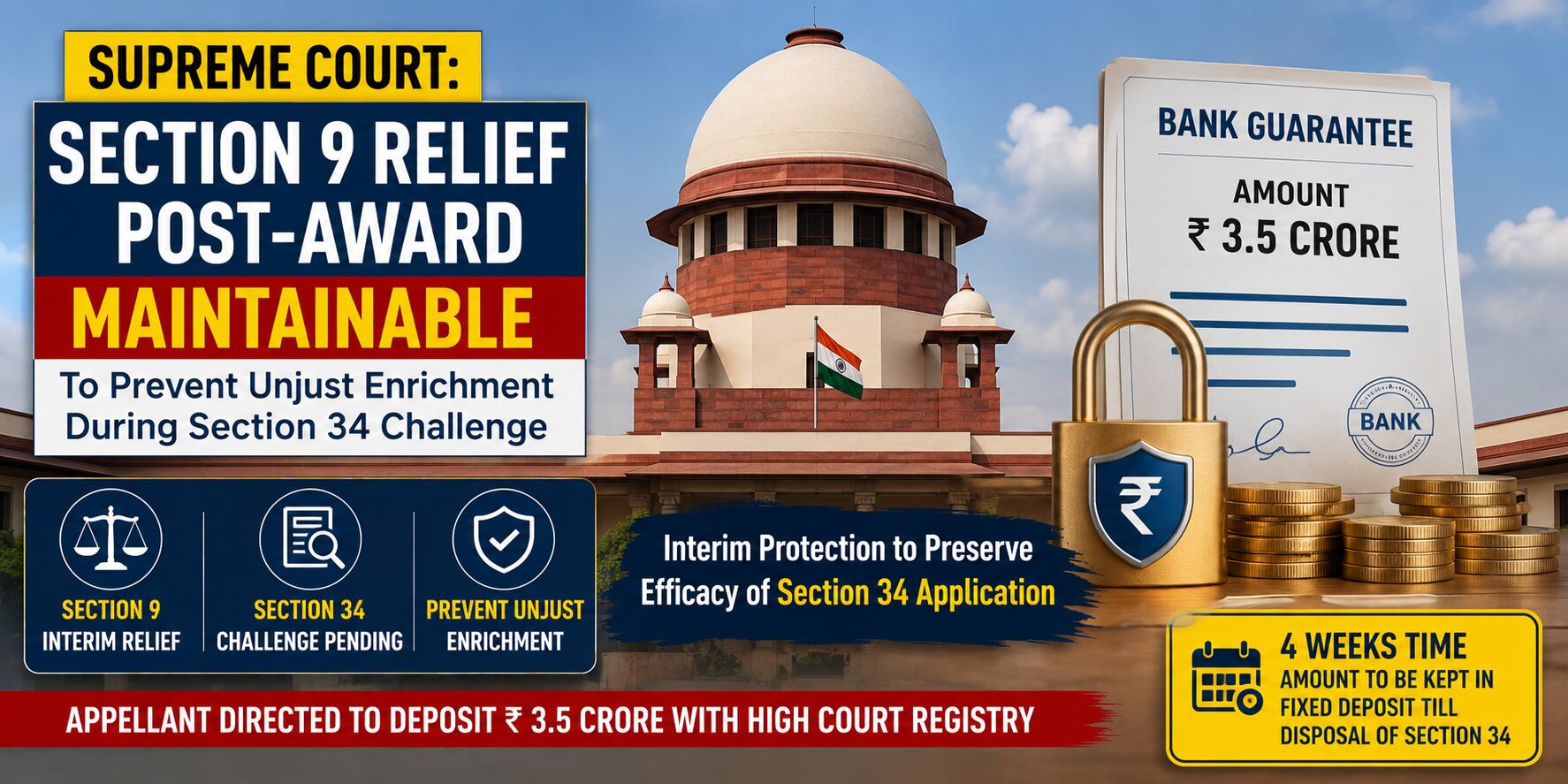
The Court held that a post-award application under Section 9 by an award debtor is legally maintainable in exceptional cases.
Judgement Details
Court
Supreme Court of India
Date of Decision
17 August 2026
Judges
Justice K.V. Viswanathan and Justice Alok Aradhe
Citation
Acts / Provisions
Facts of the Case
-
The dispute arose from a Memorandum of Understanding (MoU) executed in 2002 between National Projects Construction Corporation Ltd. and Ishvakoo (India) Pvt. Ltd.
-
Under the arrangement, Ishvakoo received approximately ₹3.5 crore as mobilisation advance.
-
The mobilisation advance was secured through bank guarantees.
-
In an earlier Section 9 proceeding in 2005, an arrangement was recorded under which the appellant would not invoke the bank guarantees as long as they were kept alive.
-
It was contemplated that if the arbitrator ultimately found the appellant entitled to recover the amount, the bank guarantees could then be invoked.
-
Ishvakoo subsequently failed to keep the bank guarantees alive.
-
The appellant consequently invoked the bank guarantees in September 2017 and received approximately ₹3.5 crore.
-
The arbitrator subsequently delivered an award on 5 December 2017.
-
The award rejected Ishvakoo's claims, but the arbitrator was apparently not aware that the bank guarantees had already been encashed.
-
Ishvakoo challenged the arbitral award under Section 34 of the Arbitration and Conciliation Act, 1996.
-
During the pendency of the Section 34 proceedings, Ishvakoo filed a fresh Section 9 application seeking interim relief concerning the amount obtained through the bank guarantees.
-
The Single Judge of the Delhi High Court directed the appellant to deposit approximately ₹3.5 crore with the High Court Registry.
-
The Division Bench of the Delhi High Court upheld the Single Judge's order.
-
The appellant challenged the High Court's decision before the Supreme Court.
-
The central question before the Supreme Court concerned whether Section 9 relief could be granted to an award debtor after an award had been passed and while a Section 34 challenge remained pending.
-
The Court also considered whether allowing the award holder to retain the money during the Section 34 proceedings would result in unjust enrichment.
Issues
-
Whether an award debtor can maintain an application under Section 9 of the Arbitration and Conciliation Act, 1996 after an arbitral award has been passed and while a Section 34 challenge to the award is pending?
-
Whether a court can grant post-award interim relief under Section 9 in exceptional and compelling circumstances to preserve the efficacy of a challenge under Section 34?
-
Whether an award debtor can obtain Section 9 relief where permitting the award holder to retain the disputed amount during the pendency of the Section 34 proceedings would cause irreparable prejudice or unjust enrichment?
-
Whether the respondent satisfied the requirements of a prima facie case and balance of convenience for obtaining interim relief under Section 9?
-
Whether the Delhi High Court was justified in directing the appellant to deposit approximately ₹3.5 crore with the High Court Registry pending disposal of the Section 34 application?
-
Whether permitting the award holder to retain the bank-guarantee amount during the pendency of the Section 34 proceedings would undermine the efficacy of the statutory challenge to the arbitral award?
Judgement
-
The Supreme Court dismissed the appeal filed by National Projects Construction Corporation Ltd.
-
The Court declined to interfere with the Delhi High Court's direction requiring the appellant to deposit ₹3.5 crore with the High Court Registry.
-
The Court recognised that a post-award Section 9 application by an award debtor is maintainable in exceptional circumstances.
-
The Court emphasised that the threshold for granting such relief to an award debtor is higher than in an ordinary interim-relief application.
-
However, in a rare and compelling case, Section 9 can be invoked to prevent irreparable prejudice and preserve the effectiveness of a pending Section 34 challenge.
-
The Court found that the respondent had established the necessary requirements for interim relief, including a prima facie case and balance of convenience.
-
The Court accepted the High Court's reasoning that allowing the appellant to retain the ₹3.5 crore during the Section 34 proceedings could result in unjust enrichment.
-
The Court therefore upheld the direction requiring the appellant to deposit the amount with the High Court Registry.
-
The appellant was granted four weeks to deposit the ₹3.5 crore.
-
Upon deposit, the amount was directed to be kept in a fixed deposit with a nationalised bank on an auto-renewal basis.
-
The fixed deposit would remain in place until disposal of the Section 34 application.
-
The Court thereby preserved the disputed amount without finally deciding the parties' substantive rights under the arbitral award.
Held
-
The Court held that such relief may be granted where necessary to prevent irreparable prejudice and preserve the efficacy of a Section 34 challenge.
-
The Court held that the respondent had established sufficient grounds for Section 9 relief, including a prima facie case and balance of convenience.
-
The Court found that allowing the appellant to retain the ₹3.5 crore during the pending Section 34 proceedings could result in unjust enrichment.
-
The Court upheld the direction requiring the appellant to deposit ₹3.5 crore with the Delhi High Court Registry.
-
The appeal was therefore dismissed.
Analysis
-
Exceptional nature of post-award Section 9 relief: The judgment confirms that Section 9 does not become completely unavailable merely because an arbitral award has already been rendered. However, an award debtor seeking such relief faces a higher threshold.
-
Preserving Section 34 remedy: The decision recognises that the statutory challenge under Section 34 should remain practically meaningful. Interim protection can be justified where events occurring during the challenge could otherwise make the eventual remedy ineffective.
-
Prevention of unjust enrichment: The Court considered whether allowing the award holder to retain the ₹3.5 crore while the award was under challenge would provide an unjust financial advantage before the Section 34 proceedings were finally determined.
-
Prima facie case and balance of convenience: The respondent was required to satisfy the established requirements for interim relief. The Court found these requirements to have been met in the circumstances.
-
Rare and compelling circumstances: The ruling does not create an automatic right for every award debtor to seek return or protection of money under Section 9. The remedy remains exceptional and fact-specific.
-
Distinction between interim protection and final adjudication: The direction to deposit the money did not finally determine who was entitled to the ₹3.5 crore. Instead, the amount was preserved in a fixed deposit pending determination of the Section 34 proceedings.
-
Relationship between Sections 9 and 34: The judgment demonstrates how Section 9 can operate alongside Section 34 to protect the subject matter of the dispute while an arbitral award is being judicially challenged.
-
Bank guarantee and encashed amount: Although the dispute originated from bank guarantees, the Court's concern was particularly focused on the consequences of allowing the award holder to retain the encashed amount while the award remained under challenge.
-
Limited interference by Supreme Court: The Supreme Court found no sufficient reason to interfere with the concurrent approach of the Delhi High Court and therefore allowed the interim arrangement to continue.
-
Broader arbitration significance: The judgment reinforces the principle that courts can use Section 9 in carefully limited circumstances to ensure that an award challenge under Section 34 is not rendered ineffective or practically meaningless.
-
Practical implication: Award holders should not assume that receipt of an amount automatically places it beyond interim judicial protection during a pending Section 34 challenge, particularly where retaining the money could cause serious prejudice.