
National Insurance Company Limited v. Motiur Rahman & Anr., 2026
A permissive user who borrows a vehicle and steps into the shoes of its owner cannot maintain a Section 163A claim against the owner and insurer of that same vehicle.
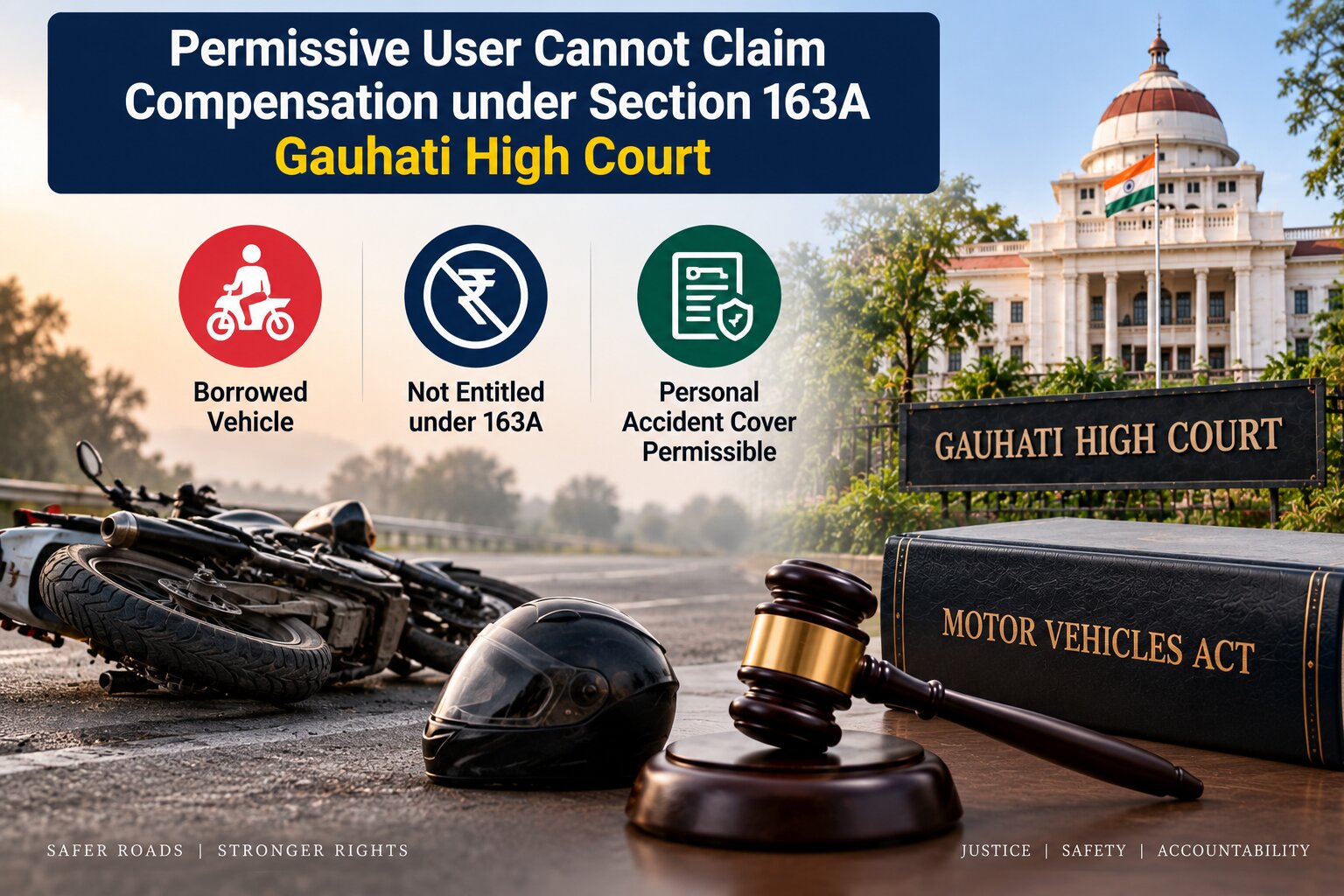
Judgement Details
Court
Gauhati High Court
Date of Decision
18 September 2026
Judges
Justice Manish Choudhury
Citation
Acts / Provisions
Facts of the Case
-
The claimant sustained injuries while riding a motorcycle belonging to another person.
-
The claimant was using the motorcycle with the owner's permission and was therefore a permissive user and borrower of the vehicle.
-
According to the claimant, the accident occurred because of bad road conditions, stones lying on the road and poor visibility caused by fog.
-
The claimant initially filed a compensation claim under Sections 166 and 140 of the Motor Vehicles Act.
-
The claim was directed against the owner and insurer of the motorcycle that the claimant himself was riding.
-
The Motor Accident Claims Tribunal, Golaghat, examined the evidence and found that the claimant himself was responsible for causing the accident and his injuries.
-
On that basis, the Tribunal held that the claimant was not entitled to compensation under Section 166, since the finding of his own responsibility had ruled out the basis for such a claim.
-
The claimant did not challenge this finding, and it consequently attained finality.
-
Despite this, the Tribunal suo motu converted the claim under Section 166 into a claim under Section 163A, reasoning that proof of rash or negligent driving was not necessary under Section 163A.
-
The Tribunal subsequently awarded ₹3.45 lakh compensation with interest at 6% per annum against the insurer.
-
The insurer challenged the award before the Gauhati High Court under Section 173 of the Motor Vehicles Act.
-
The insurer argued that the claimant was a borrower and permissive user of the motorcycle and, having himself caused the accident, had effectively stepped into the shoes of the owner.
-
It was therefore argued that the claimant could not maintain a Section 163A claim against the owner and insurer of the same vehicle.
-
The insurer also questioned the Tribunal's decision to convert the claim from Section 166 to Section 163A without notice to the parties.
-
The High Court noted that no other person or vehicle was involved in the accident.
-
The Court also took note of the final finding that the claimant himself was responsible for the accident.
-
The High Court accepted the insurer's contention that the claimant, as a permissive user and borrower, had stepped into the shoes of the owner for purposes of the Section 163A claim.
-
The Court therefore set aside the Tribunal's compensation award.
-
However, the Court noted that the accident had occurred during the validity of the insurance policy and that neither party had produced evidence regarding any personal accident coverage under the policy.
-
The Court therefore preserved the claimant's entitlement to such personal accident coverage, if available under the policy.
Issues
-
Whether a permissive user and borrower of a two-wheeler can maintain a claim under Section 163A of the Motor Vehicles Act against the owner and insurer of that very vehicle?
-
Whether a claimant who has been found responsible for the accident can claim compensation under Section 163A merely because proof of negligence is not required under that provision?
-
Whether the Tribunal was justified in suo motu converting a claim under Section 166 into one under Section 163A?
-
Whether the claimant remained entitled to any personal accident coverage available under the insurance policy despite being disentitled to compensation under Sections 166 and 163A?
Judgement
-
The Gauhati High Court allowed the insurer's appeal.
-
The Court held that the claimant was a permissive user and borrower of the motorcycle involved in the accident.
-
By borrowing and using the motorcycle, the claimant had, for the purpose of the Section 163A claim, stepped into the shoes of the owner.
-
The Court held that permitting such a claimant to recover compensation from the owner and insurer of the same vehicle would effectively amount to permitting him to maintain a claim against himself in the capacity of owner.
-
The Court also relied upon the Tribunal's unchallenged finding that the claimant himself was responsible for causing the accident and his injuries.
-
The claimant was therefore held not entitled to compensation under Section 163A.
-
Since the claimant was already found disentitled to compensation under Section 166, he was not entitled to compensation under either provision.
-
The Tribunal's judgment and award granting ₹3.45 lakh with 6% interest were therefore set aside and quashed.
-
The High Court found it unnecessary to decide the separate question concerning the Tribunal's suo motu conversion of the claim from Section 166 to Section 163A.
-
However, because the insurance policy was valid on the date of the accident, the Court directed that the claimant would be entitled to personal accident coverage, if any, available under the policy.
-
Such personal accident coverage was directed to carry 6% interest per annum from the date of filing of the claim application until realization.
-
The insurer was directed to complete the process concerning the personal accident coverage within two months.
Held
-
The fact that Section 163A operates on a no-fault basis does not remove the requirement that the claimant must otherwise fall within the class of persons entitled to invoke the provision.
-
Where the claimant himself is found responsible for the accident and is using the owner's vehicle as a borrower, a claim against the owner would effectively amount to a claim against himself.
-
The claimant was therefore not entitled to compensation under Section 163A.
-
Since the finding disentitling the claimant under Section 166 had not been challenged, he was also not entitled to compensation under Section 166.
-
The Tribunal's award of ₹3.45 lakh was consequently set aside.
-
The claimant could nevertheless claim personal accident coverage, if such coverage was provided under the valid insurance policy.
-
The insurer was directed to determine and settle such coverage within the time prescribed by the Court.
Analysis
-
Permissive user versus third-party claimant: The judgment draws an important distinction between an ordinary third-party claimant and a person who has borrowed and is himself using the insured vehicle. The latter cannot simply invoke Section 163A against the owner of the vehicle he was driving.
-
Stepping into the shoes of the owner: The central reasoning was that the claimant, as a borrower and permissive user, occupied the position of the owner for the relevant purpose. A claim against the owner in these circumstances would effectively become a claim against oneself.
-
No-fault liability is not unlimited: Section 163A removes the need to establish negligence in an otherwise maintainable claim, but it does not mean that every person injured in a motor accident automatically becomes entitled to compensation under the provision.
-
Effect of the unchallenged finding: The Tribunal had already concluded that the claimant himself caused the accident. Since that finding was not challenged, it attained finality and became an important part of the High Court's reasoning.
-
Section 166 and Section 163A: The claimant could not succeed under Section 166 because of the finding concerning his own responsibility, and he could not overcome the separate legal obstacle to a Section 163A claim arising from his status as the vehicle's borrower.
-
Suo motu conversion left open: Although the insurer challenged the Tribunal's conversion of the Section 166 claim into a Section 163A claim, the High Court expressly found it unnecessary to decide that issue because the claimant was not entitled to compensation under either provision.
-
Personal accident coverage preserved: The judgment is significant because rejection of statutory compensation did not necessarily extinguish every possible entitlement under the insurance policy. The Court separately recognised the possibility of contractual personal accident coverage.
-
Practical significance: Vehicle owners and borrowers should distinguish between statutory third-party compensation and benefits specifically provided under an insurance policy. A claimant may fail to establish statutory compensation while still having a contractual claim under a valid PA-cover provision.
-
Limited scope of the ruling: The Court's decision concerns the claimant's entitlement under Sections 166 and 163A in the particular circumstances of the case; it does not mean that every borrower of a vehicle is automatically excluded from every form of insurance benefit.