
Naresh Rai & Ors. v. State of Andhra Pradesh & Ors., 2026
Factory safety violations governed by the Factories Act cannot automatically be converted into a separate Section 304-A IPC prosecution.
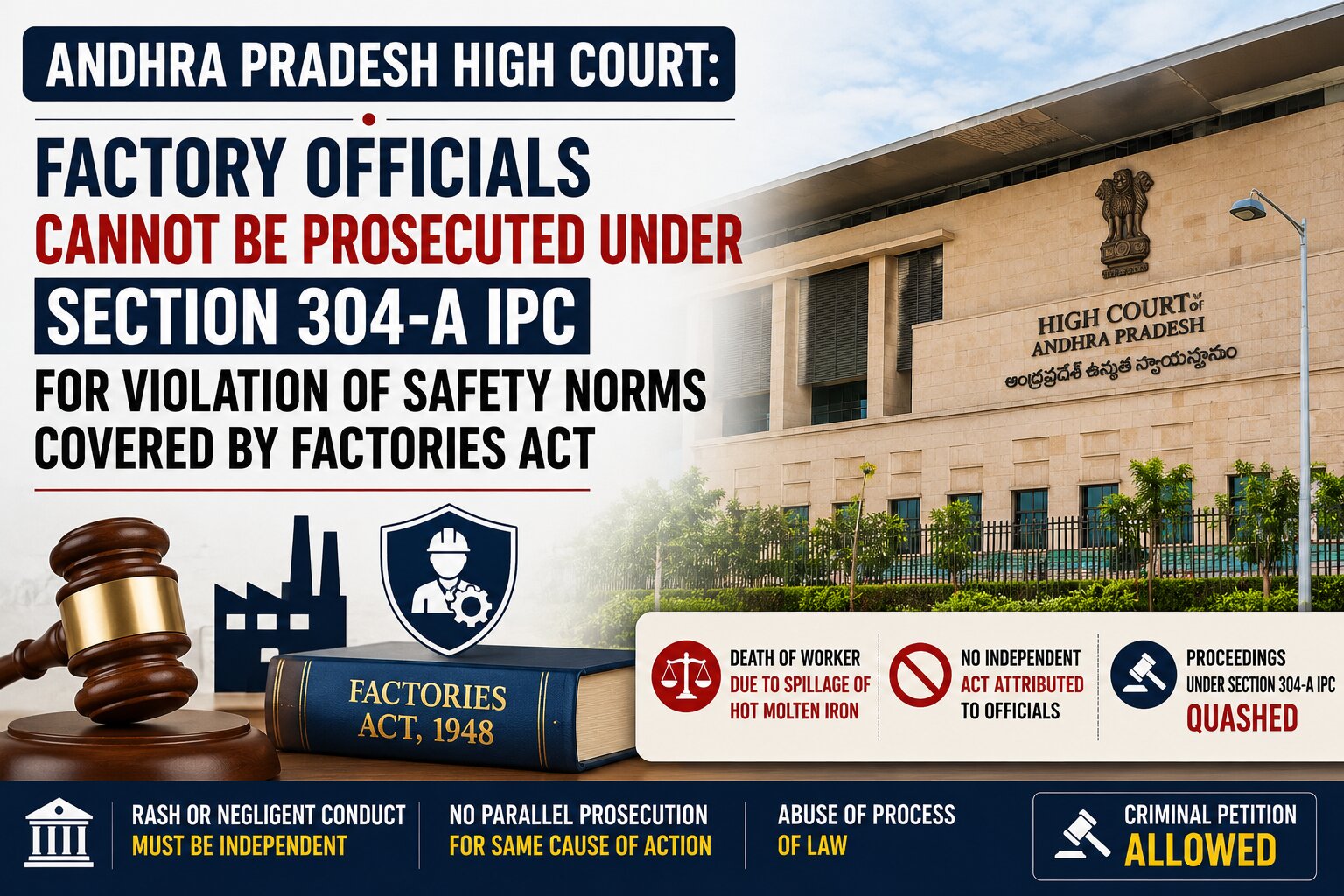
Judgement Details
Court
High Court of Andhra Pradesh
Date of Decision
4 August 2026
Judges
Justice K. Sreenivasa Reddy
Citation
Acts / Provisions
Facts of the Case
-
The case arose from the death of a crane operator working in a steel manufacturing factory.
-
In October 2014, the deceased was performing night-duty work at the factory.
-
During the operation, hot molten iron being carried through a ladle spilled and caused severe burn injuries to the worker.
-
The injuries subsequently resulted in the worker's death.
-
Following the incident, a criminal case was registered against factory officials under Section 304-A IPC.
-
The petitioners before the High Court included the factory's Supervisor (A1) and Occupier (A2).
-
During the investigation, the Inspector of Factories examined the safety conditions at the factory.
-
The Inspector alleged that the responsible factory officials had failed to comply with prescribed safety requirements.
-
The alleged safety deficiencies included failure to provide a Hot Metal Splash Impact Resistance Cabin for the EOT crane.
-
The authorities also alleged failure to prevent stagnation of water near the pit area.
-
The factory was further alleged to have failed to provide workers with adequate protective equipment, including heat-resistant clothing, gloves and face shields.
-
The Inspector's report specifically treated these omissions as violations of the Factories Act, 1948.
-
The Occupier and Manager were subsequently prosecuted under the Factories Act and were convicted and fined ₹70,000.
-
Despite the proceedings under the Factories Act, prosecution under Section 304-A IPC continued in relation to the same incident.
-
The petitioners approached the High Court seeking quashing of the Section 304-A proceedings.
-
They argued that the allegations against them were entirely based upon alleged violations of factory safety requirements and did not disclose any separate or independent act of rashness or negligence.
-
They further contended that continuing the IPC prosecution after proceedings under the Factories Act amounted to double jeopardy and abuse of the process of law.
-
The prosecution opposed the petition and argued that the material disclosed prima facie negligence resulting in the worker's death and therefore justified prosecution under Section 304-A IPC.
-
The High Court examined whether the alleged conduct disclosed an independent offence of rash or negligent conduct apart from the statutory safety violations under the Factories Act.
Issues
-
Whether factory officials can be prosecuted under Section 304-A IPC when the allegations of negligence are entirely based upon violations of safety requirements governed by the Factories Act, 1948?
-
Whether continuation of prosecution under Section 304-A IPC on the same set of allegations that had already resulted in proceedings under the Factories Act amounts to impermissible parallel prosecution?
-
Whether the alleged failure to provide safety equipment and safety infrastructure, without any specific independent overt act of rash or negligent conduct, is sufficient to attract Section 304-A IPC?
-
Whether the conviction and imposition of fine under the Factories Act for the same safety violations render continuation of the Section 304-A IPC proceedings an abuse of the process of law?
-
Whether the High Court should exercise its inherent criminal jurisdiction to quash the Section 304-A IPC proceedings when the allegations are confined to statutory safety violations under the Factories Act?
Judgement
-
The Andhra Pradesh High Court allowed the criminal petition filed by the factory officials.
-
The Court quashed the criminal proceedings pending against the petitioners under Section 304-A IPC.
-
The Court found that the allegations against the petitioners were entirely founded upon alleged non-compliance with safety requirements under the Factories Act.
-
The alleged omissions included failure to provide a Hot Metal Splash Impact Resistance Cabin for the EOT crane, failure to prevent water stagnation near the pit and failure to provide appropriate protective equipment.
-
The Inspector of Factories had specifically identified these matters as violations of the Factories Act, 1948.
-
The Court noted that, apart from describing A1 as the Supervisor and A2 as the Occupier, there was no specific overt act independently constituting rash or negligent conduct under Section 304-A IPC.
-
The Court therefore held that the prosecution could not simply transform the statutory safety violations into an independent Section 304-A offence without identifying separate conduct satisfying the ingredients of that offence.
-
The Court held that allowing the Section 304-A prosecution to continue on the same factual allegations would amount to parallel prosecution for the same cause of action.
-
Such continuation was held to be impermissible in law.
-
The High Court consequently quashed the proceedings against the petitioners.
Held
-
Where the allegations are entirely based upon non-compliance with statutory safety requirements, the prosecution must establish an independent act of rashness or negligence to attract Section 304-A IPC.
-
Merely describing an accused as the Supervisor or Occupier is insufficient to establish the independent ingredients of Section 304-A.
-
The Court found no specific overt act of rash or negligent conduct beyond the alleged violations already covered by the Factories Act.
-
Continuing the Section 304-A prosecution on the same factual allegations would amount to parallel prosecution for the same cause of action.
-
The High Court therefore exercised its jurisdiction to quash the criminal proceedings against the petitioners.
-
The criminal petition was accordingly allowed.
Analysis
-
Specific act of negligence is essential: The central principle is that merely holding a supervisory or managerial position does not automatically establish criminal negligence under Section 304-A IPC. There must be material indicating conduct satisfying the ingredients of the offence.
-
Factories Act as the governing framework: Where the alleged wrongdoing consists entirely of failure to comply with factory safety requirements, the Factories Act provides the specific statutory framework governing that conduct.
-
No automatic Section 304-A liability: A workplace death does not, by itself, establish an offence under Section 304-A IPC against every factory official responsible for safety compliance. The prosecution must connect the particular accused with an independently identifiable rash or negligent act.
-
Parallel prosecution: The High Court's principal concern was that the same safety omissions were being used as the foundation for both the proceedings under the Factories Act and the Section 304-A IPC prosecution.
-
Double jeopardy — important distinction: The petitioners relied on double jeopardy. However, the Court's reasoning, as reported, principally rests on the impermissibility of parallel prosecution on the same cause of action and absence of an independent Section 304-A offence. This should not be understood as a blanket proposition that every prosecution under two different statutes is constitutionally barred by Article 20(2).
-
Article 20(2) versus abuse of process: Constitutional double jeopardy generally concerns a person being prosecuted and punished for the same offence after a prior conviction. The High Court's reasoning here is broader and focuses on whether the same statutory safety omissions can simultaneously sustain a separate IPC prosecution without an independent criminal act.
-
Importance of overt act: The Court specifically noted that, apart from the petitioners' designations as Supervisor and Occupier, there was no specific overt act constituting rash or negligent conduct. This was crucial to the quashing of the proceedings.
-
Occupier's statutory responsibility: The fact that an Occupier has statutory duties under the Factories Act does not automatically mean that every breach of those duties satisfies Section 304-A IPC. The prosecution must still establish the distinct ingredients of the IPC offence.
-
Workplace deaths and criminal liability: The judgment does not mean that workplace deaths cannot result in prosecution under the IPC. If the evidence establishes an independent rash or negligent act causing death, Section 304-A may potentially apply. The present decision is concerned with a case where the alleged negligence was entirely founded on statutory factory-safety omissions.
-
Special law and general law: The case illustrates the importance of examining the relationship between a special regulatory statute and a general criminal provision. The Factories Act specifically regulates workplace safety, while Section 304-A IPC addresses death caused by rash or negligent conduct.
-
Quashing jurisdiction: The High Court exercised its inherent criminal jurisdiction because allowing the prosecution to continue, despite the absence of an independently attributable Section 304-A act, would constitute an abuse of the process of law.
-
Protection against vicarious criminal liability: The judgment also has significance for managers, occupiers and supervisors. Criminal liability cannot be imposed solely because of an individual's designation unless the statute or evidence establishes the necessary personal involvement or statutory basis for liability.
-
Effect of prior conviction under the Factories Act: The prior conviction and fine under the Factories Act strengthened the petitioners' argument that the alleged safety failures had already been dealt with under the specific regulatory framework.
-
Balance between workplace safety and criminal liability: The decision does not dilute the importance of workplace safety. Rather, it emphasizes that enforcement of safety regulations and criminal prosecution for causing death must each satisfy their respective legal requirements.
-
Overall significance: The judgment establishes an important distinction between statutory safety violations and independent criminal negligence. A factory official cannot be prosecuted under Section 304-A merely by repackaging the same safety violations as rash or negligent conduct.