
Nanhki @ Naimunnisha v. State of U.P. & 3 Others, 2026
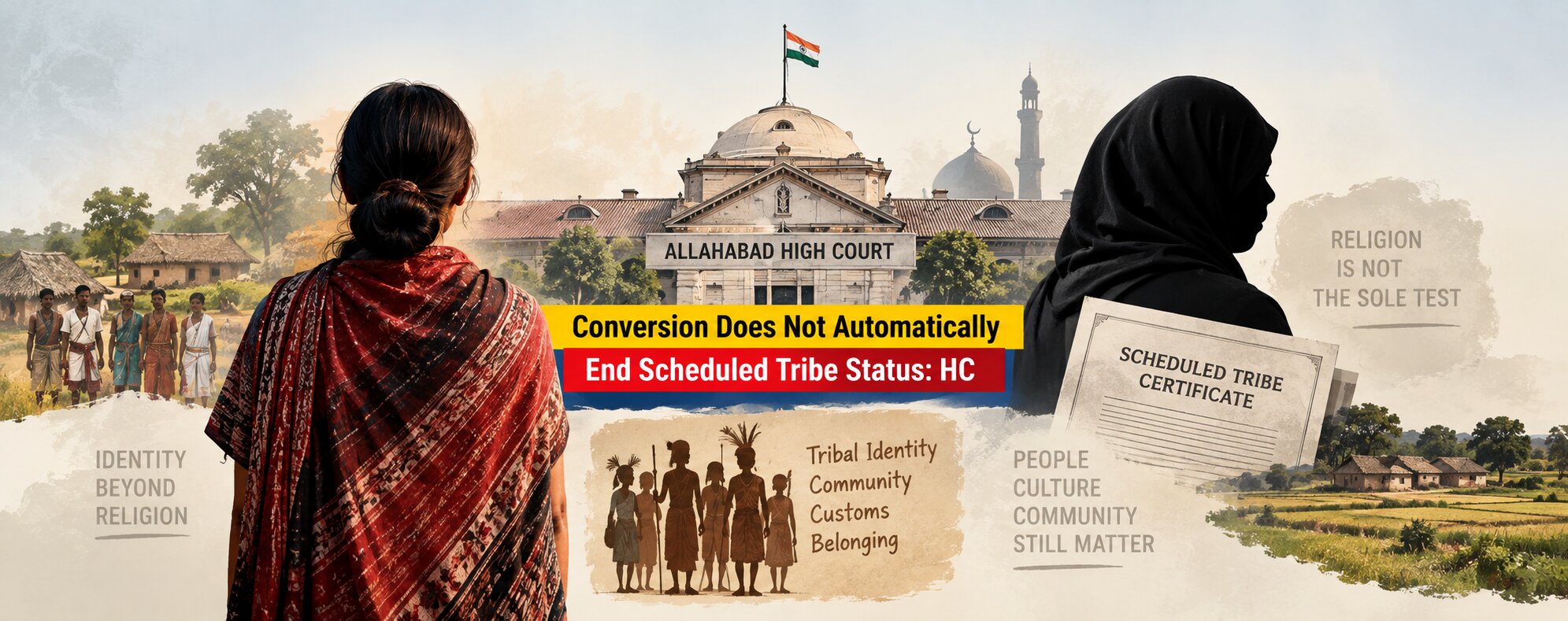
The Court held that conversion to another religion does not automatically extinguish Scheduled Tribe status.
Judgement Details
Court
High Court of Allahabad
Date of Decision
14 September 2026
Judges
Justice Arun Kumar
Citation
Acts / Provisions
Facts of the Case
-
The petitioner, Nanhki @ Naimunnisha, claimed that she was born into the Bhuiyan Scheduled Tribe community.
-
She relied upon a Scheduled Tribe certificate issued by the Tehsildar, which recognised her as belonging to the Bhuiyan Scheduled Tribe.
-
The petitioner had acquired certain parcels of land through three separate sale transactions.
-
The vendors of the disputed land were stated to belong to the Gour Scheduled Tribe.
-
The petitioner therefore contended that the transactions were legally permissible because the transfers were between members of Scheduled Tribes.
-
The Deputy Collector, Duddhi, Sonbhadra, subsequently examined the transactions and declared them void on the ground that they violated statutory restrictions relating to transfer of land belonging to Scheduled Tribes.
-
The revenue authority consequently directed that the disputed land should vest in the State Government.
-
The petitioner challenged the three orders of the Deputy Collector before the Allahabad High Court.
-
The State disputed the petitioner's claim that she continued to possess Scheduled Tribe status at the relevant time.
-
The State relied upon material indicating that the petitioner had married a Muslim man according to Islamic rites.
-
After her marriage, she came to be known as Naimunnisha and lived with her husband for several decades.
-
She had two children who bore Muslim names.
-
The family register also recorded her religion as Muslim.
-
The State argued that these circumstances, considered collectively, demonstrated that the petitioner had undergone a substantial change in her religious and social identity and had ceased to maintain a continuing connection with the Bhuiyan tribal community.
-
The petitioner disputed this contention and maintained that she continued to belong to the Bhuiyan Scheduled Tribe despite her marriage.
-
She asserted that she continued to live in her village and follow the customs and traditions of the Bhuiyan community.
-
She further argued that there was no reliable evidence proving that she had been severed from the Bhuiyan tribal community.
-
The principal question before the High Court was therefore whether the petitioner continued to possess the essential attributes of Bhuiyan tribal identity when the disputed land transactions took place.
Issues
-
Whether a person belonging to a Scheduled Tribe automatically ceases to hold Scheduled Tribe status merely because of conversion to another religion?
-
Whether the petitioner's marriage to a Muslim man and her subsequent life in a different religious and social setting established that she had ceased to possess the essential attributes of Bhuiyan tribal identity?
-
Whether the petitioner's Scheduled Tribe certificate conclusively established her continuing Scheduled Tribe status despite subsequent material questioning her continued tribal identity?
-
Whether the petitioner had established through credible evidence her continuing adherence to Bhuiyan customs and traditions, participation in tribal community life and acceptance by the Bhuiyan community?
-
Whether the disputed land transfers in favour of the petitioner were prohibited under Section 157-B of the Uttar Pradesh Zamindari Abolition and Land Reforms Act, 1950 and Section 99 of the Uttar Pradesh Revenue Code, 2006?
-
Whether the revenue authorities were justified in declaring the disputed sale transactions void and directing the vesting of the land in the State Government?
Judgement
-
The Allahabad High Court dismissed the writ petitions and upheld the orders passed by the Deputy Collector, Duddhi.
-
The Court rejected the proposition that conversion to another religion automatically terminates Scheduled Tribe status.
-
The Court held that there can be no general rule that a person ceases to be a member of a Scheduled Tribe merely because the person changes religion.
-
The Court observed that the Constitution (Scheduled Tribes) Order, 1950 does not prescribe a religion-based exclusion for Scheduled Tribes.
-
The Court held that the relevant inquiry is whether the person continues to possess and is recognised as possessing the essential attributes of the relevant tribal identity.
-
The Court identified factors such as customary practices, social organisation, community life and acceptance by the concerned tribal community as relevant considerations.
-
The Court relied extensively upon the Supreme Court's decision in Chinthada Anand v. State of Andhra Pradesh & Others (2026).
-
Applying these principles, the High Court examined the petitioner's circumstances over a prolonged period.
-
The Court considered her marriage, subsequent name, family circumstances, names of her children, the family-register entry describing her as Muslim and other materials placed before the authorities.
-
The Court emphasised that these circumstances were not considered individually but were examined according to their cumulative effect.
-
The Court found that the petitioner had failed to produce convincing evidence establishing that she continued to follow the customs and traditions of the Bhuiyan Scheduled Tribe.
-
The Court also found insufficient evidence showing her continued participation in the social and community life of the Bhuiyan tribe.
-
The Court further found that she had not satisfactorily established that she continued to be recognised and accepted by the Bhuiyan community.
-
The Court clarified that it was not applying a rigid test requiring a person to prove observance of every tribal custom throughout their life.
-
The Court also clarified that a single document describing a person as Muslim cannot, by itself, determine the question of continuing Scheduled Tribe status.
-
The petitioner's Scheduled Tribe certificate was considered relevant evidence, but the Court held that it was not conclusive where subsequent material raised a legitimate question regarding her continuing tribal identity.
-
Ultimately, the Court concluded that the petitioner had failed to establish that she continued to possess Bhuiyan Scheduled Tribe status on the dates on which the disputed transactions were executed.
-
Consequently, the statutory restrictions applicable to transfers involving Scheduled Tribe land applied to the transactions.
-
The Court therefore upheld the orders declaring the transactions void and the consequential direction concerning vesting of the land in the State Government.
Held
-
The Court held that continuing Scheduled Tribe status is a question of fact that must be determined by examining the person's continuing tribal identity and connection with the concerned tribal community.
-
The Court held that customary practices, traditions, social organisation, participation in community life and acceptance by the tribal community are relevant factors in determining continuing tribal identity.
-
The Court held that the petitioner's Scheduled Tribe certificate was relevant but was not conclusive against subsequent material concerning her continuing tribal status.
-
The Court held that the petitioner failed to satisfactorily establish continuity of her connection with the Bhuiyan community.
-
The Court held that the disputed land transactions were consequently subject to the statutory restrictions applicable to transfers in favour of persons who did not possess the requisite Scheduled Tribe status.
-
The Court accordingly dismissed the writ petitions and affirmed the orders of the revenue authorities.
Analysis
-
Religion is not the sole determining factor: The most important principle emerging from the judgment is that a change of religion does not, by itself, cause a person to lose Scheduled Tribe status.
-
Continuing tribal identity is central: The Court focused on whether the individual continued to possess the characteristics and social identity associated with the concerned tribe.
-
Community recognition is important: Continued recognition and acceptance by the tribal community can be significant evidence of continuing tribal identity.
-
The test is fact-specific: The Court did not create an inflexible rule requiring every tribal custom to be followed throughout a person's entire life.
-
No single circumstance is automatically decisive: Marriage to a person of another religion, conversion, or a single official record describing a person as Muslim cannot independently determine the issue.
-
Cumulative circumstances can be decisive: In this case, the Court considered the petitioner's prolonged life under a different name and within a different religious and social environment together with the other evidence.
-
Evidence of continuing tribal connection is important: The absence of credible evidence showing continued adherence to tribal customs, participation in community life and acceptance by the tribe became significant in the Court's determination.
-
ST certificate is relevant but not conclusive: The existence of an ST certificate is important evidence, but it does not necessarily prevent authorities from examining subsequent facts relevant to whether the person continues to possess tribal status.
-
Distinction between Scheduled Castes and Scheduled Tribes: The judgment is significant because the constitutional framework governing Scheduled Tribes does not contain the same religion-based restriction that applies to Scheduled Castes under the Constitution (Scheduled Castes) Order.
-
Protection against mechanical denial: Authorities cannot simply conclude that a person has lost ST status merely because the person has changed religion.
-
Protection against purely formal claims: At the same time, a person cannot necessarily rely solely upon an old ST certificate where substantial subsequent evidence raises questions regarding the person's continuing tribal identity.
-
Impact on land transactions: The determination of the petitioner's ST status had direct consequences for the validity of the land transactions because the law restricts transfers of protected tribal land to persons who are not members of Scheduled Tribes.
-
Overall legal principle: The judgment establishes a balanced approach: conversion is neither an automatic disqualification nor irrelevant. It is one circumstance that may be considered along with the person's customs, social life, tribal practices and continuing relationship with the community.