
Najma Khatoon v. State of Bihar, 2026
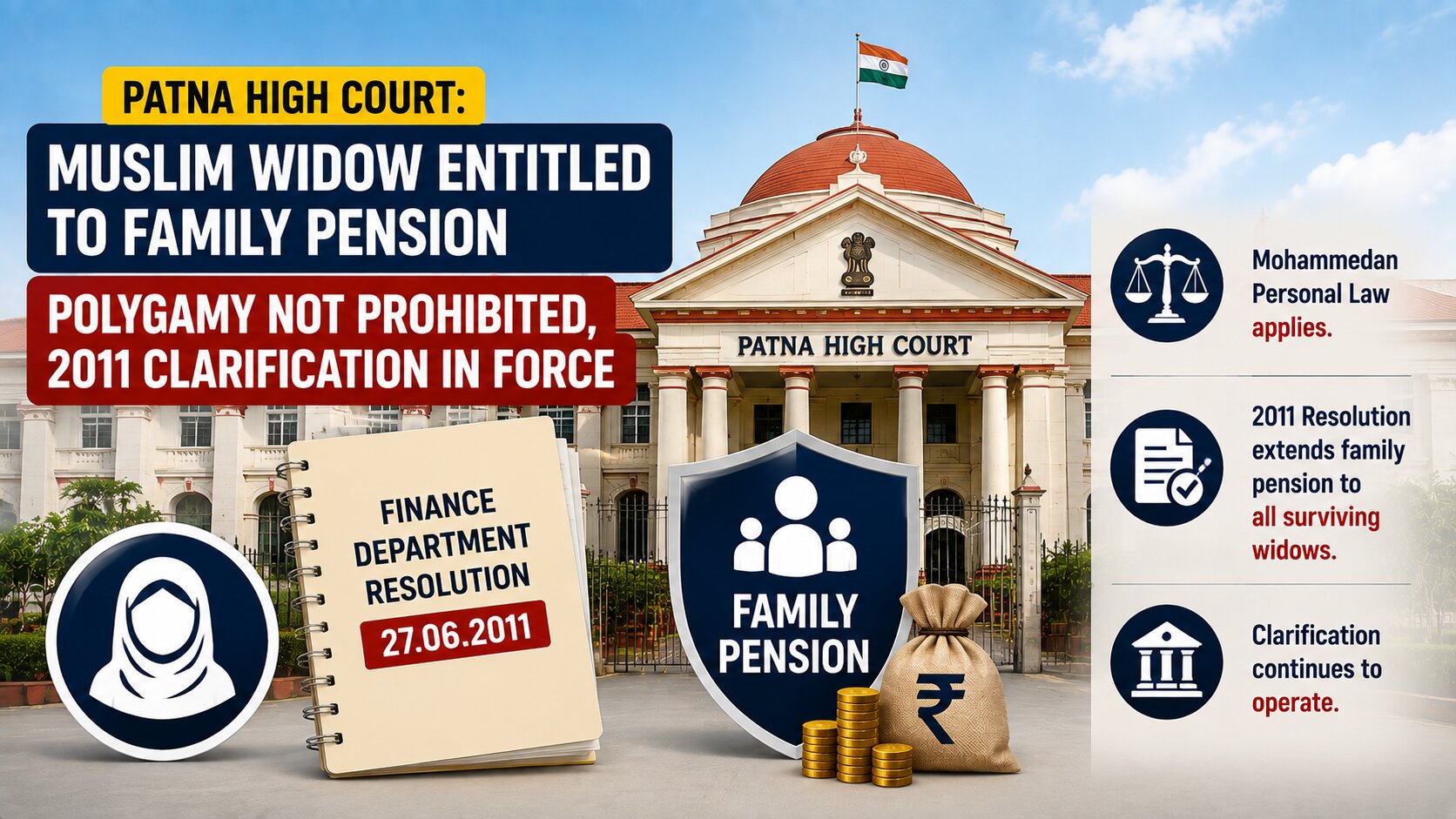
In the absence of legislation prohibiting polygamy among Muslims, Mohammedan Personal Law continues to govern Muslim marriage and marital rights.
Judgement Details
Court
Patna High Court
Date of Decision
4 August 2026
Judges
Justice Purnendu Singh
Citation
Acts / Provisions
Facts of the Case
-
The petitioner, Najma Khatoon, approached the Patna High Court seeking directions for sanction of family pension following the death of her husband.
-
Her husband was a government employee who died on 14 October 2020.
-
The petitioner claimed that her marriage with the deceased was valid under Mohammedan Personal Law.
-
She relied upon the Finance Department's Resolution dated 27 June 2011, Memo No. 1549.
-
According to the petitioner, the 2011 Resolution clarified that where a deceased Muslim government employee had contracted multiple marriages valid under Mohammedan Personal Law, the surviving widows would be entitled to family pension in equal proportion.
-
The deceased employee's first wife had died.
-
Before his death, the husband had requested the authorities to substitute the petitioner's name in the Pension Payment Order.
-
He had also requested inclusion of their younger daughter as an eligible family member.
-
Despite those requests, family pension was not sanctioned in favour of the petitioner.
-
The petitioner contended that the State had not specifically disputed her entitlement under the 2011 Resolution.
-
She argued that Mohammedan Personal Law permits a Muslim man to contract up to four marriages.
-
She further submitted that, as the only surviving wife of the deceased employee, she was entitled to receive family pension.
-
The petitioner also highlighted her financial hardship and stated that she was responsible for maintaining her unemployed adult children.
-
The State acknowledged that Mohammedan Personal Law continues to govern Muslim marriage and family relations in the absence of legislation prohibiting polygamy.
-
However, the State relied upon Rule 23 of the Bihar Government Servants' Conduct Rules, 1976, contending that a government servant must obtain prior permission before contracting a second marriage, even where such marriage is permitted under personal law.
-
The Court examined the interaction between Mohammedan Personal Law, the service conduct rules and the Finance Department's family pension clarification.
-
The Court noted that Article 44 envisages a Uniform Civil Code but that no legislation had been enacted abolishing polygamy among Muslims.
-
The Court therefore held that Mohammedan Personal Law continued to govern the marital rights and obligations of Muslims in the circumstances before it.
-
The Court also considered the continuing validity of the 2011 Finance Department Resolution.
-
It found that the clarification had not been withdrawn or superseded.
-
The Court ultimately directed the authorities to take steps for sanctioning family pension in favour of the petitioner.
Issues
-
Whether a Muslim widow whose marriage with a deceased government employee was valid under Mohammedan Personal Law is entitled to family pension in the absence of legislation prohibiting polygamy among Muslims?
-
Whether Mohammedan Personal Law continues to govern the marital rights and obligations of Muslims in the absence of legislation introducing a Uniform Civil Code or otherwise prohibiting polygamy?
-
Whether Rule 23 of the Bihar Government Servants' Conduct Rules, 1976 prevents a surviving Muslim widow from claiming family pension where the marriage was otherwise valid under Mohammedan Personal Law?
-
Whether the Finance Department's Resolution dated 27 June 2011 continues to operate and requires authorities to extend family pension to surviving widows of deceased Muslim government employees whose marriages were valid under personal law?
-
Whether the petitioner's entitlement to family pension could be denied when the State had not specifically disputed the validity of her marriage or her entitlement under the 2011 Resolution?
Judgement
-
The Patna High Court allowed the writ petition.
-
The Court held that, in the absence of legislation prohibiting polygamy among Muslims, Mohammedan Personal Law continues to govern Muslim marriage and family relations.
-
The Court noted that Article 44 of the Constitution contemplates a Uniform Civil Code, but no such legislation had abolished polygamy among Muslims in the circumstances considered.
-
The Court observed that Mohammedan Personal Law permits a Muslim man to contract up to four marriages.
-
The Court examined Rule 23 of the Bihar Government Servants' Conduct Rules, 1976.
-
It held that the service conduct rule regulates the conduct of government employees but does not, by itself, invalidate a marriage otherwise recognized under applicable personal law.
-
The Court also examined the Finance Department's 27 June 2011 Resolution.
-
The Court found that the Resolution specifically clarified that surviving widows of deceased Muslim government employees would not be denied family pension merely because the employee had contracted multiple marriages valid under Mohammedan Personal Law.
-
The Court found no material showing that the 2011 clarification had been withdrawn or superseded.
-
The Court also noted that the State had not specifically denied the petitioner's entitlement in its counter affidavit.
-
Accordingly, the Court directed the Civil Surgeon, Lakhisarai, to take all necessary steps for sanctioning family pension in favour of the petitioner.
-
The Court therefore granted the relief sought by the petitioner.
Held
-
A marriage valid under Mohammedan Personal Law cannot be ignored merely because the husband had contracted another marriage.
-
The Finance Department's 2011 Resolution continues to operate unless withdrawn or superseded.
-
Surviving widows of deceased Muslim government employees whose marriages were valid under Mohammedan Personal Law are entitled to family pension in accordance with the applicable pension rules and the 2011 clarification.
-
Rule 23 of the Bihar Government Servants' Conduct Rules regulates the conduct of government employees but does not, in the circumstances discussed, automatically extinguish the pension rights arising from a marriage recognized under personal law.
-
The petitioner was therefore entitled to have her claim for family pension processed and sanctioned.
-
The authorities were directed to take the necessary steps for sanctioning family pension in her favour.
Analysis
-
Personal law remains operative: The Court reaffirmed that personal laws governing marriage and family relations continue to operate unless they are expressly altered by legislation.
-
Article 44: The Court acknowledged the constitutional aspiration for a Uniform Civil Code but emphasized that the existence of Article 44 by itself does not abolish existing personal laws.
-
Polygamy under Mohammedan Personal Law: On the facts and legal framework presented, the Court recognized that Mohammedan Personal Law permits a Muslim man to contract up to four marriages.
-
Service conduct rules versus marital validity: The judgment distinguishes between rules regulating the conduct of government servants and the legal validity of a marriage under personal law. A service rule concerning prior permission does not necessarily determine whether a marriage is valid for all legal purposes.
-
Family pension entitlement: The central practical issue was pension rather than the broader legality of polygamy. The Court focused on whether the petitioner fell within the category protected by the Finance Department's 2011 clarification.
-
2011 Resolution: The Resolution was significant because it specifically addressed family pension for surviving widows of deceased Muslim government employees where multiple marriages were valid under Mohammedan Personal Law.
-
Continuing operation of clarification: The Court found no evidence that the 2011 Resolution had been withdrawn or superseded. Authorities therefore could not simply ignore it while considering the petitioner's pension claim.
-
State's pleadings: The Court took note of the fact that the State had not specifically disputed the petitioner's claim in its counter affidavit. This strengthened the basis for granting the relief.
-
Protection of pension rights: Family pension is a post-service financial benefit, and the Court's direction ensures that an otherwise eligible surviving widow is not deprived of the benefit merely because the deceased employee had more than one marriage recognized under applicable personal law.
-
Limited scope of the ruling: The decision, as presented in the supplied information, primarily addresses the interaction between Muslim personal law and family pension rules. It should not be read as a general judicial determination on every legal consequence of polygamy.
-
Overall significance: The judgment emphasizes that administrative authorities must follow a valid and continuing government clarification concerning family pension and cannot disregard a surviving widow's entitlement where her marriage is recognized under the applicable personal law.