
N v. State of Madhya Pradesh, 2026
The order reflects the High Court's willingness to protect consenting adults from threats, harassment and coercion arising from community or caste-based opposition to marriage.
Judgement Details
Court
Madhya Pradesh High Court
Date of Decision
20 July 2026
Judges
Justice Subodh Abhyankar & Justice Alok Awasthi
Citation
Acts / Provisions
Facts of the Case
-
The appellants, a married couple, approached the Madhya Pradesh High Court alleging harassment and social ostracism by a local community organisation (Sangathan) for entering into a same gotra (Sagotra) marriage.
-
Before solemnizing their marriage, the couple verified their genealogy extending up to ten generations and found that they did not share a common bloodline.
-
On this basis, they asserted that their marriage was legally valid under the Hindu Marriage Act, 1955.
-
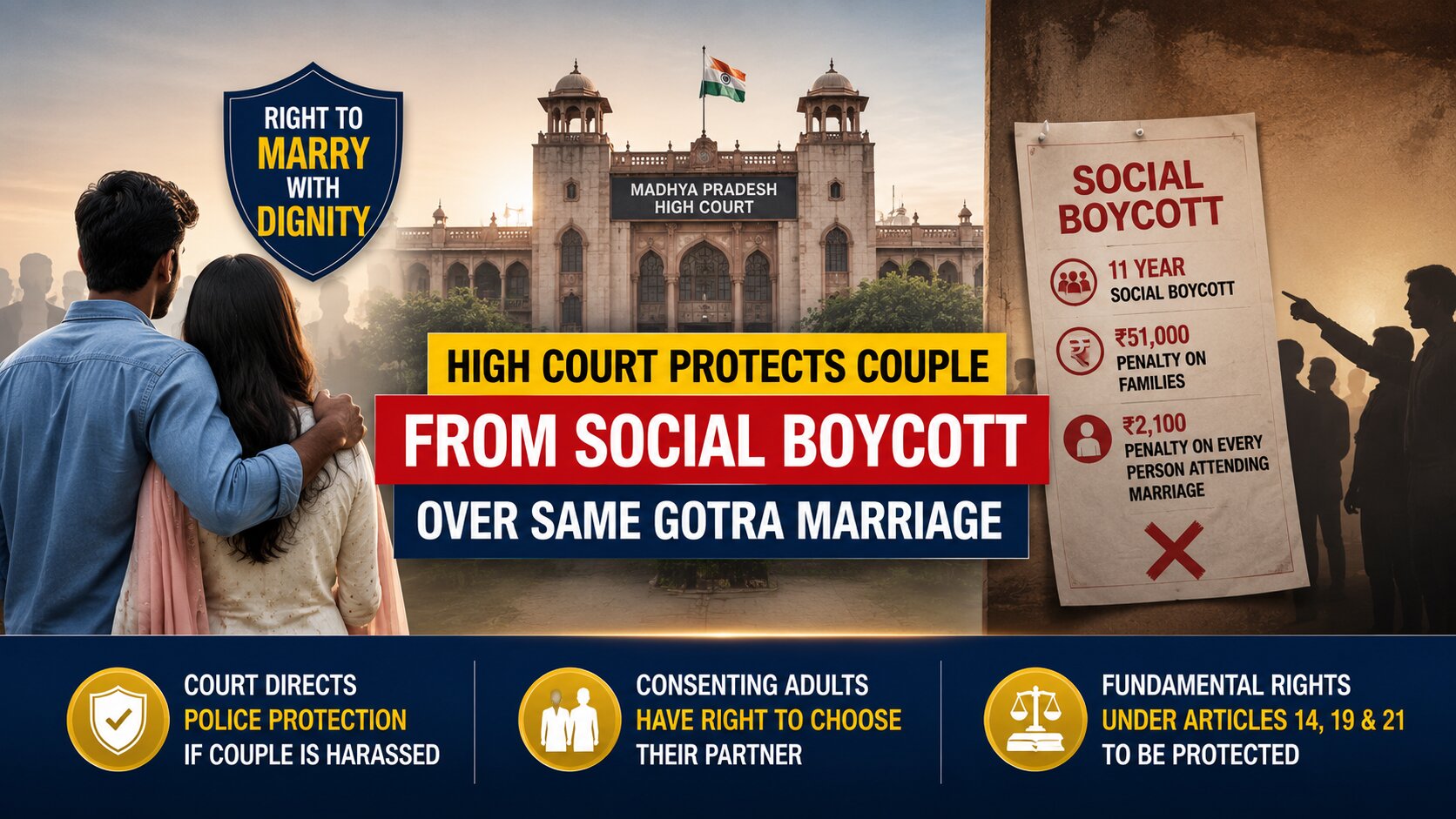
The Sangathan allegedly passed resolutions declaring an 11-year social boycott against the couple and their families.
-
The organisation also imposed a ₹51,000 penalty on the families and a ₹2,100 penalty on every guest attending the marriage.
-
The Sangathan allegedly warned members of the community that anyone attending the wedding would also face social ostracism.
-
The petitioners contended that these resolutions were passed without providing them an opportunity of hearing or examining the legal validity of their marriage.
-
The couple submitted several representations to the police seeking protection, alleging that no effective action was taken.
-
Earlier, the appellants had filed a writ petition before a Single Judge, which was dismissed on the ground that it involved disputed questions of fact.
-
Aggrieved by the dismissal, the couple preferred a writ appeal before the Division Bench seeking protection of their fundamental rights and appropriate directions against the Sangathan.
Issues
-
Whether a caste, community or social organisation can legally impose a social boycott, monetary penalties or other coercive measures upon consenting adults and their families for entering into a lawful same gotra (Sagotra) marriage?
-
Whether the failure of the State authorities to prevent such actions, allegedly violating Articles 14, 19 and 21 of the Constitution, warrants interference by the High Court under Article 226 of the Constitution of India?
-
Whether the appellants are entitled to police protection against harassment allegedly caused by the office bearers of the Sangathan?
-
Whether resolutions imposing social boycott and monetary penalties without affording an opportunity of hearing are legally sustainable?
-
Whether the dismissal of the writ petition by the Single Judge on the ground of disputed questions of fact justified interference in the writ appeal?
Judgement
-
The Division Bench issued notice to all respondents, including the State Government, Superintendent of Police, District Women Empowerment Officer and the office bearers of the Sangathan.
-
The Court directed the State Government to file its reply to the writ appeal.
-
As an interim measure, the Court directed that if the appellants were subjected to harassment and required police protection, the concerned police authorities should provide adequate protection.
-
The Court made it clear that the interim protection would continue pending consideration of the matter.
-
The matter was directed to be listed after the respondents filed their replies.
Held
-
Notice was issued to all concerned respondents.
-
The State was directed to file its response.
-
Interim police protection was granted to the appellants in the event of harassment.
-
The Court kept all substantive legal issues open for final adjudication.
-
The writ appeal remains pending for final consideration.
Analysis
-
Although the Court has not finally decided the legality of same gotra marriages or the Sangathan's actions, it recognized the necessity of protecting the appellants' personal liberty during the pendency of the proceedings.
-
The interim protection reinforces the constitutional obligation of the State to safeguard individuals whose fundamental rights are threatened by private actors.
-
The case raises significant constitutional questions concerning the extent to which private social organisations can interfere with personal choices relating to marriage.
-
The appeal also highlights the conflict between customary social practices and constitutional guarantees of equality, liberty and dignity.
-
By issuing notice and granting interim relief, the Court acknowledged that allegations of social boycott and coercive penalties merit judicial scrutiny.
-
The outcome of the case may further clarify the constitutional limits on extra-legal actions taken by community organisations against consenting adults.
-
The order aligns with the broader judicial approach that adult individuals possess the autonomy to choose their life partners free from unlawful interference.