
N. Sri Rama Prasad and Another v. Union of India, 2026
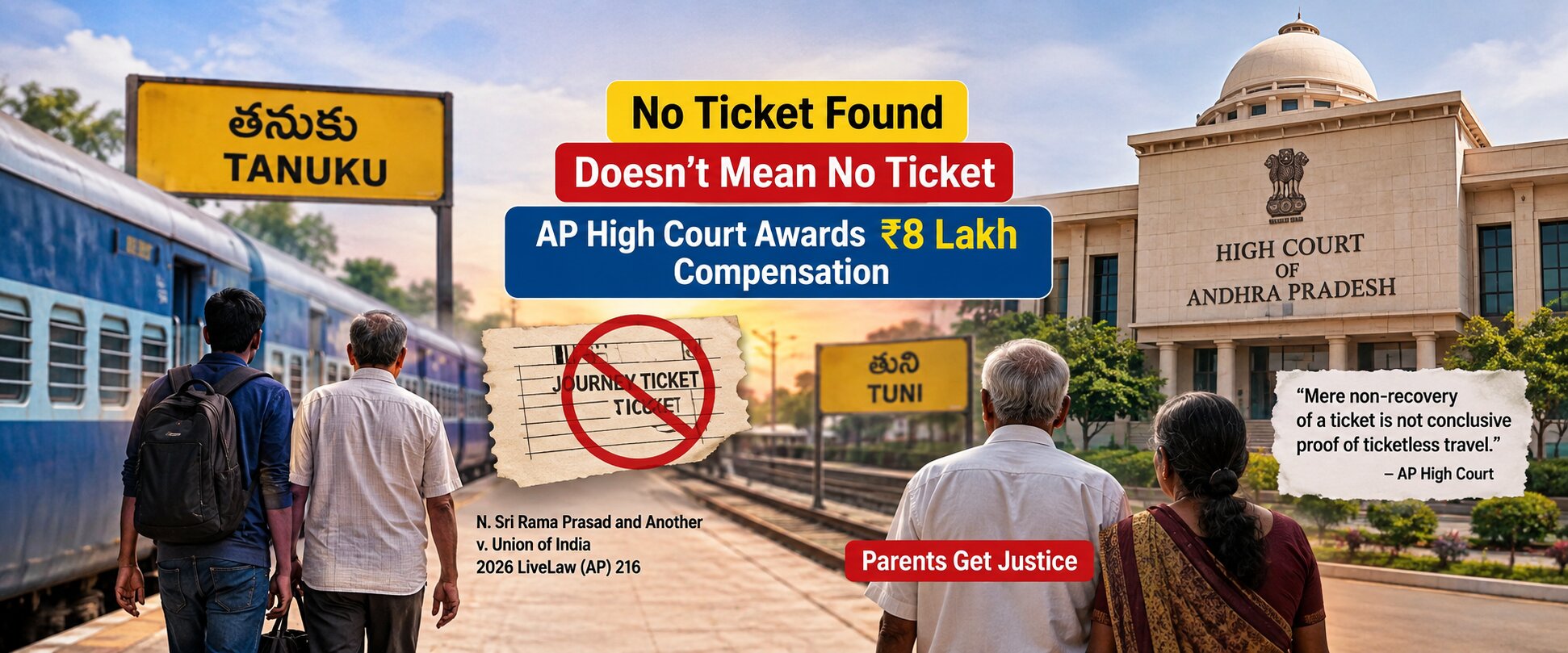
The non-recovery of a railway ticket is not, by itself, sufficient to establish that a deceased passenger was travelling without a ticket.
Judgement Details
Court
High Court of Andhra Pradesh
Date of Decision
21 September 2026
Judges
Justice Balaji Medamalli
Citation
Acts / Provisions
Facts of the Case
-
The deceased was a bachelor and an Engineering graduate who accompanied his father to Tanuku Railway Station.
-
The deceased and his father intended to travel towards Visakhapatnam for the purpose of visiting the deceased's paternal uncle at Pinninty Village, Srikakulam District.
-
The deceased's father purchased a passenger journey ticket from Tanuku to Visakhapatnam.
-
The deceased boarded the train in the presence of his father.
-
During the journey, the deceased fell from the train at Tuni Railway Station.
-
The claimants stated that there was a heavy rush of passengers and that the deceased suddenly slipped because of jerks of the moving train.
-
He fell between the train and the platform and was dragged by the train, suffering severe crush injuries to his legs and hand.
-
He was taken to a Government Central Hospital, where he was declared dead.
-
The deceased's parents subsequently approached the Railway Claims Tribunal seeking compensation under the Railways Act.
-
The Railways disputed the claim and contended that the deceased was not a bona fide passenger because no journey ticket was recovered from his belongings.
-
The Railways also alleged that the deceased had attempted to board a moving train from its off-side, causing him to fall and sustain self-inflicted injuries.
-
The Tribunal accepted that the claimants were the deceased's parents and therefore his dependants under Section 123(b).
-
However, because no journey ticket was recovered, the Tribunal concluded that the deceased was not proved to be a bona fide passenger.
-
The Tribunal consequently dismissed the compensation claim.
-
The parents challenged the Tribunal's decision before the Andhra Pradesh High Court.
-
Before the High Court, the appellants argued that the ticket could have been lost during the accident or while the deceased was being transported to hospital, particularly because several persons and agencies handled him after the accident.
-
They further contended that the deceased's other belongings were found intact during the inquest, supporting their assertion that he had possessed a journey ticket which was subsequently lost.
-
The appellants also challenged the manner and timing of the Railway's investigation, contending that the investigation report was submitted more than a year after the claim was filed despite the prescribed procedure requiring investigation within the stipulated period.
Issues
-
Whether the mere non-recovery of a journey ticket from the deceased passenger's belongings is sufficient to conclude that he was not a bona fide passenger under the Railways Act, 1989?
-
Whether the evidence regarding the purchase of the journey ticket by the deceased's father was sufficient to shift the burden to the Railways to rebut the deceased's status as a bona fide passenger?
-
Whether the deceased's fall from the train constituted an “untoward incident” attracting compensation under Section 124-A of the Railways Act, 1989?
-
Whether the Railways established that the deceased had suffered self-inflicted injuries by attempting to board a moving train?
-
Whether the failure or delay of the Railways in conducting the prescribed investigation into the incident affected the claimants' entitlement to compensation under Section 124-A of the Railways Act, 1989?
-
Whether the deceased's parents were entitled to compensation notwithstanding the absence of the journey ticket from the deceased's recovered belongings?
Judgement
-
The Andhra Pradesh High Court allowed the appeal filed by the deceased's parents.
-
The Court set aside the judgment of the Railway Claims Tribunal, which had dismissed the compensation claim.
-
The Court held that the absence of a journey ticket from the deceased's belongings, by itself, could not establish that he was travelling without a ticket.
-
The Court noted that the claimants had specifically pleaded that the deceased's father had purchased the journey ticket before the deceased boarded the train.
-
Once these facts were placed before the Court, the burden shifted to the Railways to rebut the claim that the deceased was a bona fide passenger.
-
The Court found that the Railways had not discharged that burden.
-
The Court rejected the contention that the deceased's injuries were self-inflicted merely because he allegedly attempted to board a moving train.
-
It observed that self-inflicted injury requires an element of intention and cannot automatically be established merely from an allegation of negligence.
-
The Court also considered the failure to conduct the prescribed investigation immediately after the incident.
-
The deceased's death was consequently treated as arising from an “untoward incident” within the meaning of Section 124-A.
-
The Court directed the Railways to pay ₹8 lakh as compensation.
-
The amount was directed to be apportioned equally between the deceased's two parents.
-
The Railways was directed to make the payment within two months from receipt of a copy of the order.
Held
-
Evidence that a ticket had been purchased, coupled with the surrounding circumstances, can establish the deceased's status as a bona fide passenger, even where the physical ticket is subsequently unavailable.
-
The Railways cannot place a negative burden on the claimants where the circumstances establish that a ticket had been purchased and that it may have been lost.
-
An allegation of negligence or an attempt to board a moving train does not, without more, establish a self-inflicted injury for purposes of excluding railway liability.
-
The deceased's death was treated as an untoward incident under Section 124-A of the Railways Act.
-
The deceased's parents were therefore entitled to ₹8 lakh compensation.
Analysis
-
Court's reasoning: The central reasoning of the Court was that the physical absence of a ticket cannot automatically override the surrounding evidence. A railway ticket is a physical document capable of being lost during an accident or in the subsequent handling of an injured or deceased passenger.
-
Burden of proof: The Court adopted a practical approach to the evidentiary burden. Once the claimants specifically asserted that the deceased's father had purchased the ticket and placed supporting circumstances before the Court, the Railways was required to rebut that assertion rather than simply rely upon the fact that no ticket was recovered.
-
Bona fide passenger: The judgment reinforces that determining whether a person was a bona fide passenger should not necessarily depend upon production of the physical ticket alone. The surrounding circumstances and available evidence must also be considered.
-
Self-inflicted injury: The Court distinguished between intentional self-infliction and negligent conduct. An accident resulting from negligence does not automatically become a self-inflicted injury merely because the passenger may have acted improperly.
-
Untoward incident: Once the deceased was treated as a bona fide passenger and the circumstances of the fall were accepted, the incident fell within the statutory framework governing compensation for untoward incidents under Section 124-A.
-
Railway investigation: The Court attached significance to the prescribed investigation procedure and the alleged failure to conduct the inquiry promptly. Proper investigation is particularly important in cases where evidence concerning the circumstances of an accident may disappear or become difficult to establish with the passage of time.
-
Impact on existing law: The judgment demonstrates that compensation claims under the Railways Act should not be rejected solely because the deceased passenger's ticket cannot subsequently be produced or recovered. Courts may examine the totality of circumstances surrounding the journey and accident.
-
Evidentiary significance: The decision is particularly relevant to cases involving deceased passengers, because the passenger cannot personally produce the ticket or explain how it was lost. The Court's approach therefore prevents the absence of a physical ticket from becoming an automatic and conclusive ground for rejecting a claim.
-
Compensation: By awarding ₹8 lakh to the parents, the Court ultimately provided statutory compensation after finding that the requirements for liability under Section 124-A were satisfied.