
Murti Shri Ram Chandra Ji Virajman And 6 Others v. Ashish and 19 Others, 2026
No juristic person came into existence in the form of Lord Sri Ramchandra because the idol contemplated by the gift deed was never installed or consecrated.
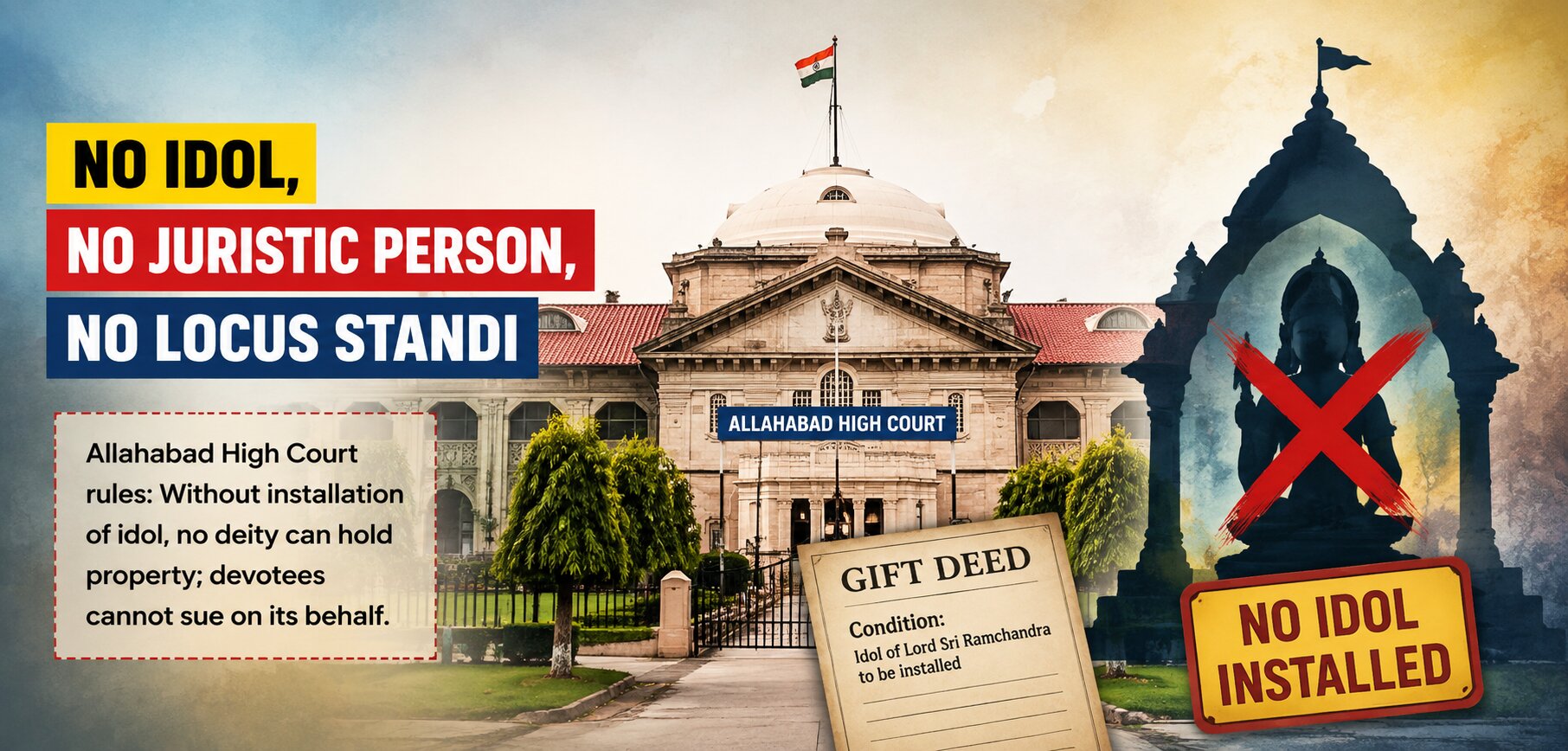
Judgement Details
Court
Allahabad High Court
Date of Decision
14 August 2026
Judges
Justice Anil Kumar
Citation
Acts / Provisions
Facts of the Case
-
Late Kedar Nath Mishra had obtained the disputed plots under a permanent lease dated 13 March 1947.
-
On 17 August 1949, Kedar Nath Mishra executed a deed of gift in favour of Late Kailash Nath Agrawal.
-
The gift deed contained a condition that an idol of Lord Sri Ramchandra would be installed on the property.
-
Kailash Nath Agrawal was described as the Manager of the proposed religious arrangement.
-
The deed also contained restrictions concerning the use of income from the property and the alteration or transfer of its title.
-
According to the plaintiffs, the legal heirs of Kailash Nath Agrawal subsequently partitioned the property and sold portions of it, allegedly contrary to the conditions contained in the gift deed.
-
The plaintiffs described themselves as Hindus by birth and devotees of Lord Rama.
-
They claimed to institute the proceedings as next friends of the alleged idol/deity of Lord Sri Ramchandra.
-
The plaintiffs sought a declaration that the defendants had lost their right to continue as Managers of the property.
-
They also sought a permanent injunction restraining the defendants from transferring or alienating the property.
-
They further sought a mandatory injunction directing the administrative authorities to take over management of the property.
-
The defendants admitted the existence of the 1949 gift deed and the condition concerning installation of the idol.
-
The defendants, however, maintained that no temple had ever been constructed and no idol had ever been installed or consecrated on the property.
-
The defendants contended that the condition relating to the proposed idol was legally ineffective and that they had openly remained in possession of and dealt with the property as owners for several decades.
-
The defendants also challenged the plaintiffs' locus standi, arguing that the plaintiffs could not represent a deity that had never acquired juristic personality.
-
An application under Order VII Rule 11 CPC was initially allowed and the plaint was rejected in 2017.
-
The rejection was subsequently set aside in appeal.
-
In the earlier first appeal, the High Court had held, at the preliminary stage, that the 1949 deed created a valid endowment in favour of Lord Sri Ramchandra and that Section 92 CPC was not attracted because the alleged endowment was private.
-
After further proceedings, the Trial Court found that the deed was essentially a personal gift and did not result in a completed religious endowment.
-
The Trial Court found that no temple had been constructed and no idol had been installed.
-
It also found that the defendants and their predecessors remained in possession and were reflected in the revenue records.
-
The Trial Court held that the restraint on alienation was void under Sections 10 and 126 of the Transfer of Property Act, although the gift itself was not thereby completely invalidated.
-
Despite deciding the substantive issues against the plaintiffs, the Trial Court held that the plaintiffs had locus standi.
-
The appellate court affirmed the substantive findings and additionally held that the suit suffered from non-joinder of necessary parties, because the administrative authorities against whom relief was sought had not been impleaded.
-
The matter thereafter reached the High Court in second appeal.
Issues
-
Whether any of the questions raised by the appellants constituted a substantial question of law within the meaning of Section 100 of the Code of Civil Procedure, 1908?
-
Whether the deed dated 17 August 1949 created a valid religious endowment in favour of Lord Sri Ramchandra despite the fact that no idol was ever installed or consecrated?
-
Whether, in the absence of installation or consecration of the idol, a juristic person came into existence in whom the disputed property could vest?
-
Whether the plaintiffs had locus standi to institute the suit as next friends of the alleged deity merely because they professed faith and devotion towards Lord Rama?
-
Whether the earlier judgment of the High Court passed while considering the application under Order VII Rule 11 CPC finally established the existence of a juristic deity or conferred substantive locus standi upon the plaintiffs?
-
Whether the plaintiffs were entitled to seek a mandatory injunction directing administrative authorities to take over management of the property when those authorities had not been impleaded as parties?
-
Whether the concurrent findings of the Trial Court and the first appellate court could be interfered with in the second appeal in the absence of a substantial question of law?
Judgement
-
The Allahabad High Court dismissed the second appeal filed by the appellants.
-
The Court first examined the questions proposed by the appellants under Section 100 CPC.
-
It held that none of the fourteen questions proposed by the appellants constituted a substantial question of law.
-
Relying upon the Supreme Court decision in Sri Chunilal V. Mehta and Sons Ltd. v. The Century Spinning and Manufacturing Company Ltd., the Court reiterated that a substantial question of law must be a genuine and debatable legal question that materially affects the rights of the parties.
-
The Court found that the questions raised by the appellants substantially concerned appreciation of evidence and findings of fact.
-
The Court therefore declined to interfere with the concurrent factual findings of the courts below.
-
On the question of religious endowment, the Court observed that the gift deed contemplated installation of the idol at a future point of time.
-
The plaintiffs themselves had admitted that no idol of Lord Sri Ramchandra was ever installed or consecrated on the disputed property.
-
The Court also noted that no temple had been constructed, no priest had been appointed, and no arrangements had been made for worship or administration of a religious institution.
-
These circumstances demonstrated that the proposed religious institution had never actually come into existence.
-
The Court therefore held that no juristic person came into existence in whom the property could vest.
-
The Court further observed that the continued possession of the property by the donee and his successors supported the conclusion that the donor had not intended to create a completed religious endowment.
-
The Court treated the transaction, on the facts proved, as essentially a private gift rather than a completed religious endowment.
-
Since no juristic deity existed, the plaintiffs could not institute proceedings on behalf of that deity.
-
The Court rejected the contention that the plaintiffs' devotion to Lord Rama itself gave them a legal right to challenge the defendants' ownership or management.
-
The Court observed that the plaintiffs had claimed no independent right of worship in the disputed property.
-
Their claim was based essentially upon their religious faith and their alleged status as next friends of the deity.
-
The Court held that such devotion, without an independent enforceable civil right, did not confer locus standi.
-
The Court also considered the earlier first-appellate judgment and held that it could not be treated as a final determination of the legal status of the alleged deity.
-
The earlier decision had arisen while considering an Order VII Rule 11 CPC application.
-
At that stage, the Court was concerned with whether the plaint disclosed a cause of action and was required to consider the pleadings at the threshold.
-
The earlier observations therefore did not finally determine the factual validity of the alleged endowment.
-
The Court further accepted the appellate court's finding regarding non-joinder of necessary parties.
-
Since the plaintiffs sought a mandatory direction against administrative authorities, those authorities ought to have been before the Court.
-
A mandatory injunction operates in personam and cannot appropriately be issued against a person or authority that has not been impleaded and heard.
-
The Court consequently found no legal basis for interfering with the judgments of the courts below.
-
The second appeal was accordingly dismissed.
Held
-
The 1949 deed did not result in a completed religious endowment on the facts established before the Court.
-
The plaintiffs had no locus standi to sue on behalf of the alleged deity because the deity had never acquired juristic personality in relation to the disputed property.
-
Mere devotion or religious faith towards Lord Rama did not give the plaintiffs an enforceable civil right to challenge the defendants' title or possession.
-
The earlier Order VII Rule 11 CPC judgment did not finally confer substantive rights or locus standi upon the plaintiffs.
-
The plaintiffs could not obtain a mandatory injunction against administrative authorities that were not impleaded as parties.
-
No substantial question of law arose under Section 100 CPC.
-
The High Court therefore dismissed the second appeal.
Analysis
-
The Court's reasoning is based on the distinction between a mere intention to create a religious endowment and the actual creation of a legally operative religious endowment.
-
The gift deed contemplated the future installation of an idol, but the contemplated event never occurred because no idol was ever installed or consecrated.
-
The absence of an idol was accompanied by the absence of a temple, priest, worship arrangements and an administrative structure for a religious institution.
-
These circumstances collectively supported the Court's conclusion that the alleged religious endowment was never actually brought into existence.
-
The Court therefore concluded that no juristic person came into existence in whom the property could vest.
-
The continued possession of the property by the donee and his successors was relevant in determining the true nature of the transaction.
-
The long-standing conduct of the parties supported the conclusion that the property continued to be treated as private property rather than property belonging to a religious endowment.
-
The Court's approach shows that the legal character of an alleged religious endowment cannot necessarily be determined solely by reading one condition contained in a deed; the surrounding circumstances and subsequent conduct may also be relevant.
-
The judgment reinforces the principle that religious devotion does not automatically create locus standi.
-
A person may be a genuine devotee of a deity but may nevertheless lack an enforceable civil right to challenge the title or possession of private property.
-
The plaintiffs' attempt to sue as next friends depended upon the existence of a legally recognized deity capable of being represented.
-
Once the Court concluded that no such juristic person had come into existence, the foundation for the plaintiffs' representative capacity disappeared.
-
The judgment also demonstrates the difference between proceedings under Order VII Rule 11 CPC and a final adjudication after evidence has been considered.
-
The earlier decision was rendered at the threshold stage and could not be treated as a final determination of disputed factual matters.
-
The Court therefore correctly distinguished the earlier observations from the subsequent findings based upon the evidence recorded during trial.
-
The decision illustrates the restricted scope of a second appeal under Section 100 CPC.
-
A party cannot ordinarily convert a second appeal into a third factual review merely by describing questions of fact as questions of law.
-
The Court applied the principle that a substantial question of law must be a genuine legal question that materially affects the rights of the parties.
-
The reliance upon Sri Chunilal V. Mehta and Sons Ltd. v. The Century Spinning and Manufacturing Company Ltd. reinforces the established test for determining whether a question qualifies as a substantial question of law.
-
The Court's treatment of the concurrent findings demonstrates judicial restraint in second appellate jurisdiction.
-
The judgment also highlights the importance of necessary parties where mandatory relief is sought.
-
Since the plaintiffs wanted administrative authorities to take over management of the property, those authorities were required to be before the Court so that an effective and binding order could be made against them.
-
The Court's observation that a mandatory injunction operates in personam reflects the basic procedural requirement of giving an affected party an opportunity to be heard.
-
The judgment further distinguishes religious belief from legal entitlement.
-
The plaintiffs' faith in Lord Rama was not disputed as a matter of religion, but the Court was concerned with whether that faith created a legally enforceable right concerning the disputed property.
-
The Court concluded that it did not.
-
The decision does not necessarily mean that installation of an idol is the sole possible legal test for every Hindu religious endowment; rather, the Court's conclusion was based upon the particular terms of the deed and the complete absence of the religious institution contemplated by that deed.
-
The judgment is significant because it prevents a proposed religious dedication from being treated as an operative juristic entity where the factual circumstances establish that the proposed religious institution was never actually brought into existence.
-
Overall, the Court held that no juristic deity existed, no property had vested in such deity, the plaintiffs had no independent enforceable interest, and no substantial question of law justified interference in second appeal.