
Mumtaz Mehraj and Another v. UT of J&K and Others, 2026
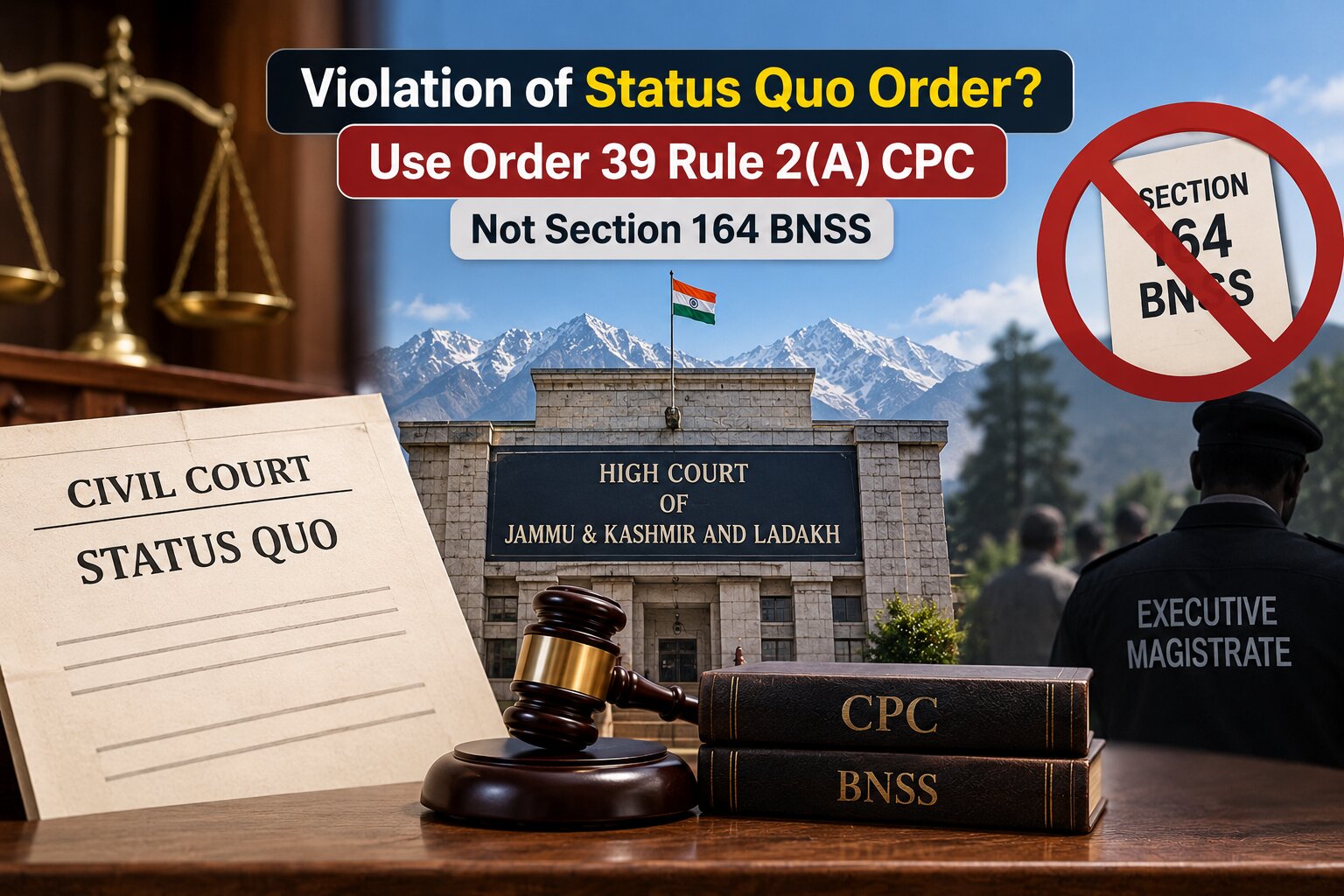
Violation of a Civil Court's status quo or injunction order is to be addressed under Order XXXIX Rule 2-A CPC.
Judgement Details
Court
High Court of Jammu & Kashmir and Ladakh
Date of Decision
18 September 2026
Judges
Chief Justice Sanjeev Kumar and Justice Mohd Yousuf Wani
Citation
Acts / Provisions
Facts of the Case
-
Respondent Nos. 6 and 7 instituted a civil suit for possession and injunction before the competent Civil Court concerning property situated at Harwan, Srinagar.
-
The pleadings in that suit indicated that respondent Nos. 6 and 7 were not in possession of the disputed property when the suit was instituted.
-
The prayer in the civil suit sought recovery of possession and mandatory relief against the defendants.
-
The Civil Court passed an interim order dated 29 October 2025, directing appellant No. 1 to maintain status quo concerning the suit property.
-
The appellants subsequently alleged that respondent No. 7 had violated the Civil Court's interim order.
-
It was alleged that during the intervening night of 7 and 8 January 2026, respondent Nos. 6 and 7, allegedly accompanied by other persons and using force, entered the disputed property with an intention to take possession from appellant No. 1.
-
An FIR was subsequently registered at Police Station Harwan under Sections 331(4), 305 and 324(4) BNS against respondent Nos. 6 and 7.
-
The SHO of Police Station Harwan took possession of the disputed property and kept it under lock and key.
-
The SHO thereafter requested the Executive Magistrate 1st Class, Harwan to initiate proceedings under Section 164 BNSS.
-
The Executive Magistrate initiated proceedings and ordered temporary attachment and sealing of the property.
-
Those proceedings eventually resulted in an order directing restoration of possession in favour of appellant No. 1.
-
The Executive Magistrate recorded a finding that appellant No. 1 had remained in actual, peaceful, settled and continuous possession of the property since 2007.
-
Respondent Nos. 6 and 7 challenged the Executive Magistrate's proceedings before the High Court through a writ petition.
-
The Single Judge held that the proceedings initiated by the Executive Magistrate at the instance of the SHO were illegal and not in accordance with Section 164 BNSS.
-
However, the Writ Court directed that the disputed property be placed under attachment with the Nazir of the Court of the Principal District Judge, Srinagar.
-
Aggrieved by that direction, the appellants preferred the present Letters Patent Appeal.
-
The Division Bench examined the civil suit, the interim status quo order and the subsequent executive proceedings to determine the proper legal remedy for the alleged violation of the Civil Court's order.
Issues
-
Whether an alleged violation of a Civil Court's status quo order should be dealt with under Order XXXIX Rule 2-A CPC rather than through proceedings under Section 164 BNSS?
-
Whether the Executive Magistrate could initiate proceedings under Section 164 BNSS when possession of the disputed property was already protected by an operative interim order of the Civil Court?
-
Whether the pleadings and prayer in the civil suit established that appellant No. 1 was in possession of the disputed property when the suit was instituted?
-
Whether the subsequent alleged attempt to disturb the appellant's possession constituted disobedience of the Civil Court's status quo order rather than a circumstance warranting proceedings under Section 164 BNSS?
-
Whether the Writ Court was justified in directing that the disputed property be placed under attachment with the Nazir of the Principal District Judge, Srinagar?
-
Whether the proceedings initiated by the Executive Magistrate at the instance of the SHO were legally sustainable in view of the existing Civil Court order protecting possession?
Judgement
-
The Division Bench allowed the Letters Patent Appeal.
-
The Court agreed with the Writ Court that the proceedings initiated by the Executive Magistrate at the instance of the SHO were illegal and uncalled for.
-
The Court held that the Civil Court had already passed an unequivocal order directing appellant No. 1 to maintain status quo regarding the disputed property.
-
The Court found that the pleadings in the civil suit itself showed that respondent Nos. 6 and 7 were out of possession when they instituted the suit.
-
The prayer seeking recovery of possession further demonstrated that appellant No. 1 was treated as being in possession.
-
The Court held that the status quo order therefore operated to protect the existing possession.
-
Any subsequent attempt to violate that order constituted disobedience of the Civil Court's order.
-
Such disobedience was required to be addressed through Order XXXIX Rule 2-A CPC, rather than by initiating proceedings under Section 164 BNSS.
-
The Court held that there was consequently no occasion to invoke Section 164 BNSS in the circumstances of the case.
-
The Bench, however, disagreed with the Writ Court's direction to place the property under attachment with the Nazir of the Principal District Judge, Srinagar.
-
The High Court therefore quashed and set aside that portion of the Writ Court's order.
-
The Trial Court was directed to expedite consideration of the main civil suit as well as the application for interim relief.
-
The Division Bench clarified that its observations should not prejudice either party before the Trial Court.
-
The appeal was accordingly allowed to the extent indicated by the Court.
Held
-
Section 164 BNSS should not be invoked merely because a party allegedly attempts to disturb possession that is already protected by an operative Civil Court order.
-
Where the Civil Court has prima facie recognised and protected a particular party's possession, subsequent interference with that possession may amount to disobedience of the Civil Court's order.
-
The existence of a Civil Court's effective status quo order is significant when determining whether executive-magistrate proceedings concerning possession are warranted.
-
The pleadings in the underlying civil suit may be examined to determine the parties' position concerning possession.
-
In the present case, the plaintiffs' own suit seeking recovery of possession indicated that they were out of possession and that appellant No. 1 was in possession.
-
The Executive Magistrate's proceedings under Section 164 BNSS were therefore not warranted in the circumstances.
-
The Writ Court correctly found the Executive Magistrate's proceedings illegal but erred in directing attachment of the property with the Nazir.
-
The Trial Court was directed to proceed expeditiously with the civil proceedings.
Analysis
-
Civil remedy versus executive proceedings: The principal legal distinction drawn by the Court is between enforcement of a Civil Court's own interim order and preventive proceedings before an Executive Magistrate. Once possession is already regulated by a Civil Court's status quo order, alleged disobedience of that order is ordinarily addressed within the civil proceedings.
-
Order XXXIX Rule 2-A CPC: The provision provides a specific mechanism for dealing with disobedience or breach of an injunction. The Court considered this mechanism appropriate where a party allegedly violates a status quo order passed by the Civil Court.
-
Role of Section 164 BNSS: The judgment indicates that Section 164 BNSS cannot simply be used as an alternative mechanism to resolve or regulate possession where the same subject matter is already governed by an operative Civil Court order.
-
Importance of existing possession: The Court examined the pleadings in the original suit and found them significant. The plaintiffs' request for a decree of possession itself indicated that they were claiming recovery of property from a person whom they treated as being in possession.
-
Status quo order: The Court attached importance to the wording of the order dated 29 October 2025. It did not direct both sides generally to maintain status quo; rather, appellant No. 1 was specifically directed to maintain status quo in relation to the property. The Court treated this as protection of the existing possession.
-
Executive Magistrate's jurisdiction: The judgment demonstrates that executive jurisdiction concerning possession cannot be exercised without regard to an existing Civil Court order governing the same property and possession.
-
Attachment by Nazir: Although the Writ Court correctly found the Section 164 proceedings unsustainable, the Division Bench found that its additional direction to place the property under attachment with the Nazir was not justified. The Court therefore removed that direction.
-
Underlying civil dispute remains open: The High Court deliberately avoided deciding the ultimate rights of the parties over the property. Its observations were confined to the legality of the executive proceedings and the proper procedural route for dealing with alleged violation of the status quo order.
-
Practical significance: The decision is important in property disputes where parties simultaneously invoke civil remedies and executive-magistrate proceedings. It indicates that parties should not bypass the mechanism provided by the Civil Court for enforcing its own injunction or status quo order.
-
Procedural discipline: The ruling reinforces the principle that when a specific statutory or procedural mechanism exists for dealing with an alleged breach of a judicial order, that mechanism should be followed rather than invoking a separate executive process concerning the same subject matter.