
Mumbai Port Authority v. National Commission for Scheduled Caste & Ors., 2026
The NCSC is a recommendatory and advisory constitutional body, not an adjudicatory tribunal.
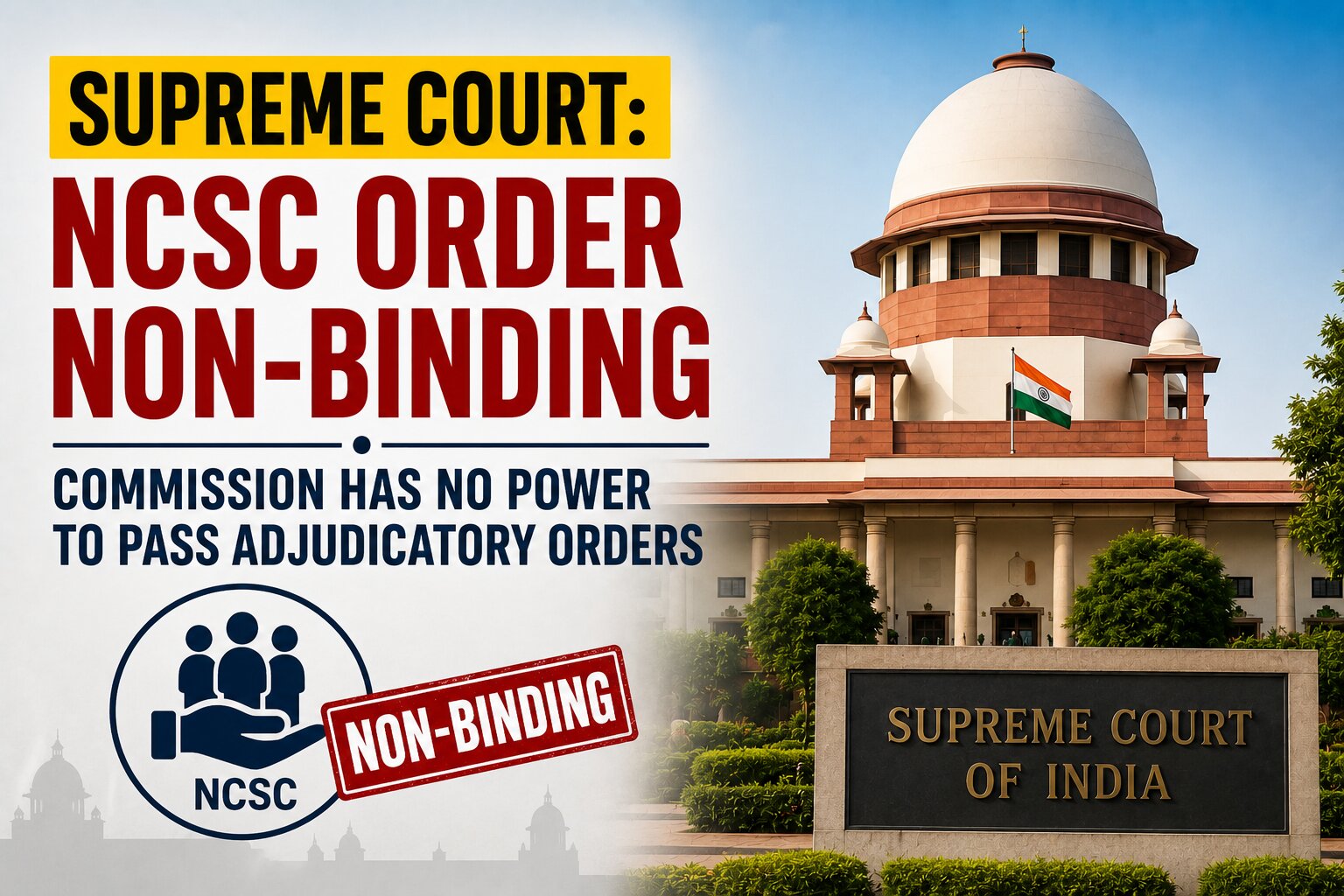
Judgement Details
Court
Supreme Court of India
Date of Decision
4 August 2026
Judges
Justice Sanjay Karol and Justice Augustine George Masih
Citation
Acts / Provisions
Facts of the Case
-
The dispute arose from a service-related matter involving a Scheduled Caste employee of the Mumbai Port Authority.
-
Respondent No. 3, a Scheduled Caste employee, had been promoted under a 2002 Office Memorandum (OM).
-
The 2002 OM superseded the earlier 1997 OM concerning seniority.
-
In 2016, the Bombay High Court quashed the 2002 OM.
-
Following the High Court's decision, the Mumbai Port Authority revised the employee's seniority in accordance with the 1997 OM.
-
As a consequence, the employee was demoted in 2020.
-
Aggrieved by the action, she approached the National Commission for Scheduled Castes (NCSC).
-
In 2024, the NCSC passed directions requiring her reinstatement and payment of arrears.
-
The Mumbai Port Authority challenged the NCSC's order before the Bombay High Court.
-
The Bombay High Court dismissed the challenge and upheld the NCSC's order.
-
The Mumbai Port Authority thereafter approached the Supreme Court.
-
The principal question before the Supreme Court was whether the NCSC possessed adjudicatory authority to issue binding directions concerning a service dispute and order payment of arrears.
-
The Supreme Court examined the constitutional powers conferred upon the NCSC under Article 338.
-
The Court relied upon the earlier Supreme Court decision in All India Indian Overseas Bank SC and ST Employees' Welfare Association v. Union of India, (1996) 6 SCC 606.
-
The Court found that the NCSC has power to investigate and inquire into deprivation of rights and safeguards of Scheduled Castes.
-
However, the Court held that these powers do not extend to passing binding adjudicatory orders determining service disputes.
-
The Supreme Court therefore set aside the Bombay High Court's judgment and declared the NCSC's direction concerning payment of arrears non-est in law.
Issues
-
Whether the National Commission for Scheduled Castes has adjudicatory jurisdiction to determine service-related disputes involving Scheduled Caste employees?
-
Whether the powers conferred upon the NCSC under Article 338 of the Constitution permit it to issue binding directions for reinstatement and payment of arrears?
-
Whether the NCSC's power to investigate and inquire into deprivation of constitutional safeguards includes the power to pass an enforceable adjudicatory order?
-
Whether the NCSC's directions concerning payment of arrears in a service dispute were constitutionally valid and legally binding upon the Mumbai Port Authority?
-
Whether the Bombay High Court was justified in upholding the NCSC's order despite the limited recommendatory and advisory nature of its constitutional powers?
Judgement
-
The Supreme Court allowed the appeal filed by the Mumbai Port Authority.
-
The Court set aside the Bombay High Court's judgment upholding the NCSC's directions.
-
The Court held that the NCSC is a constitutional body with a socially beneficent purpose, but its constitutional role is principally recommendatory and advisory.
-
The Court emphasized that the NCSC is not an adjudicatory tribunal and cannot assume the functions of a court or other adjudicatory authority.
-
The Court held that Article 338 empowers the NCSC to investigate and inquire into matters concerning the safeguards and rights of Scheduled Castes.
-
The NCSC may requisition documents and receive evidence during such investigation or inquiry.
-
However, the power to collect evidence does not automatically confer power to issue a binding adjudicatory order on the basis of that evidence.
-
The NCSC may record factual findings and make recommendations to the appropriate Government or authority.
-
It cannot itself finally adjudicate the service dispute or compel payment of arrears through an enforceable order.
-
The Court relied upon All India Indian Overseas Bank SC and ST Employees' Welfare Association v. Union of India, which had previously explained the limited nature of the Commission's powers.
-
The Court rejected the argument that the term “safeguards” in Article 338 gives the NCSC an enforcement or adjudicatory jurisdiction.
-
The Court held that the NCSC's directions concerning payment of arrears were contrary to the Constitution and non-est in law.
-
The Supreme Court consequently allowed the appeal.
Held
-
Article 338 empowers the NCSC to investigate and inquire into deprivation of rights and constitutional safeguards of Scheduled Castes.
-
The Commission may requisition documents, receive evidence and record factual findings.
-
The Commission may make recommendations to the concerned Government or authority based upon its findings.
-
However, the NCSC cannot pass binding adjudicatory orders determining service disputes.
-
The power to investigate and inquire does not include the power to enforce a particular service-related remedy.
-
The NCSC therefore lacked jurisdiction to direct the Mumbai Port Authority to reinstate the employee and pay arrears as an adjudicatory command.
-
The NCSC's direction concerning payment of arrears was declared contrary to the Constitution and non-est in law.
-
The Bombay High Court's decision upholding the NCSC order was set aside.
-
The appeal filed by the Mumbai Port Authority was allowed.
Analysis
-
Core constitutional distinction: The judgment draws a clear line between an institution having investigative powers and one having adjudicatory powers. The NCSC can investigate violations but cannot function as a court.
-
Article 338 has defined limits: The Commission's constitutional authority must remain within the functions expressly contemplated by Article 338. The Court refused to expand those powers into an adjudicatory jurisdiction.
-
Investigative power is not adjudicatory power: The ability to summon documents, receive evidence and investigate a complaint does not mean that the Commission can issue a binding order determining the legal rights of parties.
-
Recommendatory role: After conducting an inquiry, the NCSC may record factual findings and recommend appropriate action to the concerned Government or authority. The final decision remains with the legally competent authority.
-
Service disputes: The judgment is particularly significant for government and public-sector employment disputes involving Scheduled Caste employees. The NCSC cannot replace the statutory or constitutional mechanism ordinarily competent to determine such service disputes.
-
Protection of Scheduled Caste safeguards remains important: The decision does not diminish the constitutional purpose of the NCSC. The Court expressly recognized the Commission as a socially beneficent constitutional body.
-
But constitutional purpose does not expand jurisdiction: A beneficial constitutional objective cannot, by itself, confer powers that the Constitution has not granted. The Commission must exercise its important protective role within its prescribed legal limits.
-
No tribunal-like function: The Court made clear that the NCSC is not intended to take over the adjudicatory functions of courts, tribunals or competent administrative authorities.
-
Factual findings versus binding orders: The Commission may determine facts during an inquiry and communicate its findings, but it cannot convert those findings directly into an enforceable command for payment of money or alteration of service rights.
-
Relevance of precedent: The Supreme Court relied upon its earlier decision in All India Indian Overseas Bank SC and ST Employees' Welfare Association v. Union of India, reinforcing continuity in the interpretation of Article 338.
-
Meaning of “safeguards”: The Court rejected an expansive interpretation under which the word “safeguards” would itself confer enforcement powers. The constitutional text authorizes inquiry into deprivation of rights and safeguards but does not make the Commission an adjudicatory authority.
-
Judicial review: The judgment reinforces that an administrative or constitutional commission cannot assume powers belonging to courts merely because the subject matter concerns constitutional or statutory rights.
-
Impact on public authorities: Government departments and public authorities remain required to respect the NCSC's investigative and recommendatory functions, but a Commission recommendation cannot automatically be treated as an adjudicatory decree.
-
Impact on employees: Employees belonging to Scheduled Castes can continue to approach the NCSC regarding deprivation of safeguards and rights. However, where the dispute requires a binding determination of service rights, the appropriate statutory or judicial forum must be approached.
-
Separation of institutional functions: The judgment preserves the distinction between investigation, recommendation and adjudication, preventing overlap between constitutional commissions and courts or tribunals.
-
Overall significance: The ruling is important for understanding the constitutional status of the NCSC and establishes that its significant protective role does not transform it into a court capable of passing binding orders in service disputes.