
Mukesh Popatlal Gada v. State of Maharashtra, 2026
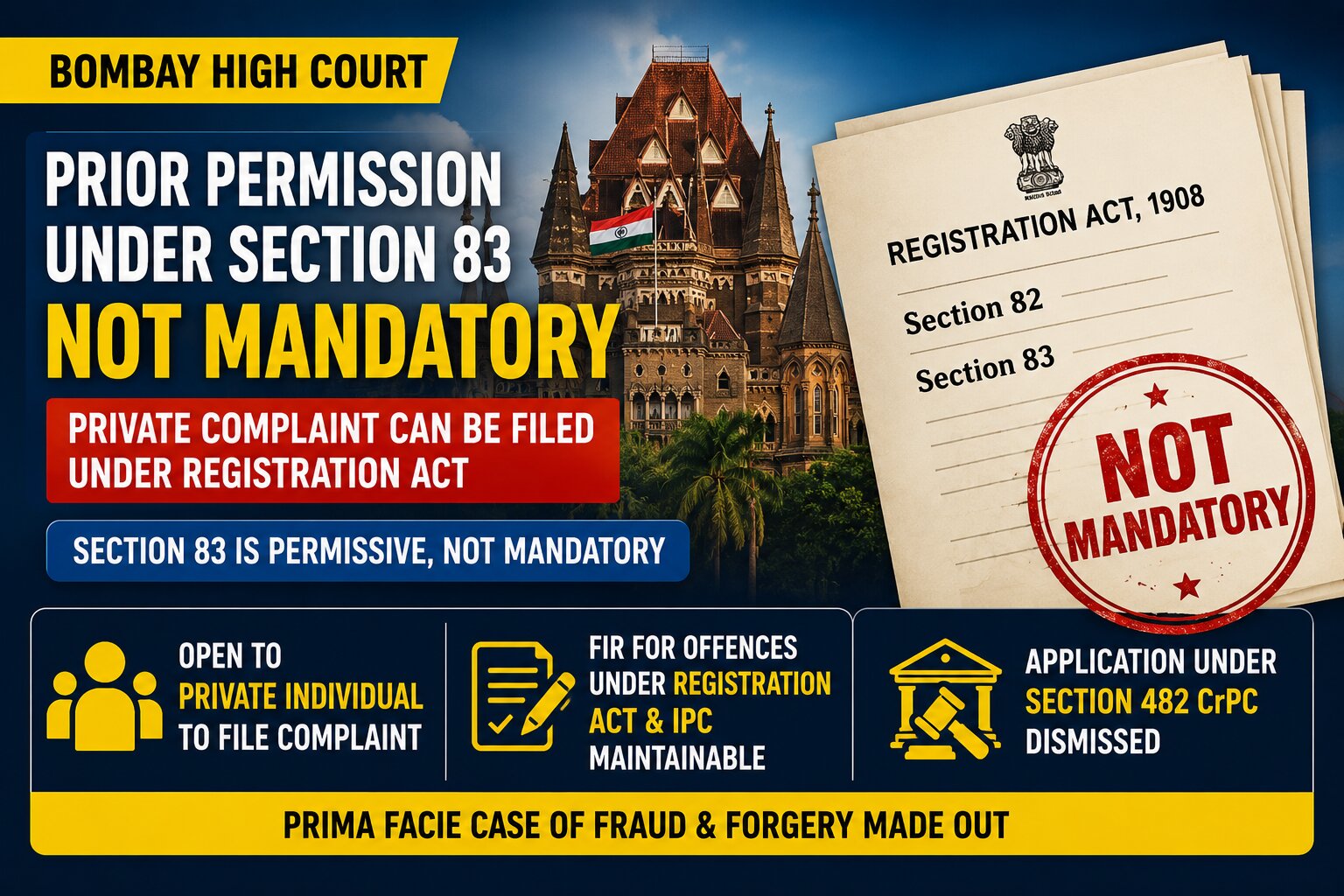
Prior permission under Section 83 of the Registration Act, 1908 is not mandatory for initiating prosecution under the Act.
Judgement Details
Court
Bombay High Court
Date of Decision
20 August 2026
Judges
Justice Ranjitsinha Raja Bhonsale
Citation
Acts / Provisions
Facts of the Case
-
The proceedings arose from an FIR registered for an alleged offence under Section 82 of the Registration Act, 1908.
-
Sections 420, 467, 468 and 471 IPC were subsequently added to the FIR.
-
The FIR was registered on the complaint of the Sub-Registrar following a complaint lodged by the President of Anupama Co-operative Housing Society.
-
The allegations concerned the use of a Power of Attorney dated 23 September 1980 in connection with the registration of land transactions.
-
It was alleged that the Power of Attorney relied upon for registration of the land had not itself been registered.
-
Questions were also raised concerning whether the person who had executed the Power of Attorney was alive or dead at the relevant time.
-
The applicants challenged the criminal proceedings before the Bombay High Court by invoking its inherent jurisdiction under Section 482 CrPC.
-
The applicants argued that the allegations did not satisfy the ingredients of an offence under Section 82 of the Registration Act.
-
They further contended that the prosecution could not have been initiated without obtaining prior permission under Section 83 of the Registration Act.
-
The Court examined the language and scheme of Sections 82 and 83 to determine whether such prior permission was mandatory.
-
The Court also examined the Power of Attorney alongside the subsequent sale deeds.
-
It noticed that the Power of Attorney appeared to have been used in relation to land bearing different survey numbers from those referred to in the document.
-
The Court further noted that the survey numbers appearing in the Power of Attorney were allotted only in 2004, despite the Power of Attorney being dated 1980.
-
The Court also noted that Balram Jaisinghani, the person connected with the Power of Attorney, had died in 1989, whereas the document was allegedly used for executing sale deeds in 2010.
-
On these circumstances, the Court found a prima facie case of fraud and forgery.
Issues
-
Whether prior permission under Section 83 of the Registration Act, 1908 is mandatory before criminal proceedings can be initiated for an offence under the Act?
-
Whether the use of the word “may” in Section 83 of the Registration Act makes the provision permissive rather than mandatory?
-
Whether a private individual can initiate a complaint concerning an offence under the Registration Act without obtaining prior permission under Section 83?
-
Whether the allegations concerning the Power of Attorney dated 23 September 1980 disclose a prima facie offence under Section 82 of the Registration Act?
-
Whether the alleged use of the Power of Attorney in relation to different survey numbers and after the death of its executant establishes a prima facie case of forgery and fraud?
-
Whether prior notice to the accused is mandatory before registration of an FIR for an offence under the Registration Act?
-
Whether the materials on record disclose prima facie offences under Sections 420, 467, 468 and 471 of the Indian Penal Code?
-
Whether the applicants had made out a case for exercise of the High Court's inherent jurisdiction under Section 482 CrPC to quash the FIR and criminal proceedings?
Judgement
-
The Bombay High Court dismissed the application filed under Section 482 CrPC.
-
The Court held that prior permission under Section 83 of the Registration Act is not mandatory for initiating prosecution.
-
The Court interpreted the use of the word “may” in Section 83 as demonstrating that the provision is permissive rather than mandatory.
-
The Court held that the statutory scheme permits prosecution to be initiated when the registering officer obtains knowledge of an offence in his official capacity, but Section 83 does not create an exclusive requirement that prosecution can be instituted only with prior permission.
-
The Court relied upon the decision in Dharmadeo Rai v. Ramnagina Rai in reaching this conclusion.
-
The Court further held that a private individual is also entitled to file a complaint concerning an offence under the Registration Act.
-
On the facts, the Court found that the Power of Attorney dated 23 September 1980 appeared to have been misused many years after the death of Balram Jaisinghani.
-
The Court compared the Power of Attorney with the subsequent sale deeds and found that the documents referred to different survey numbers.
-
The Court noted that the survey numbers mentioned in the 1980 Power of Attorney were allotted only in 2004, creating a serious prima facie indication of forgery.
-
The Court also noted that the Power of Attorney was allegedly used for executing sale deeds in 2010, despite the death of Balram Jaisinghani in 1989.
-
These circumstances, according to the Court, established a prima facie case of fraud and forgery.
-
The Court found that the allegations disclosed a prima facie case under Section 82 of the Registration Act as well as Sections 420 and other relevant provisions of the IPC.
-
The Court rejected the argument that a prior notice was required before registration of the FIR.
-
The Court observed that such a notice is not contemplated as a mandatory requirement under the Registration Act in every case.
-
Since a prima facie case was disclosed against the applicants, the Court found no justification for exercising its inherent jurisdiction under Section 482 CrPC.
-
The application was therefore dismissed.
Held
-
The word “may” used in Section 83 indicates that the provision is permissive and not mandatory.
-
A private individual may file a complaint regarding an offence under the Registration Act.
-
The alleged use of a 1980 Power of Attorney containing survey numbers that were allotted only in 2004 constituted a strong prima facie circumstance indicating forgery.
-
The use of the Power of Attorney after the alleged death of its executant and its use for subsequent sale deeds also supported a prima facie case of fraud and forgery.
-
The Registration Act does not require prior notice before registration of an FIR in every case.
-
Since the allegations disclosed prima facie offences under the Registration Act and IPC, the applicants were not entitled to relief under Section 482 CrPC.
-
The criminal application was accordingly dismissed.
Analysis
-
Interpretation of Section 83: The principal legal issue concerned whether Section 83 creates a mandatory procedural condition precedent for prosecution. The Court rejected that interpretation and treated the provision as enabling rather than restrictive.
-
Meaning of “may”: The Court placed significance on the legislative use of the word “may”, holding that it indicates discretion and does not impose an absolute obligation to obtain prior permission.
-
Private complaint: The judgment clarifies that criminal proceedings concerning offences under the Registration Act are not confined exclusively to prosecutions initiated pursuant to action by the registering officer. A private individual can also approach the criminal law process by filing a complaint.
-
Prima facie threshold: At the stage of considering a Section 482 petition, the Court was not required to finally determine whether forgery or cheating had been proved. It was sufficient that the material disclosed a prima facie case warranting continuation of the proceedings.
-
Power of Attorney: The discrepancy between the date of the Power of Attorney and the survey numbers appearing in it was particularly significant. A document dated 1980 referring to survey numbers allotted only in 2004 provided a substantial basis for the allegation that the document had been fabricated or subsequently manipulated.
-
Use after death: The fact that Balram Jaisinghani had died in 1989, while the Power of Attorney was allegedly used in 2010, further strengthened the prima facie case concerning misuse of the document.
-
Forgery and cheating: The circumstances were not confined to a technical violation of registration procedure. The Court found sufficient material at the preliminary stage to support allegations involving forgery, cheating and use of a forged document.
-
Notice before FIR: The Court rejected the proposition that an accused must ordinarily be given notice before an FIR is registered under the Registration Act. Such a requirement was not found in the statutory scheme.
-
Section 482 CrPC: The judgment reinforces that the High Court's inherent jurisdiction should not ordinarily be exercised to terminate proceedings where the allegations, taken at face value and supported by the record, disclose prima facie criminal offences.
-
Impact on existing law: The decision strengthens the permissive interpretation of Section 83 and clarifies that its mechanism does not operate as a mandatory jurisdictional bar against prosecution. It also emphasizes that procedural objections cannot be used to quash proceedings where the underlying material reveals substantial allegations of fraud and forgery.
-
Broader significance: The ruling is important in disputes involving allegedly fabricated or misused registration documents because it prevents Section 83 from being treated as an automatic shield against criminal prosecution and preserves the ability of affected individuals to initiate criminal proceedings.