
M/s Saudi Arabian Airlines v. Union of India & Ors., 2026
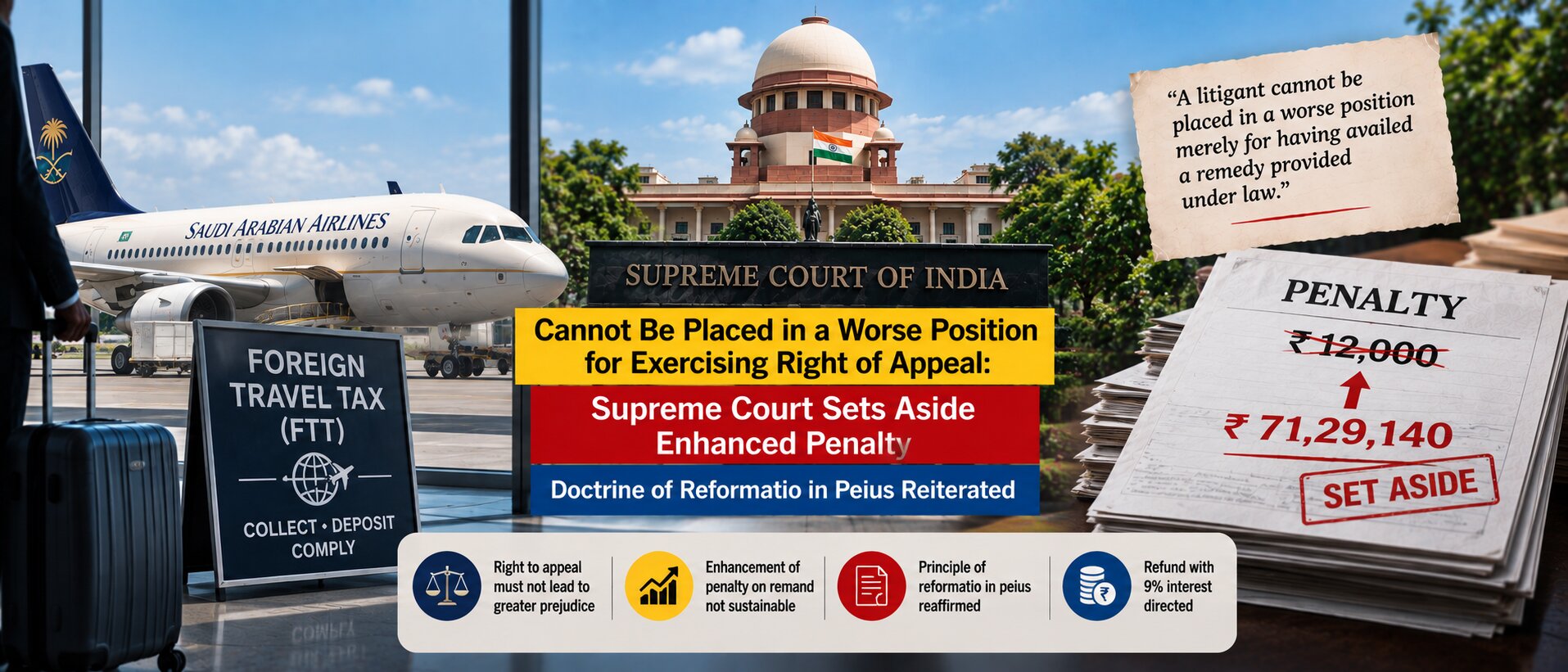
The doctrine of reformatio in peius protects an appellant from an adverse alteration of the position merely because the appellant pursued a legal remedy.
Judgement Details
Court
Supreme Court of India
Date of Decision
1 September 2026
Judges
Justice J.B. Pardiwala and Justice Ujjal Bhuyan
Citation
Acts / Provisions
Facts of the Case
-
The appellant, Saudi Arabian Airlines, was authorised to collect Foreign Travel Tax (FTT) from passengers travelling internationally under Section 35 of the Finance Act, 1979.
-
Between 1994 and 1997, the airline delayed depositing FTT with the Government treasury on six occasions.
-
In five instances, the airline had already purchased demand drafts before the prescribed due dates but could not deposit them in time, which it attributed to security restrictions.
-
The sixth delay was attributed to the concerned employee being on emergency leave.
-
The original adjudicating authority imposed a penalty of ₹12,000 for the six instances of delayed deposit.
-
The airline challenged the penalty through the statutory appellate remedy.
-
The matter was remanded for fresh adjudication.
-
On remand, the adjudicating authority passed a de novo order and enhanced the penalty drastically to ₹71,29,140.
-
The airline argued that it had been placed in a position substantially worse than it would have been in had it not exercised its right of appeal.
-
The enhanced penalty was more than 590 times the original penalty.
-
The airline challenged the enhanced penalty before the appellate authority, the revisional authority under the Ministry of Finance and the Bombay High Court.
-
All these authorities rejected the airline's contention.
-
They held that the original penalty was below the statutory minimum and that the remand permitted fresh consideration and enhancement of the penalty.
-
The airline thereafter approached the Supreme Court.
-
The Supreme Court examined whether a person exercising a statutory right of appeal could be placed in a substantially worse position merely because the appeal resulted in remand.
-
The Court considered the doctrine of reformatio in peius, which concerns a change for the worse following an appeal.
-
The Court relied upon Jyoti Plastic Works Pvt. Ltd. v. Union of India, Jawal Neco Ltd. v. Commissioner of Customs and its recent decision in Nagarajan v. State of Tamil Nadu.
Issues
-
Whether a litigant can be placed in a worse position merely because the litigant exercised a statutory right of appeal?
-
Whether the penalty imposed after remand could be enhanced substantially beyond the original penalty when the enhancement resulted from the appellant's own exercise of the right to appeal?
-
Whether the doctrine of reformatio in peius applies where an appellant's position becomes substantially worse after pursuing a lawful statutory remedy?
-
Whether the adjudicating authority could enhance the penalty from ₹12,000 to ₹71,29,140 on remand despite the appellant being the party who had challenged the original order?
-
Whether the enhanced penalty and subsequent orders confirming it were legally sustainable?
Judgement
-
The Supreme Court allowed the appeal filed by Saudi Arabian Airlines.
-
The Court held that a litigant should not ordinarily be placed in a worse position merely because the litigant has exercised a remedy provided by law.
-
The Court extensively considered the doctrine of reformatio in peius, meaning a change for the worse.
-
The Court observed that the principle represents a rule of fair procedure and is connected with natural justice and equality.
-
The Court relied upon the Bombay High Court's decision in Jyoti Plastic Works Pvt. Ltd. v. Union of India.
-
The Court also relied upon Jawal Neco Ltd. v. Commissioner of Customs, which recognised that an appellant should not become worse off merely because an appeal was filed.
-
The Supreme Court further relied upon its decision in Nagarajan v. State of Tamil Nadu.
-
The Court held that the enhancement of the penalty from ₹12,000 to ₹71,29,140 occurred solely because the appellant had exercised its statutory right of appeal.
-
The Court held that such a consequence could not be accepted, even if the original penalty had been technically erroneous or below the statutory minimum.
-
The Court therefore set aside the enhanced penalty in its entirety.
-
It also set aside the orders of the Bombay High Court, revisional authority, first appellate authority and the de novo adjudicating authority insofar as they concerned the six instances of delayed FTT payment.
-
The Court directed that any amount already paid towards the penalty be refunded with 9% annual interest.
-
The refund was directed to be made within three months.
-
The appeal was accordingly allowed.
Held
-
A litigant cannot be placed in a worse position merely for exercising a statutory right of appeal.
-
The substantial enhancement of penalty following the appellant's own appeal was impermissible in the circumstances.
-
The fact that the original penalty may have been erroneous did not justify placing the appellant in a substantially worse position because it appealed.
-
The penalty of ₹71,29,140 was set aside.
-
The connected orders of the authorities and the Bombay High Court were also set aside to the relevant extent.
-
Any amount already paid towards the penalty was directed to be refunded with 9% interest per annum within three months.
Analysis
-
Reformatio in peius: The judgment gives significant importance to the principle that an appellant should not suffer an adverse consequence merely because the appellant exercised a lawful remedy.
-
Fairness in appellate proceedings: The Court treated the principle as part of a broader requirement of fair procedure.
-
Right to appeal: A statutory right of appeal should not become a source of additional punishment simply because the person chooses to exercise it.
-
Extraordinary enhancement: The increase from ₹12,000 to ₹71,29,140 was enormous. The Court considered it impermissible to expose the appellant to such a consequence solely because it challenged the original order.
-
Error in original order: The Court accepted that the original penalty might have involved a technical error. However, that did not justify an enhancement resulting solely from the appellant's decision to seek appellate relief.
-
Natural justice: The Court connected the prohibition against reformatio in peius with principles of natural justice, particularly fairness in the administration of legal remedies.
-
Equality: The principle was also linked to the broader idea of equality, ensuring that a person does not suffer simply for invoking a legal remedy available to them.
-
Consistency with precedent: The judgment follows the reasoning in Jyoti Plastic Works, Jawal Neco and Nagarajan, strengthening the developing jurisprudence against adverse consequences arising solely from an appeal.
-
Impact on administrative adjudication: The decision is relevant to tax and regulatory proceedings where an appellate or remand process may potentially result in a much greater liability than the original order.
-
Important limitation: The judgment does not mean that an appellate or remand authority can never impose a higher liability. The significant principle is that a person should not be made worse off merely because the person exercised the statutory remedy, particularly in circumstances attracting the doctrine of reformatio in peius.
-
Protection of legal remedies: The ruling strengthens confidence in the appellate process by ensuring that exercising a statutory remedy does not itself become a reason for imposing a disproportionately adverse consequence.
-
Practical significance: The decision is particularly important for tax, customs and regulatory litigation, where remand proceedings can sometimes result in increased demands or penalties.