
M/s. Sada Anand Developers v. Shree Balaji Realty, 2026
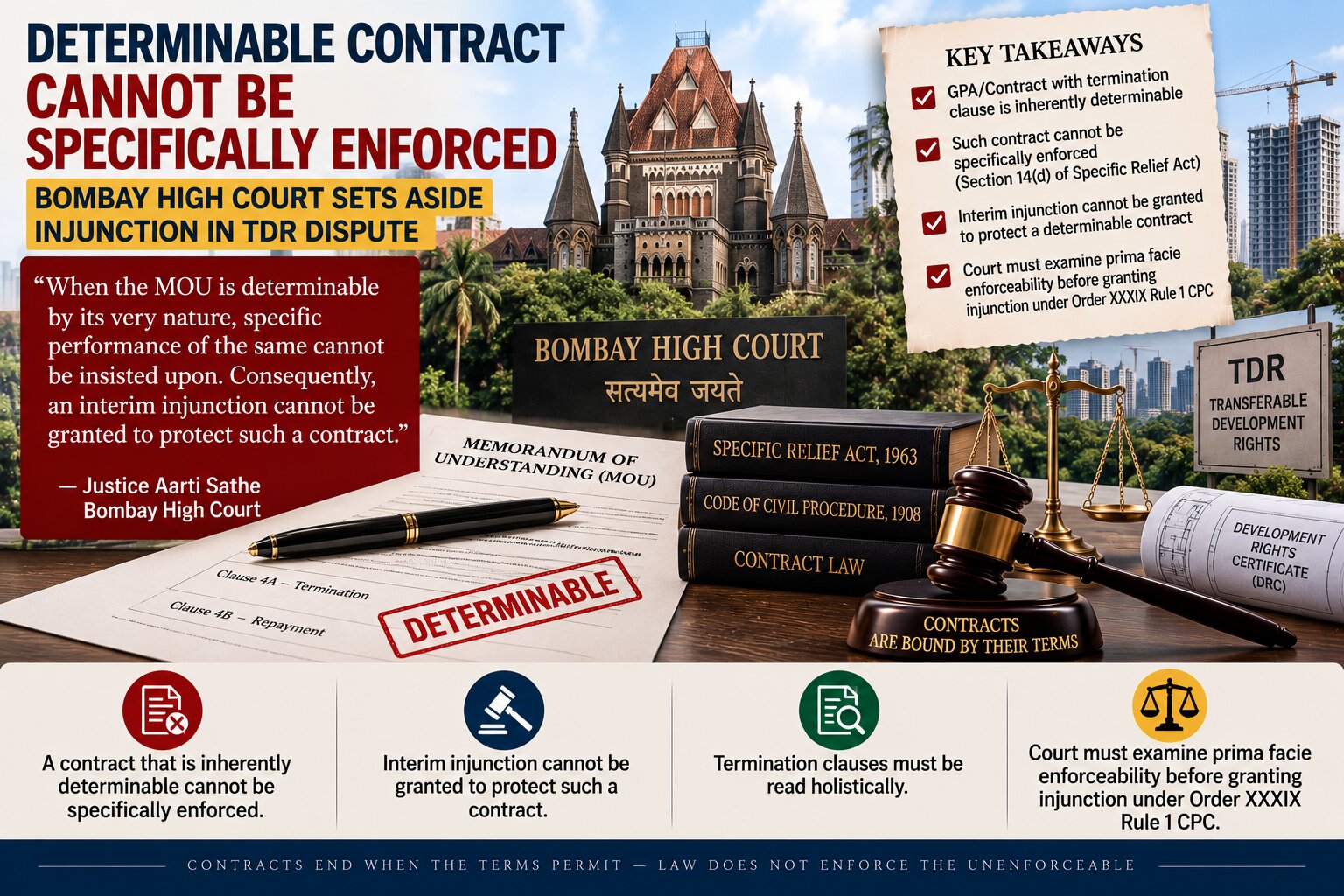
A contract that is inherently determinable cannot ordinarily be specifically enforced.
Judgement Details
Court
Bombay High Court
Date of Decision
24 August 2026
Judges
Justice Aarti Sathe
Citation
Acts / Provisions
Facts of the Case
-
The dispute concerned 5,200 sq. metres of Transferable Development Rights (TDR) covered by an MOU dated 13 July 2022.
-
The respondent had agreed to purchase the TDR from the appellant.
-
Under the MOU, the appellant was required to obtain the Development Rights Certificate (DRC) within the stipulated period.
-
The appellant was unable to obtain the DRC and consequently issued a notice dated 18 October 2023 cancelling the MOU.
-
The respondent approached the Civil Court seeking protection concerning the TDR.
-
The Trial Court temporarily restrained the appellant from transferring, alienating or creating third-party interests in the 5,200 sq. metres of TDR.
-
The appellant argued that Clauses 4A and 4B expressly contemplated cancellation of the MOU and repayment of the amount received.
-
It was therefore contended that the MOU was inherently determinable and could not be specifically enforced under Section 14(d) of the Specific Relief Act.
Issues
-
Whether the MOU was inherently determinable in view of its contractual termination provisions?
-
Whether a determinable contract can be specifically enforced under Section 14(d) of the Specific Relief Act?
-
Whether an interim injunction can be granted to protect contractual rights when specific performance of the underlying MOU itself is not maintainable?
-
Whether the Trial Court was justified in granting an injunction under Order XXXIX Rule 1 CPC without first examining the prima facie enforceability of the MOU?
-
Whether the Trial Court's injunction order was sustainable in the absence of a prima facie finding on specific enforceability?
Judgement
-
The Bombay High Court allowed the appeal and quashed and set aside the Trial Court's order dated 14 February 2025.
-
The Court held that Clauses 4A and 4B of the MOU had to be interpreted holistically.
-
On such interpretation, the Court found that the MOU was determinable by its very nature.
-
The contractual terms themselves contemplated termination and repayment without requiring the parties to establish a particular reason for termination.
-
Consequently, the MOU could not be specifically enforced under Section 14(d) of the Specific Relief Act.
-
The Court held that the Trial Court had incorrectly granted an injunction under Order XXXIX Rule 1 CPC without first examining the prima facie enforceability of the MOU.
-
The Court also noted that there was no existing property in which the respondent was in possession or from which it faced a threat of dispossession.
-
The impugned injunction was therefore set aside.
Held
-
Where the contract itself contains provisions permitting termination, the parties cannot insist upon specific performance of such determinable obligations.
-
An interim injunction cannot be granted merely to preserve a contract whose specific performance is legally unenforceable.
-
Before granting interim relief under Order XXXIX Rule 1 CPC, the Court must examine whether the claimant has established a prima facie enforceable right.
-
The Trial Court erred by granting an injunction without first addressing the appellant's contention that the MOU was determinable and unenforceable.
-
The impugned order dated 14 February 2025 was therefore quashed and set aside.
Analysis
-
The judgment emphasizes the important relationship between specific performance and interim injunctions. Interim relief cannot ordinarily be used to indirectly enforce a contractual obligation that the law does not permit the court to specifically enforce.
-
The Court gave a holistic interpretation to the termination clauses rather than reading Clauses 4A and 4B separately. This approach showed that cancellation and repayment were contemplated mechanisms within the contractual arrangement itself.
-
The Court treated the ability to terminate under the MOU as an indication that the agreement was determinable by its nature.
-
Section 14(d) of the Specific Relief Act therefore became central to the dispute. Once specific performance was prima facie unavailable, the respondent could not obtain an injunction that effectively preserved the contractual arrangement.
-
The judgment also highlights the importance of establishing a prima facie case before granting interim relief. The Trial Court had moved directly to an injunction without first deciding whether the MOU itself was capable of specific enforcement.
-
The Court distinguished contractual rights from property-possession rights. Since the respondent was not facing dispossession from an existing property, the justification for the injunction was further weakened.
-
The ruling serves as a reminder that an injunction is an equitable and discretionary remedy, and the court must examine the underlying legal right before protecting it through interim orders.
-
Overall, the decision reinforces that parties cannot use interim injunctions to achieve indirectly what they could not obtain through a decree of specific performance.