
M/s Oil and Natural Gas Corporation Ltd. v. Suryakand D Lad & Ors., 2026
The principal employer's obligation under Section 21(4) of the CLRA Act concerning wages does not automatically extend to gratuity.
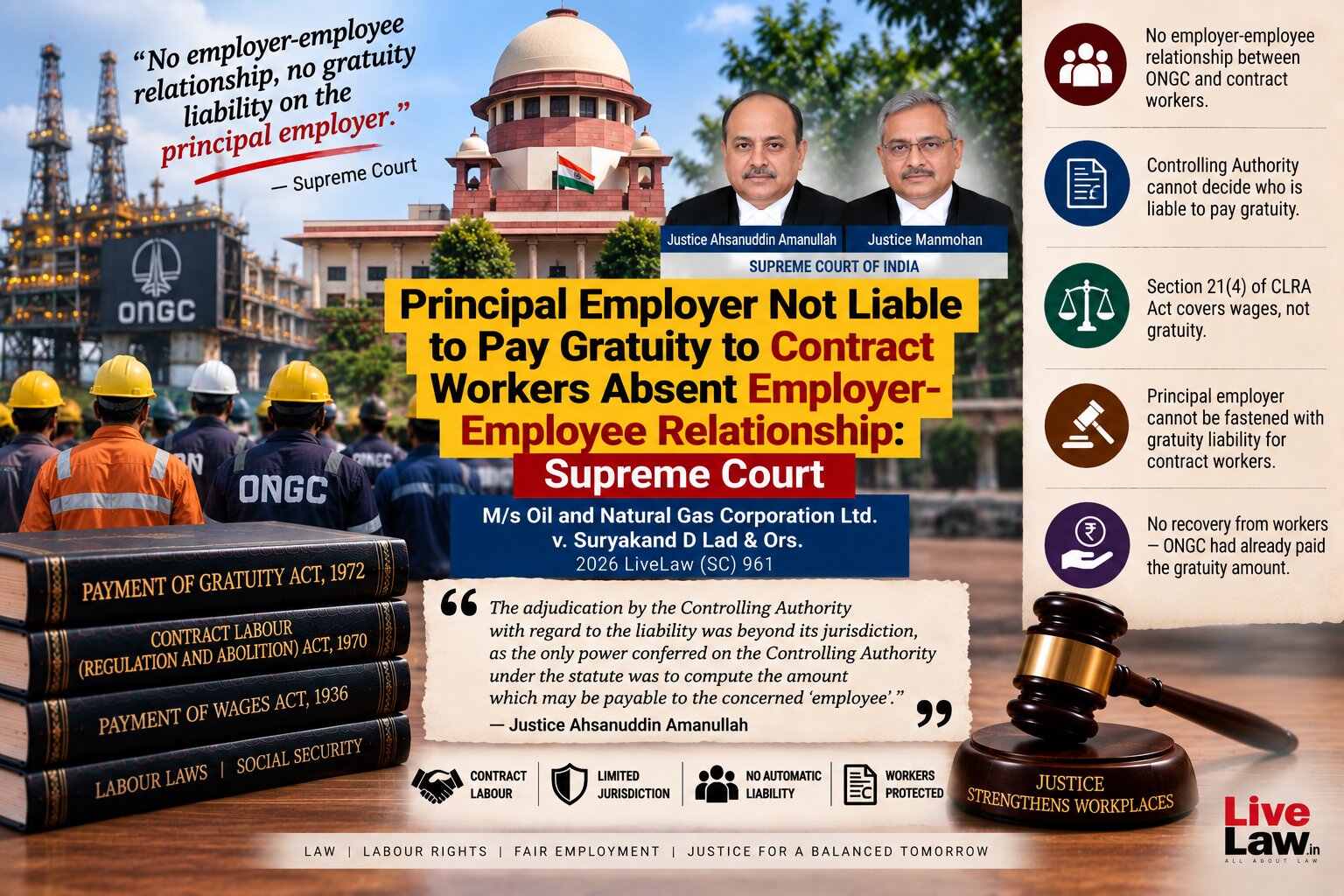
Judgement Details
Court
Supreme Court of India
Date of Decision
15 September 2026
Judges
Justice Ahsanuddin Amanullah and Justice Manmohan
Citation
Acts / Provisions
Facts of the Case
-
The dispute concerned workers who were engaged through a contractor for work connected with Oil and Natural Gas Corporation Ltd. (ONGC).
-
The workers claimed gratuity and proceedings were initiated before the Controlling Authority.
-
ONGC objected to the claim on the ground that the workers were not its employees and that there was no employer-employee relationship between ONGC and the contractual workers.
-
The Controlling Authority nevertheless held ONGC liable to pay gratuity.
-
The Appellate Authority reversed the Controlling Authority's decision and ruled in favour of ONGC.
-
The Bombay High Court subsequently reversed the Appellate Authority's order and restored liability against ONGC.
-
ONGC challenged the High Court's decision before the Supreme Court.
-
Before the Supreme Court, ONGC argued that gratuity under Section 4 of the Payment of Gratuity Act is payable to an employee, whereas the respondents were employees of the contractor and not of ONGC.
-
It was further argued that Section 21(4) of the CLRA Act makes the principal employer responsible for payment of wages in specified circumstances but does not make it liable for gratuity.
-
ONGC also relied upon the contractual provision expressly stating that the contract did not create an employer-employee relationship between ONGC and the contractor's workers.
-
The respondents contended that the gratuity liability should ultimately fall upon the principal employer.
-
The Supreme Court also considered the limited statutory jurisdiction of the Controlling Authority.
Issues
-
Whether a principal employer can be held liable to pay gratuity to workers engaged through a contractor in the absence of an employer-employee relationship?
-
Whether the Controlling Authority under the Payment of Gratuity Act has jurisdiction to determine and fasten liability upon a principal employer who disputes the existence of an employer-employee relationship?
-
Whether the principal employer's liability under Section 21(4) of the CLRA Act extends to payment of gratuity to contractual workers?
-
Whether the Bombay High Court was justified in reversing the Appellate Authority's order which had ruled in favour of ONGC?
Judgement
-
The Supreme Court allowed ONGC's appeals and set aside the Bombay High Court's order.
-
The Court restored the decision of the Appellate Authority, which had ruled in favour of ONGC.
-
The Court held that the Controlling Authority's adjudication concerning liability to pay gratuity was beyond its statutory jurisdiction.
-
The Controlling Authority's power was limited to computing the amount of gratuity payable to the concerned employee.
-
The Court accepted the submission that, where the existence of an employer-employee relationship with the principal employer itself is disputed, the Controlling Authority cannot adjudicate and fasten such liability upon the principal employer.
-
The Court found the submissions concerning the Payment of Wages Act and the CLRA Act to be sustainable.
-
Since ONGC had already paid the gratuity amount to the workers, the Supreme Court directed that no recovery should be made from them.
Held
-
A principal employer cannot be made liable for gratuity payable to workers engaged through a contractor when there is no employer-employee relationship between the principal employer and the contractual workers.
-
The Controlling Authority under the Payment of Gratuity Act cannot adjudicate a disputed question concerning the identity of the employer and thereby fasten gratuity liability upon a principal employer.
-
Its statutory function is to compute the amount of gratuity payable to an eligible employee; it cannot decide a fundamentally disputed question of employer liability beyond the scope of that jurisdiction.
-
The Bombay High Court was not justified in interfering with the Appellate Authority's order in favour of ONGC.
-
As the gratuity had already been paid by ONGC, the workers were protected from recovery of the amount.
Analysis
-
The judgment primarily turns on the distinction between entitlement to gratuity and liability to pay gratuity.
-
Gratuity under the Payment of Gratuity Act is connected to the employee-employer relationship. Therefore, where workers are engaged through an independent contractor, the identity of the employer becomes legally significant.
-
The Supreme Court emphasized the limited jurisdiction of the Controlling Authority. Its role is not to conduct a broad adjudication concerning disputed employer-employee relationships and then impose liability upon a person alleged to be the employer.
-
The Court also distinguished the principal employer's obligations under the CLRA Act from gratuity liability. Responsibility concerning wages under Section 21(4) does not, by itself, convert the principal employer into the employer for purposes of gratuity.
-
The ruling reinforces the importance of determining who is the actual employer before fastening statutory employment benefits upon a principal employer.
-
The Court's reliance on Municipal Council, Nandyal Municipality, Kurnool District, AP v. K. Jayaram & Ors. further supports the principle that engagement through a contractor does not, by itself, establish an employer-employee relationship with the principal employer.
-
The decision also provides practical protection to workers who had already received gratuity: although ONGC's liability was not sustained, the Court directed that no recovery be made from the workers because the amount had already been paid.
-
Thus, the judgment clarifies both the substantive question of employer liability and the jurisdictional limits of the Controlling Authority under the gratuity legislation.