
M/s Circar Paper Mills Ltd. v. District Collector, Nellore Distt. & Ors., 2026
Summary Eviction Barred in Bona Fide Title Disputes
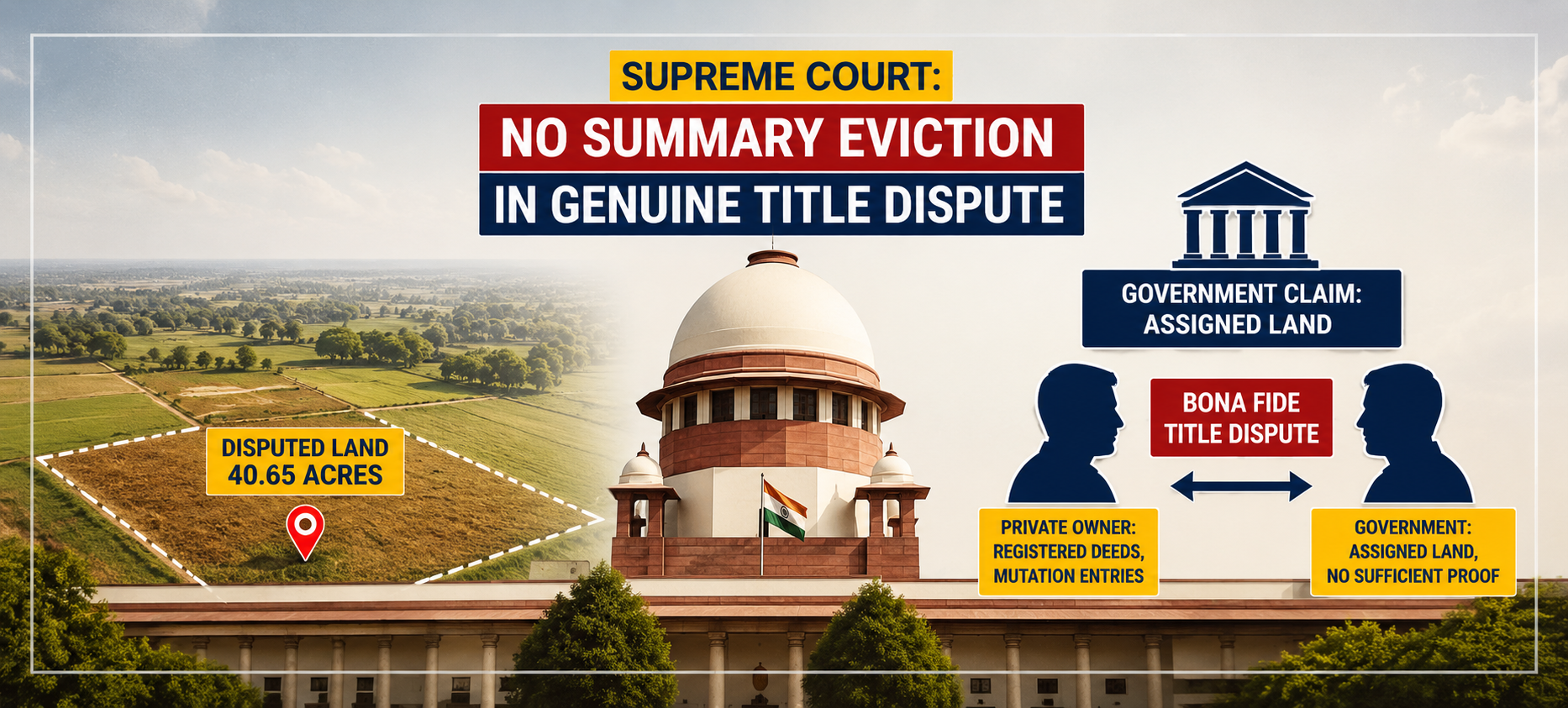
Judgement Details
Court
Supreme Court of India
Date of Decision
29 August 2026
Judges
Justice J.B. Pardiwala and Justice K. Vinod Chandran
Citation
Acts / Provisions
Facts of the Case
-
The dispute concerned approximately 65.94 acres of land in Kodurupadu Village, Nellore District, out of which the State claimed 40.65 acres to be Government-assigned land.
-
The private parties traced their title and possession to transactions dating back to approximately 1920. The property was subsequently inherited by B.J. Rao.
-
B.J. Rao sold different portions of the property. Circar Paper Mills Ltd. purchased approximately 46.23 acres in 1980 through registered sale deeds, and its name was subsequently entered/mutated in the revenue records.
-
Circar Paper Mills used the property for industrial purposes and continued in possession until the company went into liquidation.
-
Pursuant to orders of the Company Court, the Official Liquidator took possession of the company's properties on 27 March 2001.
-
The Company Court subsequently permitted the Official Liquidator to sell the properties by public auction.
-
J.K. Sugar Mills Ltd. emerged as the successful bidder with a bid of ₹7.80 crore.
-
At the auction stage, the Government objected, claiming that 40.65 acres constituted assigned land and therefore could not legally be transferred.
-
The Company Court nevertheless confirmed the auction, subject to payment of an amount to the Government concerning the disputed land.
-
The appellate court subsequently set aside the Company Court's order, resulting in the matter reaching the Supreme Court.
-
The Supreme Court was therefore required to examine whether the Government could effectively use summary proceedings to assert its claim and interfere with possession when there was a long-standing and bona fide dispute concerning title.
Issues
-
Whether the Government could resort to summary proceedings for eviction/resumption when there was a bona fide and longstanding dispute regarding the title and ownership of the land?
-
Whether the Government had produced sufficient material to conclusively establish that the disputed 40.65 acres constituted assigned land?
-
Whether a serious dispute regarding title, possession and ownership could properly be determined through summary proceedings rather than through a properly constituted civil proceeding?
-
Whether the long-standing possession, registered sale deeds and mutation entries relied upon by the private parties made the dispute unsuitable for summary eviction?
-
Whether the auction conducted by the Official Liquidator pursuant to the orders of the Company Court could be interfered with merely on the basis of the Government's assertion regarding the character of the land?
-
Whether the principle laid down in Government of Andhra Pradesh v. Thummala Krishna Rao & Another applied to the present dispute?
Judgement
-
The Supreme Court allowed the appeal and set aside the impugned appellate decision. It restored the order of the Company Court concerning the auction proceedings.
-
The Court emphasized that summary eviction jurisdiction cannot become a substitute for adjudication of a genuine dispute concerning title.
-
The private parties relied upon registered sale deeds.
-
There were corresponding mutation entries in the revenue records.
-
The alleged private ownership and possession extended back for several decades.
-
The Government had not adequately substantiated its competing claim to title.
-
The Government's objection arose at a very late stage, when the property was already under the control of the Official Liquidator and was being auctioned pursuant to Company Court orders.
-
The dispute therefore involved questions that could not appropriately be conclusively determined through a summary proceeding.
-
The Court observed that the long possession itself was a significant circumstance against resort to summary eviction.
-
The Supreme Court consequently directed restoration of the auction proceedings and directed that possession, if not already delivered, be given to J.K. Sugar Mills; possession already obtained was not to be interfered with.
-
In the connected proceedings concerning Sundaramma and others, the Court restored the writ proceedings before the High Court for fresh consideration on merits.
Held
-
The Government cannot use summary eviction proceedings to conclusively determine a serious, bona fide and longstanding dispute relating to title and possession of land.
-
Where competing claims of ownership are supported by historical possession, registered documents and revenue/mutation records, and the Government's title itself is genuinely disputed, the appropriate course is proper adjudication in appropriate proceedings, rather than summary eviction.
-
The Supreme Court applied the principle in Government of Andhra Pradesh v. Thummala Krishna Rao & Another that where the question of title requires proper adjudication, summary eviction cannot be resorted to until the title dispute is resolved through appropriate proceedings.
-
Final result: Appeal allowed.
-
The auction proceedings were restored, and the Company Court's order was revived.
Analysis
-
The most important principle emerging from the judgment is that summary jurisdiction has limitations.
-
A summary proceeding may be appropriate where the Government's title or right to possession is clear and the occupant's status is equally clear. However, it cannot appropriately be used where the parties present substantial competing claims of title requiring examination of documents, historical transactions, possession and revenue records.
-
The Supreme Court therefore distinguished between a straightforward case of Government land being occupied without authority and a case involving a genuine title dispute.
-
The Court attached considerable importance to the fact that the private claimants traced possession and ownership back several decades.
-
The judgment specifically noted the significance of long possession in determining whether summary eviction should be permitted. (Live Law)
-
This does not mean that long possession automatically creates valid title. Rather, it means that when long possession is accompanied by registered documents and other evidence supporting title, the Government cannot simply bypass proper adjudication by invoking summary powers.
-
The private parties relied upon registered sale deeds and mutation entries.
-
The Court noted that the Government could not simply ignore these records, particularly when government authorities had themselves dealt with the properties in circumstances indicating private ownership.
-
Its importance in this case lay in the overall evidentiary picture, together with registered conveyances, historical possession and other circumstances.
-
The timing of the Government's objection was another important consideration.
-
The property had been in private possession for decades, the company had purchased it, the Official Liquidator had taken possession pursuant to Company Court orders, and the auction process had commenced.
-
The State's claim regarding the 40.65 acres became a major objection at the auction stage. The Supreme Court therefore examined whether the Government could effectively disrupt a judicially supervised liquidation process without properly establishing its competing claim.
-
The Supreme Court relied upon the earlier decision in Government of Andhra Pradesh v. Thummala Krishna Rao & Another.
-
Where the Government and a private party have a genuine dispute regarding title, and determining the Government's right requires adjudication of questions such as acquisition, encroachment or adverse possession, summary eviction should not be used as a substitute for a properly constituted suit.
-
The 2026 judgment therefore reinforces and gives continuing precedential weight to this limitation on summary eviction powers.
-
The judgment also has significance from the perspective of rule of law and procedural fairness.
-
Government authorities possess statutory powers to protect Government land. However, such powers must be exercised within the limits of the statute.
-
Where the Government itself has a disputed claim of title, it cannot simply assume the correctness of its own claim and use summary machinery to obtain possession.
-
It reinforces the distinction between summary administrative proceedings and full adjudication of title.
-
The judgment should not be read as holding that a person can acquire ownership merely by remaining in possession for a long period.
-
The crucial circumstance was the existence of a bona fide dispute supported by substantial documentary and historical material, coupled with the Government's inability, at the summary stage, to conclusively establish its competing title.
-
Thus, the judgment is principally about the limits of summary eviction jurisdiction, rather than a general declaration that private parties automatically possess valid title.