
M/s Bajaj Trading Company v. Union of India, 2026
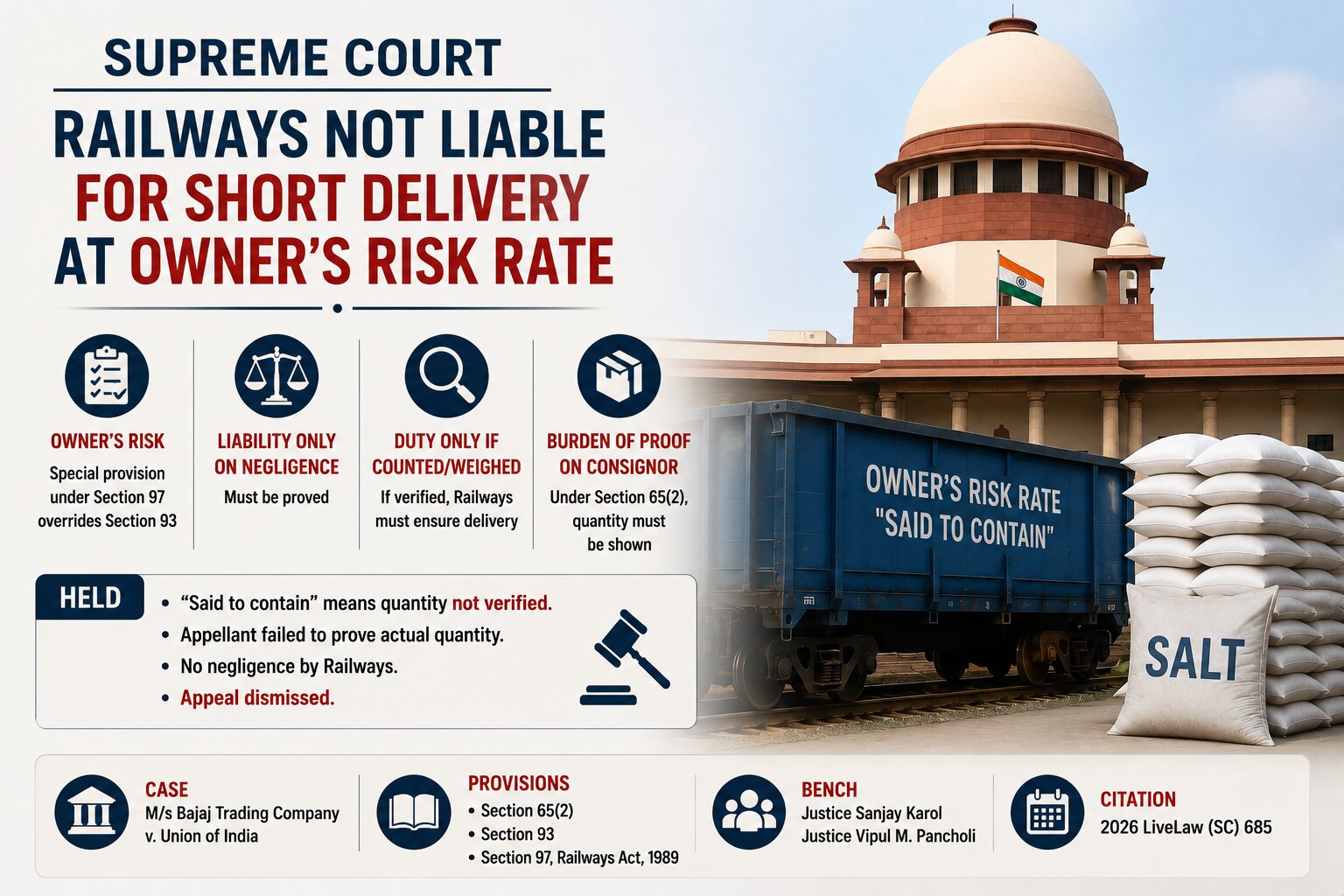
Section 97 of the Railways Act governs consignments booked at the Owner's Risk Rate and overrides the general liability under Section 93.
Judgement Details
Court
Supreme Court of India
Date of Decision
18 July 2026
Judges
Justice Sanjay Karol & Justice Vipul M. Pancholi
Citation
Acts / Provisions
Facts of the Case
-
The appellant booked 40,444 bags of salt from Chirai Junction, Gujarat, to Dharmanagar, Assam, in November 2009.
-
The goods were transported by the Indian Railways under the Owner's Risk Rate.
-
The Railway Receipt carried a "said to contain" endorsement, indicating that railway officials had not verified or counted the quantity of goods loaded.
-
Upon arrival at the destination, only 38,702 bags were allegedly delivered, resulting in an alleged shortage of 1,742 bags.
-
The Railways issued a Shortage Certificate, acknowledging the shortage in delivery but denied legal liability.
-
The appellant filed a claim before the Railway Claims Tribunal seeking compensation for the alleged short delivery.
-
The Tribunal rejected the claim, holding that negligence on the part of the Railways was not established.
-
The Gauhati High Court affirmed the Tribunal's decision.
-
Aggrieved thereby, the appellant approached the Supreme Court.
Issues
-
Whether the Railways are liable for short delivery of goods transported under the Owner's Risk Rate without proof of negligence or misconduct?
-
Whether the general liability under Section 93 of the Railways Act overrides the special provisions contained in Section 97 relating to consignments booked at the Owner's Risk Rate?
-
Whether a "said to contain" endorsement on the Railway Receipt absolves the Railways from responsibility for verifying the quantity of goods loaded?
-
Whether the burden of proving the quantity of goods entrusted to the Railways rests upon the consignor under the proviso to Section 65(2) of the Railways Act?
-
Whether the appellant established negligence on the part of the Railway Administration so as to claim compensation for the alleged shortage?
Judgement
-
The Supreme Court dismissed the appeal filed by the appellant.
-
The Court held that Section 97 of the Railways Act, 1989, being a special provision governing consignments booked at the Owner's Risk Rate, overrides the general liability under Section 93.
-
It observed that where goods are booked at the Owner's Risk Rate, the Railways can be held liable only if negligence or misconduct on their part is established.
-
The Court held that no such negligence was proved in the present case.
-
It observed that the Railway staff had not counted, weighed or verified the quantity of bags before transportation.
-
Since the Railways never assumed responsibility for verifying the quantity loaded, they could not be held liable for the alleged shortage.
-
The Court noted that the Railway Receipt contained a "said to contain" endorsement, clearly indicating that the quantity mentioned was supplied by the consignor and was not verified by railway officials.
-
Referring to the proviso to Section 65(2), the Court held that the burden of proving the quantity of goods entrusted rested upon the consignor, consignee or endorsee.
-
The appellant failed to produce documentary evidence regarding the procurement, processing and dispatch of 40,444 bags of salt.
-
Consequently, the Court held that the appellant failed to discharge the statutory burden of proof.
-
Finding no negligence or misconduct on the part of the Railways, the Court upheld the concurrent findings of the Railway Claims Tribunal and the Gauhati High Court.
Held
-
The Railways are liable only when negligence or misconduct is proved.
-
Unless the Railways have counted or weighed the goods before transportation, they cannot ordinarily be held liable for alleged short delivery.
-
The burden of proving the actual quantity entrusted to the Railways lies upon the consignor under the proviso to Section 65(2).
-
The appeal was dismissed for failure to establish negligence or prove the quantity of goods entrusted.
Analysis
-
The judgment clarifies the distinction between the general liability of the Railways under Section 93 and the limited liability applicable to consignments booked under the Owner's Risk Rate.
-
The Court reaffirmed that special statutory provisions prevail over general provisions, giving precedence to Section 97.
-
The ruling emphasizes that the Railways assume responsibility for the quantity of goods only when they have verified, counted or weighed the consignment before transit.
-
The judgment strengthens the legal significance of the "said to contain" endorsement, recognizing it as evidence that the Railway Administration did not verify the quantity loaded.
-
The Court reaffirmed the statutory burden imposed by Section 65(2), requiring consignors to prove the quantity entrusted where railway verification is absent.
-
The decision protects the Railways from liability based solely on allegations of shortage where they never assumed responsibility for verifying the quantity.
-
At the same time, the Court clarified that if railway officials had actually counted or weighed the goods, a corresponding duty of care would arise, and liability could follow in cases of negligent short delivery.
-
The judgment provides important guidance for commercial consignments transported under the Owner's Risk Rate, particularly regarding documentary proof and allocation of the burden of proof.