
M/s ABC Express v. State of Gujarat, 2026
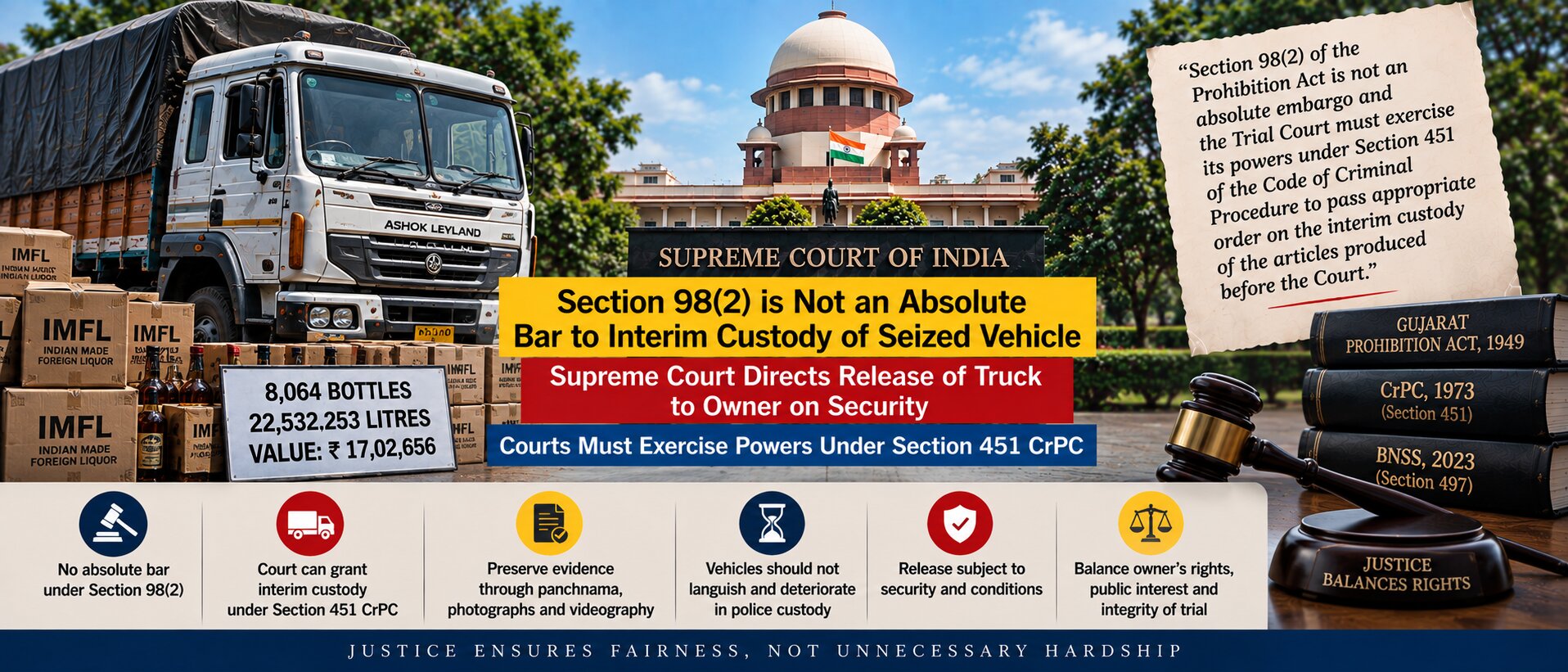
Section 98(2) of the Gujarat Prohibition Act does not create an absolute bar against interim release of a seized vehicle.
Judgement Details
Court
Supreme Court of India
Date of Decision
2 September 2026
Judges
Justice Prashant Kumar Mishra and Justice Sree Chandrashekar
Citation
Acts / Provisions
Facts of the Case
-
The appellant was the owner of an Ashok Leyland truck that was intercepted while travelling from Modasa towards Vadodara via Lunawada.
-
The driver could not produce the required pass or permit for the goods being transported.
-
On search, the truck was found carrying 8,064 bottles of Indian-Made Foreign Liquor (IMFL).
-
The quantity of liquor was approximately 22,532.253 litres, valued at around ₹17,02,656.
-
The liquor was concealed among consignments of edible goods valued at approximately ₹98.66 lakh.
-
A criminal case was registered under various provisions of the Gujarat Prohibition Act, 1949.
-
A chargesheet was subsequently filed against four accused persons, including the driver.
-
The appellant claimed that it was a transport company and had no involvement in the alleged offence.
-
The truck remained parked at the police station for more than a year and was allegedly deteriorating due to prolonged non-use.
-
The appellant approached the Chief Judicial Magistrate seeking interim custody of the vehicle under Section 497 BNSS.
-
The application was rejected by the Chief Judicial Magistrate, Lunawada.
-
The Sessions Court, Mahisagar, subsequently upheld the rejection.
-
The Gujarat High Court also declined to grant interim custody of the truck.
-
The appellant then approached the Supreme Court.
-
The State opposed release of the vehicle, arguing that Section 98(2) of the Gujarat Prohibition Act prevented release of the conveyance on bond or surety when the quantity of liquor exceeded the prescribed limit.
-
The Supreme Court examined whether Section 98(2) created an absolute bar against interim release of a seized vehicle.
-
The Court also considered the relationship between Section 98 of the Gujarat Prohibition Act and the general judicial powers concerning custody of seized property under Section 451 CrPC.
-
The Court considered the earlier decisions in Khengarbhai Lakhabhai Dambhala v. State of Gujarat, Sunderbhai Ambalal Desai v. State of Gujarat, Basavva Kom Dyamangouda Patil v. State of Mysore and General Insurance Council v. State of Andhra Pradesh.
Issues
-
Whether Section 98(2) of the Gujarat Prohibition Act creates an absolute bar against granting interim custody of a seized vehicle to its owner?
-
Whether the Trial Court can exercise its power under Section 451 CrPC to grant interim custody of a vehicle seized under the Gujarat Prohibition Act?
-
Whether the Drug Disposal/Confiscation provisions under the Gujarat Prohibition Act prevent the Court from considering interim custody of the seized vehicle during the pendency of trial?
-
Whether the prolonged retention of the seized truck at the police station justified its release to the owner on appropriate security?
-
Whether the Trial Court, Sessions Court and High Court erred in refusing interim custody by treating Section 98(2) as an absolute embargo?
Judgement
-
The Supreme Court allowed the appeal.
-
The Court set aside the orders passed by the Trial Court, Sessions Court and Gujarat High Court refusing interim custody of the truck.
-
The Court held that Section 98(2) of the Gujarat Prohibition Act is not an absolute embargo against release of a seized vehicle during the pendency of trial.
-
The Court relied upon its earlier decision in Khengarbhai Lakhabhai Dambhala v. State of Gujarat.
-
The Court held that Section 98 and Section 132 of the Gujarat Prohibition Act operate in a different field from the general powers of the criminal court under Section 451 CrPC.
-
The Court observed that where seized property has been produced before the Court during an inquiry or trial, the Court can exercise its powers under Section 451 CrPC to determine appropriate custody.
-
The Court also relied upon the principle that vehicles should not ordinarily be allowed to remain unused at police stations for prolonged periods.
-
The Court noted that continued retention can cause deterioration, loss of value and hardship to the owner.
-
The Court held that the evidentiary value of the vehicle could be preserved through a detailed panchnama, photographs and videography.
-
The Court therefore concluded that the balance of convenience favoured release of the truck.
-
The appellant was directed to furnish a personal bond and security of ₹15,00,000 to the satisfaction of the Trial Court.
-
The appellant was also required to undertake to produce the vehicle before the Investigating Officer or Trial Court whenever directed.
-
The appellant was restrained from alienating the vehicle or creating any third-party interest in it during the pendency of the trial.
-
Before handing over the truck, a detailed panchnama was directed to be prepared along with photographs and videography documenting its condition.
-
The documentation was to be undertaken in the presence of the appellant's representative and two independent witnesses.
-
The Supreme Court clarified that its observations were limited strictly to interim custody of the vehicle.
-
The observations were not to affect the merits of the criminal trial.
-
The trial was directed to proceed uninfluenced by the Supreme Court's observations.
Held
-
The Trial Court can exercise its powers under Section 451 CrPC in appropriate cases involving seized vehicles.
-
The Court must balance the owner's interests, public interest and the need to preserve evidence.
-
A vehicle should not ordinarily remain at a police station for an unnecessarily long period when its evidentiary value can be preserved through proper documentation.
-
Panchnama, photography and videography can adequately preserve the condition and evidentiary value of the vehicle.
-
The lower courts adopted an excessively narrow interpretation of their powers concerning interim custody.
-
The truck was therefore directed to be released to its owner, subject to security and other conditions.
-
The release of the vehicle would have no bearing on the merits of the criminal trial.
Analysis
-
Section 98(2) is not absolute: The Supreme Court rejected the interpretation that the provision completely prevents a criminal court from considering interim custody of a seized vehicle.
-
Judicial discretion: The Court emphasised that the Trial Court must exercise judicial discretion after considering the circumstances of each case rather than mechanically refusing custody.
-
Section 451 CrPC: The judgment confirms the continuing relevance of the Court's power to deal with seized property during inquiry or trial.
-
Protection of property: Prolonged detention of a vehicle can cause significant financial loss to its owner, particularly where the vehicle is used for commercial purposes.
-
Vehicle deterioration: A vehicle kept stationary at a police station can deteriorate rapidly, lose roadworthiness and become vulnerable to damage, theft or removal of parts.
-
Evidence can be preserved: The Court recognised that retaining the physical vehicle throughout the trial is not always necessary. Proper panchnama, photographs and videography can preserve its evidentiary characteristics.
-
Balance of interests: Courts must balance the interests of the vehicle owner against the requirements of investigation, trial and public interest.
-
Earlier Supreme Court precedents: The Court relied on established principles from Sunderbhai Ambalal Desai, Basavva Kom Dyamangouda Patil and General Insurance Council concerning unnecessary retention of seized property.
-
Chargesheet already filed: The filing of the chargesheet was relevant because the investigation had progressed substantially, reducing the justification for continued physical retention of the vehicle.
-
Security protects proceedings: Requiring a substantial security amount and an undertaking to produce the vehicle provides protection while allowing the owner to regain possession.
-
No effect on trial merits: The Court expressly separated the question of interim custody from the determination of criminal liability. Release of the truck does not amount to an acquittal or finding on the merits.
-
Significance: The judgment strengthens the principle that seized vehicles should not be unnecessarily kept in police custody when their evidentiary value can be preserved through appropriate safeguards.