
Mondira Ghosh v. Chaitali Ghosh, 2026
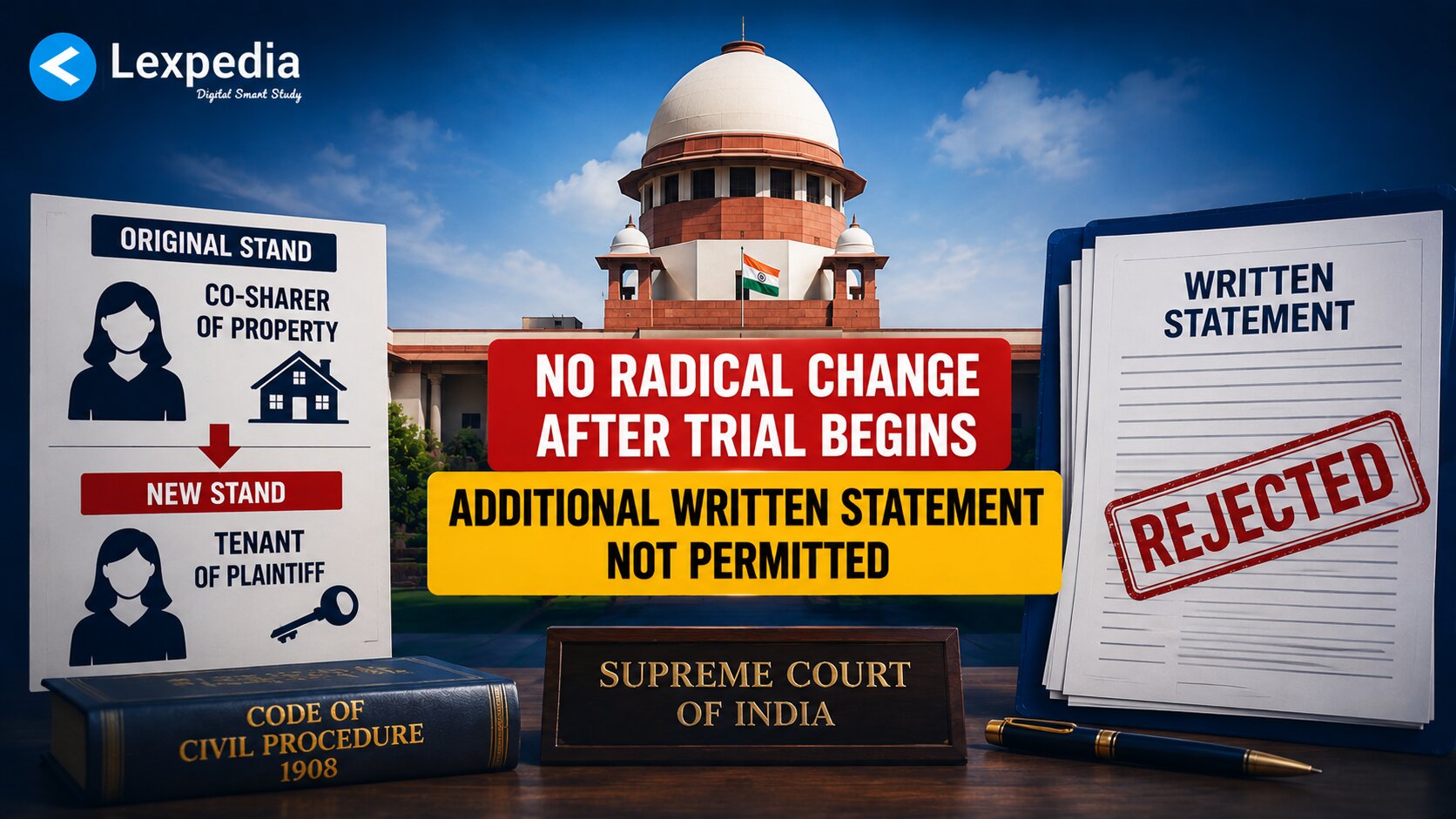
Defendant Cannot Radically Change Defence Through Additional Written Statement After Trial Begins.
Judgement Details
Court
Supreme Court of India
Date of Decision
1 June 2026
Judges
Justice Sanjay Kumar & Justice K. Vinod Chandran
Citation
Acts / Provisions
Facts of the Case
- The plaintiff, Mondira Ghosh, filed a civil suit seeking a declaration that the defendant, Chaitali Ghosh, was in unlawful possession of the suit property and sought her eviction.
-
In her original written statement filed in December 2022, the defendant denied the plaintiff's claim and asserted that she was a bona fide co-sharer in the property.
-
Issues in the suit were framed in May 2023.
-
Thereafter, the plaintiff's witness was extensively cross-examined and the trial had substantially progressed.
-
At this stage, the defendant filed an application under Order VIII Rule 9 CPC seeking permission to file an additional written statement along with a counterclaim.
-
Through the proposed additional written statement, the defendant sought to completely change her earlier stand.
-
Instead of claiming to be a co-sharer, she now sought to contend that she was a tenant under the plaintiff.
-
The trial court rejected the application, holding that such a contradictory plea could not be introduced at that stage.
-
The Calcutta High Court partly allowed the defendant's challenge and permitted filing of the additional written statement upon payment of costs.
-
The plaintiff challenged the High Court's order before the Supreme Court.
Issues
-
Whether a defendant can file an additional written statement under Order VIII Rule 9 CPC introducing a defence completely inconsistent with the original written statement?
-
Whether a defendant can withdraw an earlier plea and substitute it with a contradictory case after commencement of trial?
-
Whether Order VI Rule 7 CPC prohibits a party from taking a stand inconsistent with previous pleadings?
-
Whether an additional written statement can be used to bypass the restrictions contained in the proviso to Order VI Rule 17 CPC?
-
Whether the High Court was justified in permitting the additional written statement at an advanced stage of the trial?
Judgement
-
The Supreme Court allowed the appeal filed by the plaintiff.
-
The Court set aside the Calcutta High Court's order permitting the additional written statement.
-
The Bench restored the trial court's order rejecting the defendant's application.
-
The Court observed that the defendant had initially claimed to be a co-sharer of the property.
-
Through the proposed additional written statement, she attempted a complete volte-face by claiming the status of a tenant.
-
The Bench held that the new plea was fundamentally inconsistent with the original defence.
-
The Court noted that this was not a case of inadvertent omission of facts from the original written statement.
-
Rather, the defendant sought to abandon her earlier case and substitute it with a wholly contradictory stand.
-
The Court held that such conduct violated the mandate of Order VI Rule 7 CPC.
-
It further observed that the application was filed only to circumvent the restrictions imposed by the proviso to Order VI Rule 17 CPC after commencement of trial.
-
The Bench characterized the application as a clear abuse of process of law.
Held
-
A defendant cannot radically alter the nature of her defence through an additional written statement after trial has commenced.
-
Additional written statements cannot be used to introduce a completely contradictory and inconsistent case.
-
Order VI Rule 7 CPC prohibits departure from earlier pleadings through inconsistent allegations.
-
Order VIII Rule 9 CPC cannot be used to bypass the restrictions imposed by the proviso to Order VI Rule 17 CPC.
-
The defendant's application constituted an abuse of process of law.
-
The trial court rightly rejected the application.
Analysis
-
The judgment reinforces the principle that pleadings form the foundation of civil litigation and parties must remain consistent with their pleaded case.
-
The Court emphasized that procedural provisions cannot be manipulated to fundamentally alter the nature of a dispute after trial has begun.
-
By distinguishing between an omitted fact and a contradictory plea, the Court clarified the limits of subsequent pleadings under Order VIII Rule 9 CPC.
-
The ruling protects the integrity of trial proceedings by preventing parties from changing their defence after assessing the strength or weakness of evidence already recorded.
-
The judgment also strengthens the purpose behind the proviso to Order VI Rule 17 CPC, which seeks to prevent delayed and prejudicial amendments after commencement of trial.
-
The decision discourages tactical litigation strategies designed to prolong proceedings or create confusion.
-
The Court's characterization of the application as an abuse of process underscores the judiciary's intolerance toward attempts to circumvent statutory procedural safeguards.
-
The ruling serves as an important precedent in civil litigation concerning amendment of pleadings and consistency of defence.