
Monali Baghmare & Ors. v. State of Chhattisgarh & Anr., 2026
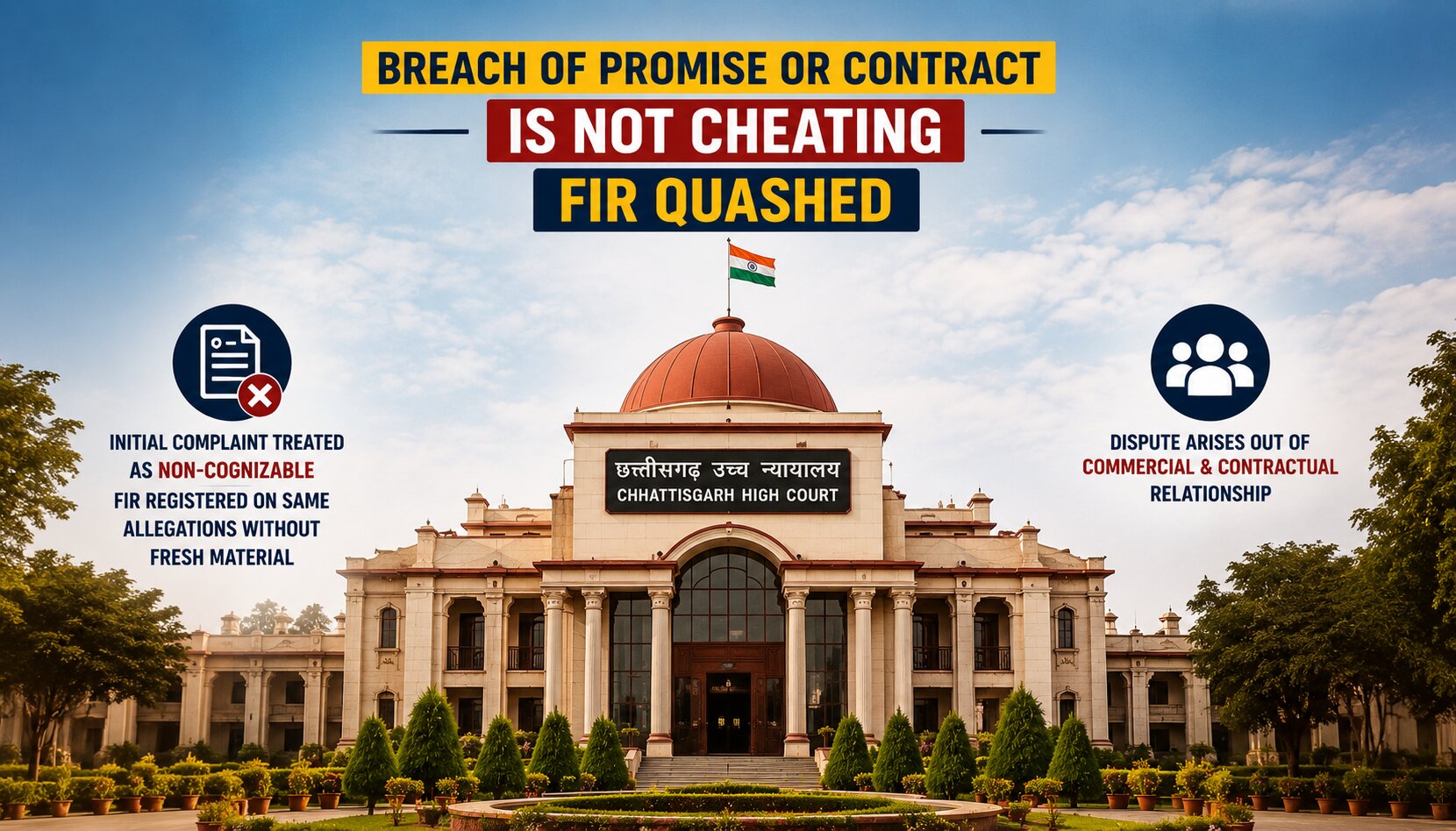
The Court held that mere breach of contract or non-fulfilment of a promise does not constitute cheating unless fraudulent or dishonest intention existed from the beginning of the transaction.
Judgement Details
Court
Chhattisgarh High Court
Date of Decision
17 August 2026
Judges
Chief Justice Ramesh Sinha and Justice Ravindra Kumar Agrawal
Citation
Acts / Provisions
Facts of the Case
-
The petitioners were involved in a business arrangement with the complainant and other persons.
-
The complainant alleged that the petitioners induced him and others to deposit a total amount of ₹1,02,480.
-
According to the complaint, the money was deposited on the assurance that the complainant and others would be appointed as Salesmen/Agents.
-
It was further alleged that they were promised a monthly salary of ₹22,000 along with other benefits.
-
The promised benefits were allegedly not provided.
-
The complainant consequently alleged that the petitioners had committed cheating.
-
The persons involved had voluntarily joined the business as Independent Business Owners.
-
They had executed Direct Seller Agreements on stamp paper governing the relationship between the parties.
-
The agreements did not contain a stipulation providing for a monthly salary of ₹22,000.
-
The agreements also did not contain the alleged promise concerning food and accommodation.
-
The complainant submitted a complaint to the police on 18 September 2025.
-
The police initially treated the matter as a non-cognizable dispute.
-
Proceedings were recorded under Section 155 CrPC, corresponding to Section 174 BNSS.
-
The complainant was advised to approach the competent court.
-
However, only two days later, on 20 September 2025, the police registered an FIR on the same allegations.
-
No fresh material or significant change in circumstances was shown to have occurred between the initial non-cognizable proceedings and registration of the FIR.
-
The petitioners approached the High Court seeking quashing of the FIR.
-
They argued that the dispute was essentially commercial and contractual.
-
They further argued that there was no material demonstrating that they had a fraudulent or dishonest intention from the inception of the transaction.
-
The High Court examined whether the allegations disclosed the essential ingredients of cheating under Section 318(4) BNS.
-
The Court also examined the significance of the police initially treating the same complaint as a non-cognizable dispute and subsequently registering an FIR without any fresh material.
Issues
-
Whether mere non-fulfilment of contractual promises or breach of contractual terms, without fraudulent or dishonest intention at the inception of the transaction, constitutes cheating under Section 318(4) of the Bharatiya Nyaya Sanhita, 2023?
-
Whether the allegations in the FIR prima facie disclose the essential ingredients of the offence of cheating under Section 318(4) BNS?
-
Whether a dispute arising primarily from a commercial or contractual relationship can be given a criminal colour in the absence of material indicating fraudulent intention from the inception?
-
Whether registration of an FIR on the same allegations that had initially been treated by the police as a non-cognizable dispute, without any fresh material, is sufficient to indicate an improper criminalisation of a contractual dispute?
-
Whether the existence of Direct Seller Agreements governing the parties' rights and obligations supports the conclusion that the dispute is essentially contractual in nature?
-
Whether continuation of the criminal proceedings in the absence of the essential ingredients of the alleged offence would amount to an abuse of the process of law?
Judgement
-
The Chhattisgarh High Court allowed the petition.
-
The Court quashed the impugned FIR registered against the petitioners.
-
The Court found that the dispute essentially arose from a commercial and contractual relationship between the parties.
-
The Direct Seller Agreements governed the rights and obligations of the parties.
-
The agreements did not contain the alleged promise of a ₹22,000 monthly salary or the provision of food and accommodation.
-
The Court found no prima facie material demonstrating that the petitioners possessed a fraudulent or dishonest intention at the inception of the transaction.
-
The Court emphasised that fraudulent intention at the inception is an essential component of the offence of cheating.
-
Mere subsequent failure to fulfil a promise or contractual obligation does not automatically establish criminal cheating.
-
The Court also considered the fact that the police initially treated the complaint dated 18 September 2025 as a non-cognizable matter.
-
Despite there being no apparent fresh material, the police registered an FIR on 20 September 2025 on the same allegations.
-
The Court found that the record did not disclose any tangible material explaining the change from a non-cognizable proceeding to registration of a cognizable FIR.
-
This circumstance supported the petitioners' contention that a business dispute had been given a criminal colour.
-
The Court held that the essential ingredients of the alleged criminal offence were not made out.
-
Continuation of the criminal proceedings was therefore not justified.
-
The FIR was consequently quashed.
Held
-
The Court held that the dispute in the present case was primarily commercial and contractual.
-
The Court found no prima facie evidence establishing the requisite fraudulent intention at the inception.
-
The Court considered the police's initial treatment of the complaint as a non-cognizable dispute significant.
-
Registration of the FIR on the same allegations, without fresh material explaining the change in approach, supported the conclusion that the contractual dispute had been given a criminal colour.
-
The essential ingredients of Section 318(4) BNS were not established.
-
The High Court therefore quashed the FIR.
Analysis
-
Cheating requires initial dishonest intention: The central principle is that criminal cheating is not established merely because a contractual promise is subsequently not fulfilled. The prosecution must show the requisite dishonest or fraudulent intention at the time the promise or transaction was made.
-
Contractual dispute versus criminal offence: The Court distinguished between a genuine commercial dispute and conduct that is criminal from its inception. A party cannot ordinarily convert every failed business arrangement into a criminal prosecution.
-
Importance of contractual documents: The Direct Seller Agreements were significant because they recorded the actual contractual relationship. The absence of provisions promising a ₹22,000 salary, food or accommodation weakened the allegations based on those alleged promises.
-
Subsequent failure is not automatically cheating: Even if one party fails to perform a contractual obligation, that failure by itself does not establish that the party had dishonest intentions when the contract was entered into.
-
Change from NCR to FIR: The Court found the sequence of events important. The police initially treated the complaint as non-cognizable but registered a cognizable FIR only two days later on the same allegations.
-
Need for fresh material: Where there is a significant change in the nature of police proceedings, the record should disclose the material or circumstances justifying that change. The absence of such material supported the petitioners' contention.
-
Criminal colour to civil dispute: The judgment reinforces the principle that criminal law should not be used merely as a pressure mechanism for resolving contractual or commercial disagreements.
-
Quashing jurisdiction: The High Court can intervene where the allegations, even if accepted at face value, do not disclose the essential ingredients of the alleged offence or where continuation of the proceedings would amount to an abuse of process.
-
Business relationships and criminal liability: The decision is particularly relevant to disputes involving sales agencies, direct-selling arrangements, employment-like assurances and commercial inducements, where dissatisfied parties may attempt to invoke criminal provisions after a business relationship breaks down.
-
No finding on contractual liability: Quashing the FIR does not necessarily mean that every contractual claim of either party is finally determined. Appropriate civil or contractual remedies may remain available.
-
Broader significance: The judgment protects the boundary between civil/commercial liability and criminal liability, while reiterating that criminal prosecution requires the ingredients of the specific offence to be established.