
Mohd. Saquib Ansari v. State NCT of Delhi, 2026
Prolonged incarceration cannot continue indefinitely merely because the accused is being prosecuted under the UAPA.
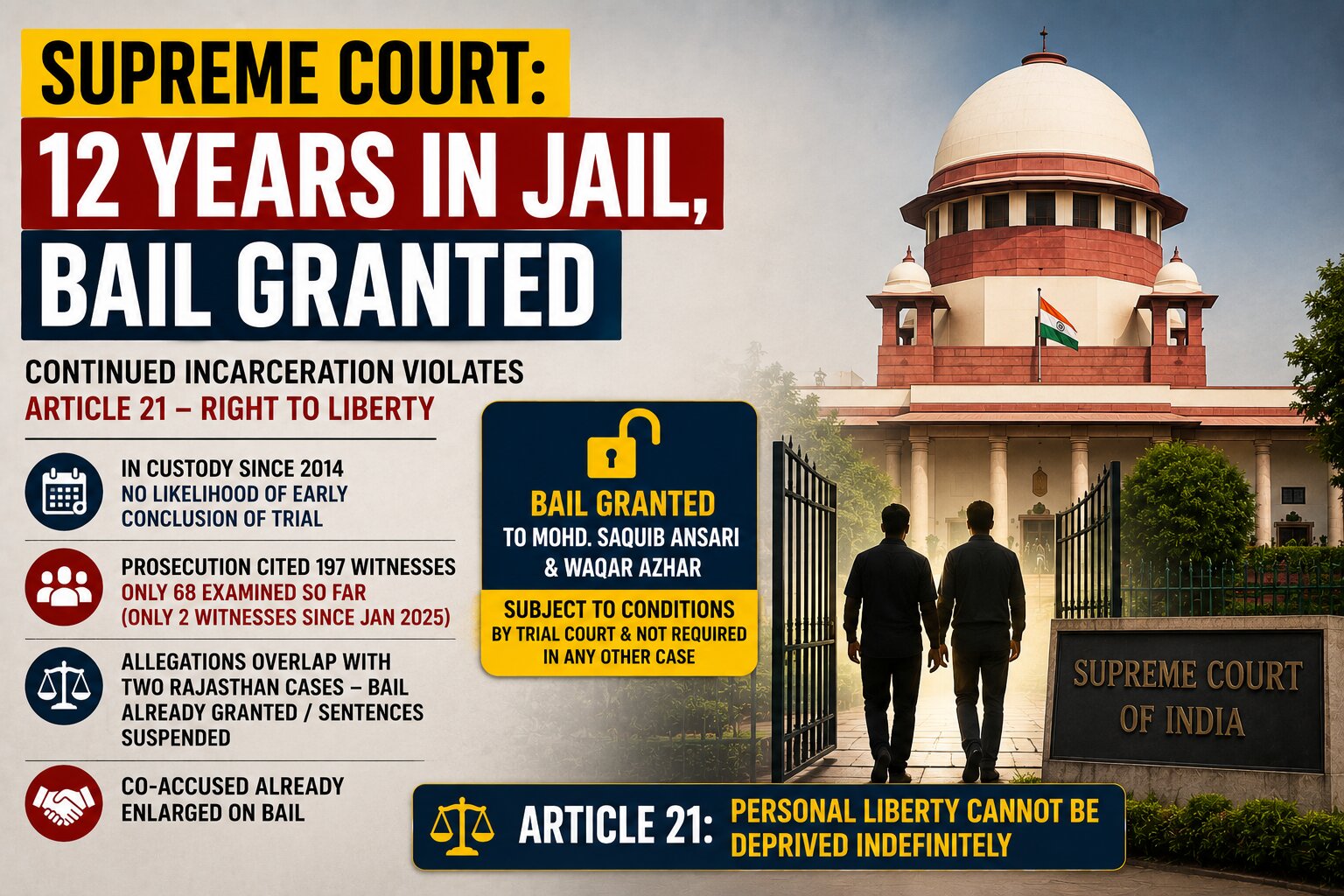
Judgement Details
Court
Supreme Court of India
Date of Decision
4 August 2026
Judges
Justice Vikram Nath and Justice Sandeep Mehta
Citation
Acts / Provisions
Facts of the Case
-
The case concerned Mohd. Saquib Ansari and Waqar Azhar, who were facing prosecution under the UAPA.
-
The proceedings arose from FIR No. 54 of 2011, registered by the Delhi Police Special Cell.
-
The petitioners had remained in custody since 2014, resulting in nearly 12 years of incarceration.
-
The prosecution case originated from the arrest of Mohd. Qateel Siddiqui in November 2011.
-
His alleged disclosures led the investigating agency to an alleged Rajasthan module of the Indian Mujahideen.
-
Explosives and alleged IED-making materials were subsequently recovered from premises connected with the petitioners in Rajasthan.
-
Separate FIRs were registered in Rajasthan in addition to the Delhi case.
-
The allegations in the Delhi and Rajasthan cases substantially overlapped.
-
In one Rajasthan case, the petitioners were convicted in 2021, but their sentences were subsequently suspended by the Rajasthan High Court.
-
In another Rajasthan case, the petitioners had already been granted bail.
-
Consequently, the Delhi case was the principal proceeding in which the petitioners remained incarcerated.
-
Their bail applications were rejected by the Trial Court under the stringent requirements of Section 43D(5) UAPA.
-
The Delhi High Court subsequently upheld the rejection of bail.
-
The petitioners then approached the Supreme Court.
-
The Supreme Court examined the actual progress of the Delhi trial through the e-Courts record.
-
The prosecution had cited 197 witnesses, but only 68 witnesses had been examined.
-
The Court particularly noted that from January 2025 onward, only two witnesses had been examined, with one examination remaining incomplete.
-
The Delhi case involved 25 accused persons, further contributing to the lengthy proceedings.
-
The Court also noted that a co-accused, Mohd. Maroof, had already been granted bail.
-
Considering the prolonged custody and extremely slow progress of the trial, the Supreme Court examined whether continued detention remained constitutionally justified.
Issues
-
Whether nearly twelve years of incarceration without a reasonable prospect of an early conclusion of trial violates the right to personal liberty guaranteed under Article 21 of the Constitution?
-
Whether prolonged incarceration can justify grant of bail to an accused prosecuted under the stringent provisions of the UAPA?
-
Whether the restrictions contained in Section 43D(5) of the UAPA must be considered alongside the constitutional guarantee of personal liberty under Article 21?
-
Whether the extremely slow progress of the trial, with only 68 out of 197 prosecution witnesses examined, justified the release of the petitioners on bail?
-
Whether the overlapping nature of the Delhi and Rajasthan proceedings and the bail or suspension of sentence already granted in the Rajasthan cases were relevant circumstances for deciding bail?
-
Whether the petitioners could be released on bail subject to appropriate conditions despite the seriousness of the allegations against them?
Judgement
-
The Supreme Court allowed the petitions for bail.
-
The Court directed the release of Mohd. Saquib Ansari and Waqar Azhar on bail in the Delhi case.
-
Their release was made subject to conditions imposed by the Trial Court.
-
The Court also directed that they would not be released if they were required to remain in custody in any other case.
-
The Court gave significant importance to the fact that the petitioners had already spent nearly 12 years in custody.
-
The Court examined the actual progress of the trial rather than merely considering the pendency of the proceedings.
-
Out of 197 prosecution witnesses, only 68 had been examined.
-
The Court found it particularly significant that only two witnesses had been examined since January 2025.
-
The Court concluded that the trial was progressing at an extremely slow pace.
-
There appeared to be no realistic prospect of the trial concluding in the near future.
-
The Court also considered the overlapping allegations in the Delhi and Rajasthan cases.
-
It took note of the fact that the petitioners had already obtained bail or suspension of sentence in the Rajasthan proceedings.
-
The bail granted to a co-accused in the Delhi proceedings was also considered.
-
Considering the totality of circumstances, the Court held that continued incarceration had become grossly violative of the right to liberty under Article 21.
-
The Court therefore ordered the petitioners' release on bail.
-
The order did not amount to an acquittal or determination of their innocence.
Held
-
Nearly twelve years of custody, combined with extremely slow trial progress and no reasonable prospect of an early conclusion, created a serious Article 21 violation.
-
The constitutional guarantee of personal liberty remains relevant even in cases involving stringent anti-terror legislation.
-
The actual pace of the trial is an important consideration when assessing whether continued incarceration is constitutionally justified.
-
The fact that only 68 of 197 witnesses had been examined demonstrated the considerable delay in the proceedings.
-
The overlapping nature of the Delhi and Rajasthan cases and the relief already granted in the Rajasthan proceedings were relevant circumstances.
-
The bail granted to a co-accused was also a relevant consideration.
-
The petitioners were therefore entitled to bail subject to appropriate conditions.
-
Grant of bail did not determine the merits of the prosecution case.
Analysis
-
Article 21 and personal liberty: The principal constitutional principle is that personal liberty cannot be restricted indefinitely merely because criminal proceedings remain pending.
-
UAPA does not eliminate constitutional protection: Section 43D(5) creates stringent conditions for bail, but those restrictions must operate consistently with the fundamental guarantee of Article 21.
-
Extraordinary delay: The decisive factor was not simply the length of custody. It was the combination of nearly 12 years of incarceration and exceptionally slow trial progress.
-
Speedy trial: The right to a reasonably expeditious criminal trial forms an important component of personal liberty. An accused should not effectively suffer punishment through prolonged pre-trial detention before guilt has been finally established.
-
Trial progress matters: The Court looked at concrete figures — 197 witnesses cited, 68 examined, and only two examined since January 2025 — to assess whether the trial could realistically conclude in the foreseeable future.
-
No automatic bail after a particular period: The decision should not be interpreted as establishing an automatic rule that every UAPA accused becomes entitled to bail after a fixed number of years. The Court considered the overall facts and circumstances.
-
Seriousness of allegations: Serious allegations under the UAPA remain relevant. However, seriousness alone cannot justify incarceration that has become constitutionally disproportionate because the trial is moving exceptionally slowly.
-
Overlapping proceedings: The Court considered the fact that substantially similar allegations were being pursued in multiple proceedings and that the petitioners had already received relief in the Rajasthan cases.
-
Parity: The fact that a co-accused had already been granted bail was another relevant circumstance, although parity is not by itself conclusive in a UAPA matter.
-
Bail is not acquittal: The Supreme Court's decision concerns the legality and constitutional justification of continued custody. It does not determine whether the petitioners are guilty or innocent.
-
Balancing liberty and prosecution: By making release subject to conditions imposed by the Trial Court, the Court balanced the petitioners' liberty with the need to ensure their availability during the continuing trial.
-
Importance for UAPA cases: The judgment demonstrates that even under special anti-terror legislation, courts must continuously consider whether continued detention remains justified in light of constitutional liberty.
-
Role of trial courts: The case highlights the importance of effective and timely trial management, particularly where a prosecution involves numerous accused and a very large number of witnesses.
-
Constitutional principle: The broader principle is that pre-trial detention should not become indefinite punishment merely because the criminal trial has not concluded.