
Mohd. Kamil Alias Guddu and Another v. State of U.P. Through Addl. Secy., Home Deptt., Lko, 2026
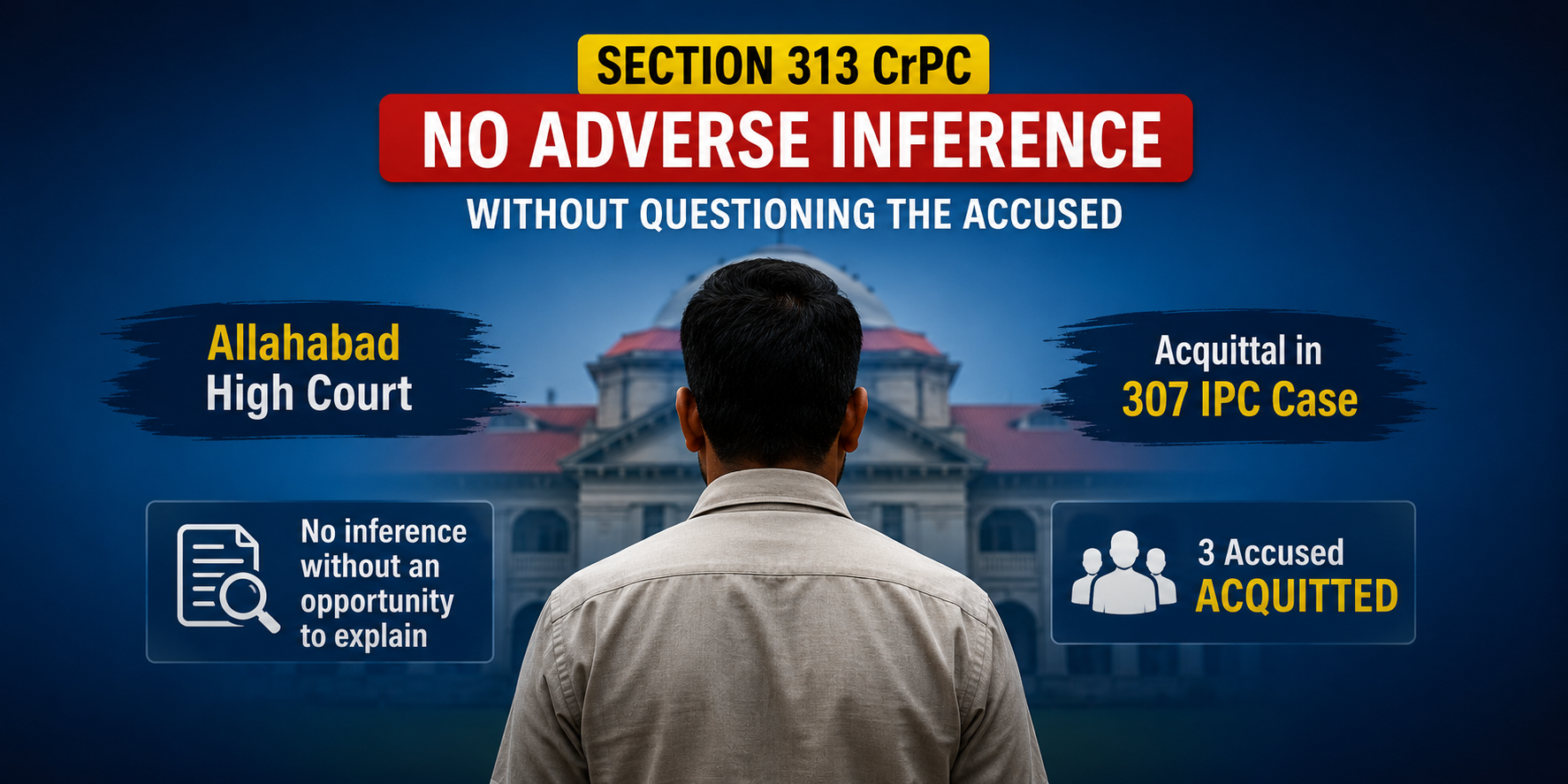
Section 313 CrPC: No Adverse Inference Without Questioning the Accused
Judgement Details
Court
Allahabad High Court
Date of Decision
30 August 2026
Judges
Justice Subhash Vidyarthi
Citation
Acts / Provisions
Facts of the Case
-
The case arose from an alleged attempt-to-murder incident dated June 9, 2006.
-
According to the prosecution, appellants Aarif Ali @ Aarif, Mohd. Kamil @ Guddu and Abdul Rauf fired at the complainant, Subarati, using country-made pistols. The complainant allegedly sustained pellet injuries to his face, neck and chest.
-
The Trial Court convicted all three accused under Section 307 IPC and sentenced each of them to seven years' rigorous imprisonment and a fine of ₹20,000.
-
The accused challenged their conviction before the Allahabad High Court.
-
During the hearing, the High Court noticed several weaknesses in the prosecution case. Importantly, Aarif had himself sustained four injuries during the incident. Although these injuries were medically documented, the prosecution failed to satisfactorily explain how he had sustained them.
-
The Trial Court had also relied on the fact that Aarif had not mentioned his injuries in his Section 313 CrPC statement. The High Court found this approach legally erroneous because the accused cannot be expected to explain a circumstance that was not specifically put to him by the Court under Section 313 CrPC.
Issues
-
Whether an adverse inference could be drawn against an accused for failing to explain a circumstance that was not put to him during his examination under Section 313 CrPC?
-
Whether the prosecution satisfactorily explained the injuries sustained by accused Aarif during the occurrence?
-
Whether the unexplained injuries of Aarif created a reasonable doubt regarding the prosecution's version of the incident?
-
Whether the contradictions concerning the genesis of the occurrence affected the credibility of the prosecution case?
-
Whether the alleged manner and place of firing were consistent with the physical and medical evidence on record?
-
Whether the prosecution had proved the guilt of the three accused under Section 307 IPC beyond reasonable doubt?
Judgement
The Allahabad High Court allowed the two connected criminal appeals and set aside the conviction and sentence imposed by the Trial Court.
The Court held that the Trial Court had adopted an incorrect approach in treating the accused's failure to mention Aarif's injuries in his Section 313 CrPC statement as a circumstance against him.
The High Court emphasized that Section 313 CrPC places a duty upon the Court to put incriminating circumstances to the accused for his explanation. If a particular circumstance is never put to the accused, the accused's failure to explain it cannot subsequently be used as an adverse circumstance against him.
The Court also identified several other inconsistencies, including:
-
The unexplained injuries suffered by Aarif.
-
Contradictions regarding the genesis of the occurrence.
-
Inconsistencies concerning whether Rauf had children or cattle.
-
Doubts concerning the place and manner of firing.
-
Absence of blood at the alleged place of occurrence despite the complainant claiming profuse bleeding.
-
Failure to produce the alleged bloodstained clothes.
-
Inconsistency between the medical evidence concerning blackening around the injury and the alleged distance from which the shots were fired.
Considering the evidence cumulatively, the Court concluded that the prosecution's case suffered from material infirmities creating reasonable doubt.
The accused were consequently acquitted of the offence under Section 307 IPC.
The Court also declined to adjudicate Mohd. Kamil's claim of juvenility because, after his acquittal, that issue had become academic unless the State challenged the judgment before the Supreme Court.
Held
-
The Allahabad High Court held that no adverse inference can be drawn against an accused under Section 313 CrPC for failing to explain a circumstance that was never put to him by the trial court.
-
The Court further held that: The accused is not required to give a narration of the prosecution story. It is the duty of the Court to specifically put the incriminating circumstances to the accused.
-
The unexplained injuries suffered by Aarif, together with other contradictions and inconsistencies in the prosecution evidence, created a reasonable doubt about the prosecution's version.
-
Accordingly, the prosecution failed to establish the guilt of the accused beyond reasonable doubt, and all three accused were acquitted.
Analysis
-
The most significant aspect of the judgment concerns the proper application of Section 313 CrPC.
-
Section 313 provides an opportunity to the accused to personally explain circumstances appearing in the evidence against him. However, this provision does not place an obligation upon the accused to independently narrate his entire defence or identify every circumstance that may support him.
-
The Court must first put the relevant incriminating circumstance to the accused and provide an opportunity for explanation. Only thereafter can the accused's response, or absence of an explanation, be considered in accordance with law.
-
The High Court rejected the Trial Court's reasoning that Aarif's failure to mention his injuries in his Section 313 statement could be used against him.
-
This reinforces the principle of fair trial and natural justice. An accused should not suffer an adverse consequence from failing to answer a question that was never asked.
-
In other words: No question → No opportunity to explain → No adverse inference on that basis.
-
The Court attached considerable significance to the fact that Aarif had sustained four injuries during the same incident.
-
Where an accused sustains injuries during an occurrence, particularly where the prosecution's witnesses are alleged to have been present, the prosecution may be expected to offer a credible explanation when the circumstances warrant it.
-
The absence of an explanation raised the possibility that the prosecution witnesses had not disclosed the complete circumstances of the occurrence.
-
The Court did not rely solely upon the Section 313 issue. Instead, it examined the prosecution evidence cumulatively.
-
The contradictions concerning the origin of the quarrel, the alleged location of the accused, the firing distance, the absence of blood evidence and the medical findings collectively weakened the prosecution case.
-
The judgment therefore demonstrates an important criminal-law principle:
-
Where material circumstances create reasonable doubt regarding the prosecution's version, the accused is entitled to the benefit of that doubt.
-
The Court also considered the relationship between the medical evidence and the prosecution's eyewitness version.
-
The alleged firing distance was approximately 55–60 feet, while the medical evidence indicated blackening around the injury, which was difficult to reconcile with the prosecution's account of the distance.
-
Similarly, the complainant claimed significant bleeding, but the investigating officer did not find blood at the spot and the alleged bloodstained clothes were not produced.
-
These discrepancies weakened the reliability of the prosecution narrative.
-
The Court's approach is particularly important because it did not treat each contradiction in isolation. It considered the cumulative effect of the infirmities.
-
The combined effect of: unexplained accused injuries + defective Section 313 examination + contradictions regarding the genesis + doubtful firing position + inconsistent medical evidence + absence of corroborating physical evidence
-
created a reasonable doubt concerning the prosecution's case.
-
This case is particularly useful for judiciary aspirants because it illustrates the practical application of Section 313 CrPC.
-
A key principle to remember is: The accused is not required to explain a circumstance unless that circumstance has first been put to him by the Court under Section 313 CrPC.
-
This principle should be distinguished from situations where a circumstance has properly been put to the accused and the accused fails to provide a satisfactory explanation.