
MOHAMMED KHALEEL (D) THROUGH LRs & ORS. v. JAYAMMA, 2026
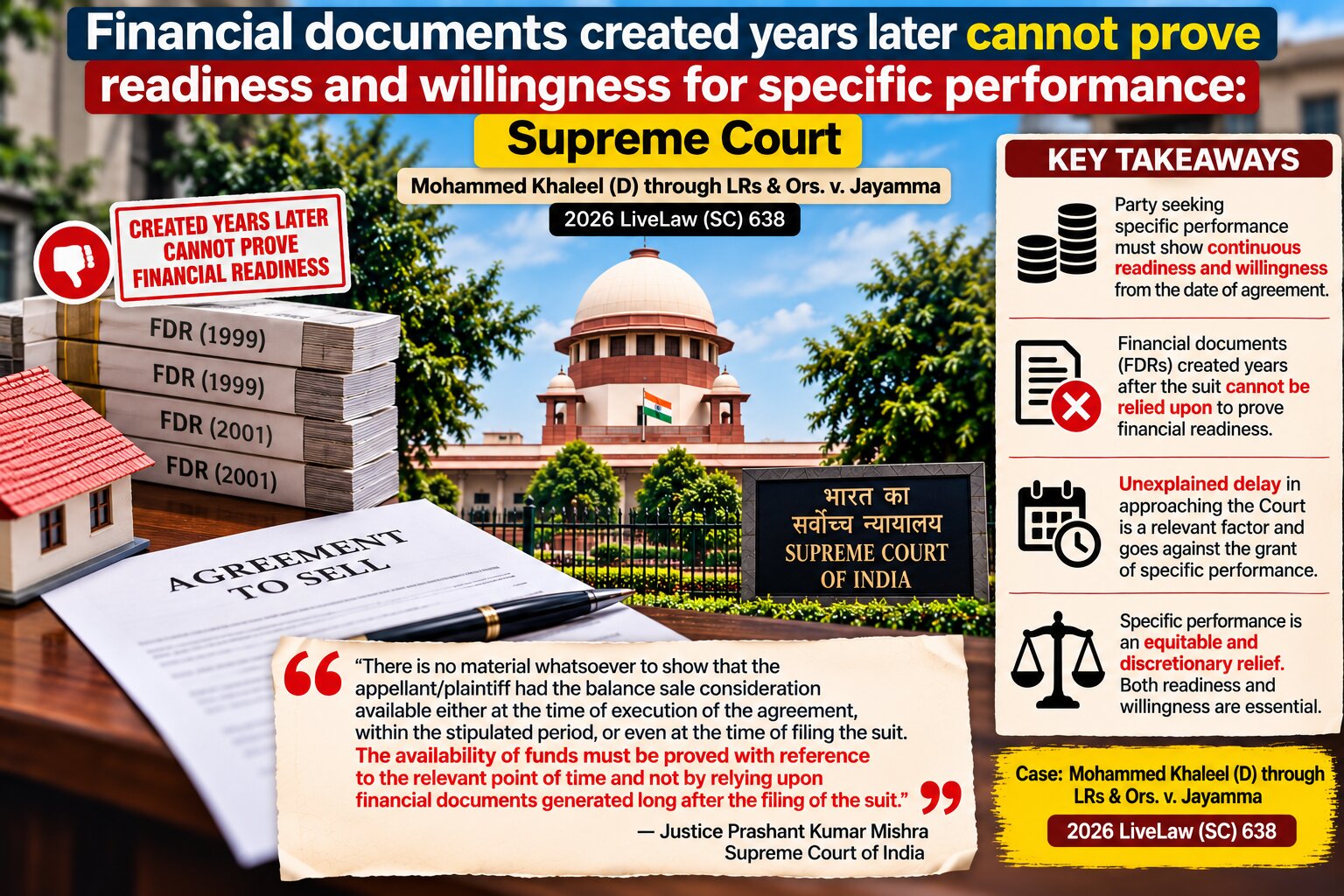
A plaintiff seeking specific performance must continuously demonstrate readiness and willingness to perform the contractual obligations required from him.
Judgement Details
Court
Supreme Court of India
Date of Decision
2 September 2026
Judges
Justice Prashant Kumar Mishra and Justice N.V. Anjaria
Citation
Acts / Provisions
Facts of the Case
-
Mohammed Khaleel entered into an agreement to sell with Jayamma on 20 December 1990.
-
The agreement concerned a vacant site measuring approximately 100 feet × 78 feet in Mysore.
-
The total agreed sale consideration was ₹3,00,000.
-
The plaintiff paid ₹25,000 as earnest money.
-
The balance amount of ₹2,75,000 was to be paid at the time of registration of the sale deed.
-
The agreement contemplated completion of the transaction within four months.
-
The defendant handed over several original title-related documents to the plaintiff under the agreement.
-
The plaintiff claimed that an approach road was also required to be formed to the property.
-
Disputes subsequently arose concerning the measurement of the property, formation of the approach road and obtaining the necessary statutory permission under ULCRA.
-
On 15 April 1991, the plaintiff issued a legal notice seeking performance of the agreement.
-
The defendant subsequently issued a notice dated 26 April 1991, stating that the plaintiff had failed to obtain the required permission and that the stipulated period for completing the sale had expired.
-
The defendant accordingly treated the agreement as rescinded and sought return of the documents.
-
The plaintiff issued another notice on 30 April 1991, maintaining that the necessary road had not been formed and that statutory permission had not been obtained.
-
On 30 July 1992, the plaintiff again issued a notice claiming that the defendant had forcibly taken possession and asserting readiness and willingness to perform the contract, subject to obtaining the necessary ULCRA permission.
-
The defendant replied that she was not the owner of the adjoining land over which the plaintiff wanted the approach road and alleged that the plaintiff was introducing additional conditions into the transaction.
-
The plaintiff eventually instituted the suit for specific performance on 20 December 1993, nearly two years and nine months after the defendant's refusal/rescission.
-
The plaintiff sought specific performance and possession of the property and also claimed alternative monetary compensation in the event specific performance was refused.
-
During the trial, the plaintiff relied upon various documents, including four Fixed Deposit Receipts of ₹70,000 each, totalling ₹2,80,000.
-
However, the FDRs were dated 4 October 1999, 22 November 1999, 3 April 2001 and 23 August 2001.
-
The Trial Court decreed the suit for specific performance on 31 January 2002, finding, among other things, that the plaintiff was ready and willing to perform his contractual obligations.
-
The Karnataka High Court subsequently reversed the Trial Court's decree on 9 December 2009.
-
The High Court held that the plaintiff had failed to establish readiness and willingness and also considered his delay in approaching the Court to be significant.
-
The plaintiff's legal representatives thereafter pursued the matter before the Supreme Court.
-
The Supreme Court examined whether the plaintiff had established the continuous readiness and willingness required for obtaining specific performance.
Issues
-
Whether the plaintiff seeking specific performance was required to continuously demonstrate readiness and willingness to perform his contractual obligations from the date of the agreement?
-
Whether financial capacity to pay the balance sale consideration must be established with reference to the relevant contractual period and the time of institution of the suit?
-
Whether Fixed Deposit Receipts created several years after the institution of the suit can establish the plaintiff's financial readiness at the relevant time?
-
Whether unexplained delay in filing a suit for specific performance, despite the suit being filed within the prescribed limitation period, can be considered while determining the plaintiff's readiness and willingness?
-
Whether the plaintiff's failure to take necessary steps for obtaining statutory permission required for completion of the transaction demonstrated lack of continuous willingness to perform the contract?
-
Whether the appellants were entitled to the equitable and discretionary relief of specific performance despite their failure to establish continuous readiness and willingness?
Judgement
-
The Supreme Court dismissed the appeal filed by Mohammed Khaleel's legal representatives.
-
The Court upheld the Karnataka High Court's decision refusing specific performance.
-
The Court held that continuous readiness and willingness is a condition precedent for obtaining specific performance under Section 16(c) of the Specific Relief Act as it stood prior to the 2018 amendment.
-
The Court explained that readiness relates primarily to the plaintiff's financial capacity, while willingness concerns the plaintiff's conduct and intention to perform the contract.
-
The Court found no reliable evidence establishing that the plaintiff had the balance sale consideration of ₹2,75,000 available during the relevant period.
-
The Court rejected reliance upon the four FDRs because they were created several years after the suit was instituted.
-
The Court clarified that the plaintiff was not required to physically deposit the entire sale consideration in Court, but he was required to produce reliable evidence showing availability of sufficient funds at the relevant time.
-
The Court found that the plaintiff had also failed to demonstrate continuous willingness because he did not take the necessary steps required from his side for obtaining the ULCRA permission.
-
The Court further considered the plaintiff's delay of approximately two years and nine months in filing the suit after the defendant's refusal.
-
The Court held that merely filing the suit within the limitation period did not automatically entitle the plaintiff to specific performance.
-
Since specific performance is an equitable and discretionary remedy, the plaintiff's conduct and promptness were relevant considerations.
-
The Court concluded that the appellants had failed to establish both statutory requirements of readiness and willingness.
-
The appeal was accordingly dismissed.
Held
- Readiness means financial capacity: The plaintiff must establish that he had the financial ability to pay the balance consideration at the relevant time.
-
Willingness concerns conduct: The Court examines the plaintiff's conduct and intention throughout the transaction to determine whether he genuinely intended to perform the contract.
-
Funds must be shown at the relevant time: Financial capacity must be established with reference to the period when the contract was required to be performed and, where relevant, the time of filing the suit.
-
Later-created FDRs are insufficient: FDRs created several years after institution of the suit cannot establish that the plaintiff possessed the necessary funds when the contractual obligations had to be performed.
-
Actual deposit in Court is unnecessary: The plaintiff need not physically deposit the entire sale consideration before the Court, but must produce reliable and acceptable evidence demonstrating availability of the necessary funds.
-
Delay is relevant even within limitation: A suit filed within the limitation period is not automatically entitled to a decree for specific performance. Unexplained delay can be relevant to the equitable relief.
-
Statutory cooperation matters: Where statutory permission is required for completion of the transaction, failure by the plaintiff to perform the steps required from his side may demonstrate lack of willingness.
-
Specific performance is equitable relief: The plaintiff seeking such relief must demonstrate conduct consistent with genuine and continuous willingness to perform.
-
Appeal dismissed: Because the appellants failed to establish the twin requirements of readiness and willingness and also approached the Court after substantial unexplained delay, specific performance was refused.
Analysis
- In Mohammed Khaleel (D) Through LRs & Ors. v. Jayamma, the Supreme Court reaffirmed that continuous readiness and willingness is a fundamental requirement for obtaining specific performance under Section 16(c) of the Specific Relief Act as it stood before the 2018 amendment.
- The Court distinguished readiness, which primarily concerns financial capacity, from willingness, which concerns the plaintiff's conduct and intention. The appellants failed to establish financial readiness because the FDRs relied upon by them were created several years after the suit had already been filed.
- The Court further held that the plaintiff's two-year-and-nine-month delay in approaching the Court after the defendant's refusal was relevant even though the suit was technically filed within the limitation period.
- The judgment therefore establishes that a plaintiff seeking specific performance cannot rely upon post-suit financial documents or mere assertions of willingness. The Court will examine the plaintiff's conduct and financial capacity throughout the relevant period.