
Mogal Shuaibulla Baig v. State of Andhra Pradesh & Ors., 2026
Illegal detention is the essential foundation of a habeas corpus petition.
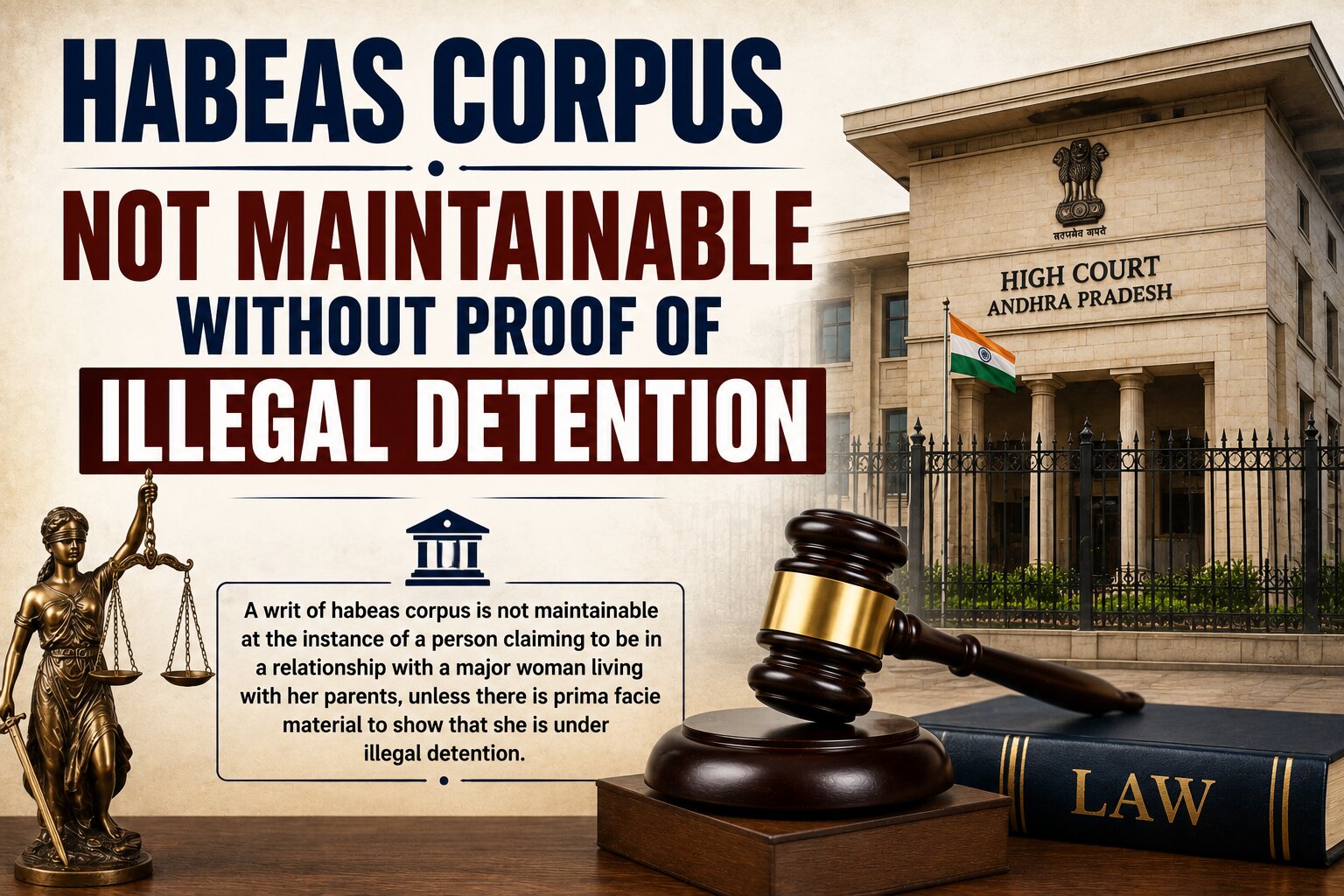
Judgement Details
Court
Andhra Pradesh High Court
Date of Decision
10 August 2026
Judges
Justice Ravi Nath Tilhari and Justice Subhendu Samanta
Citation
Acts / Provisions
Facts of the Case
-
The petitioner claimed to be in a relationship with a 22-year-old major woman.
-
He alleged that the woman was being illegally detained by her mother and brother.
-
The petitioner approached the Andhra Pradesh High Court seeking a writ of habeas corpus for her production and release.
-
He relied upon photographs and WhatsApp conversations to establish that he and the woman were in a consensual relationship.
-
He claimed that they intended to continue their life together and marry in the future.
-
The woman was residing with her mother and brother in the parental home.
-
The petitioner alleged that she was being prevented from leaving the parental home.
-
The Court examined the photographs and WhatsApp conversations produced by the petitioner.
-
The Court found that the material did not indicate that the woman was being forcibly restrained.
-
There was no prima facie material demonstrating that the woman wanted to leave her parental home but was being prevented from doing so.
-
The Court also found no material establishing that the woman's stay with her family was against her free will.
-
The petitioner essentially sought to rely upon the alleged relationship as the basis for invoking habeas corpus.
-
The High Court held that the existence of a relationship, by itself, does not establish illegal detention.
-
The Court therefore dismissed the habeas corpus petition.
-
The petitioner was left free to pursue any other remedy available under law.
Issues
-
Whether a writ of habeas corpus is maintainable at the instance of a person claiming to be in a relationship with a major woman who is residing with her parents, in the absence of prima facie material establishing illegal detention?
-
Whether photographs and WhatsApp conversations demonstrating a relationship between the petitioner and a major woman are sufficient to establish that the woman is being illegally detained by her parents?
-
Whether the mere desire of a person to continue a live-in relationship with a major woman gives him a right to seek her production or release through a writ of habeas corpus?
-
Whether the residence of a major woman with her mother and brother in the parental home, without evidence of force or restraint, constitutes illegal detention?
-
Whether the petitioner established any violation of the woman's fundamental rights under Article 21 so as to justify issuance of a writ of habeas corpus?
Judgement
-
The Andhra Pradesh High Court dismissed the habeas corpus petition.
-
The Court held that the essential requirement for issuing a writ of habeas corpus is the existence of illegal detention or unlawful restraint.
-
The woman was a major, and there was no prima facie evidence that she was being confined against her wishes.
-
The Court found that the photographs and WhatsApp conversations did not establish that the woman wanted to leave her parental home but was being prevented from doing so.
-
The Court held that the alleged relationship between the petitioner and the woman did not, by itself, create a right to seek her release through habeas corpus.
-
The Court observed that a person cannot claim a right to live with a major woman merely by relying upon an alleged live-in relationship.
-
The Bench found no sufficient factual foundation demonstrating violation of the woman's Article 21 rights.
-
The Court emphasised that habeas corpus cannot be issued merely as a matter of course.
-
The petition was therefore dismissed.
-
The Court left it open to the petitioner to pursue any other remedy available under law.
Held
- A major woman voluntarily residing with her parents is not ordinarily considered to be illegally detained merely because another person claims to be in a relationship with her.
-
The existence of a live-in relationship or intention to marry does not, by itself, establish illegal detention.
-
Photographs and WhatsApp messages showing a relationship are insufficient unless accompanied by material demonstrating force, coercion or unlawful restraint.
-
A person claiming to be the woman's boyfriend cannot use habeas corpus merely to enforce his alleged choice to live with her.
-
The Court must carefully scrutinise the foundational requirement of illegal detention when the alleged detenue is a major woman living with her parents.
-
There must be prima facie material showing that the woman's liberty is being unlawfully restricted.
-
Habeas corpus is a writ of right, but it is not issued automatically in every case.
-
In the absence of evidence of unlawful detention, the writ jurisdiction cannot be invoked merely to facilitate a personal relationship.
Analysis
-
Central principle: Habeas corpus protects individual liberty against unlawful detention. It is not a general remedy for resolving disputes concerning relationships, marriage or cohabitation.
-
Major woman's autonomy: The judgment recognises the importance of the woman's own free will. The crucial question is not simply whether she is living with her parents, but whether she is being restrained against her will.
-
Relationship is not enough: Even if the petitioner and the woman were in a genuine relationship, that fact alone would not establish illegal detention.
-
Live-in relationship: The Court specifically rejected the proposition that an alleged live-in relationship automatically gives the petitioner a right to seek production or release of the woman through habeas corpus.
-
Evidence required: A habeas corpus petition must contain material capable of establishing unlawful restraint. Mere photographs, chats or assertions regarding a relationship may not satisfy that threshold.
-
Free will: The absence of evidence that the woman wanted to leave her parents but was prevented from doing so was central to the Court's conclusion.
-
Article 21: The Court found no sufficient factual foundation showing that the woman's personal liberty under Article 21 was being violated by her mother or brother.
-
Scope of habeas corpus: Although the writ has developed into a broad constitutional remedy for protecting liberty, its fundamental purpose remains protection against unlawful detention.
-
Parental residence: A major woman living in her parental home cannot automatically be treated as a detenue simply because someone outside the family claims a relationship with her.
-
Protection against misuse: The judgment prevents habeas corpus proceedings from being transformed into a mechanism through which one individual seeks to enforce a claimed right to companionship or cohabitation.
-
Choice versus detention: The Court distinguished between a person's choice to live with another individual and the legal question of whether that individual is being unlawfully prevented from exercising that choice.
-
Burden of establishing foundational facts: Before issuing habeas corpus, the Court must have sufficient material suggesting that an unlawful deprivation of liberty has actually occurred.
-
Practical significance: Persons genuinely facing unlawful confinement can invoke habeas corpus, but those seeking to establish or enforce a relationship must rely upon the appropriate legal remedies rather than treating habeas corpus as a means of securing cohabitation.