
Mihir Prakash Bajoria v. Vidushi Jain Bajoria, 2026
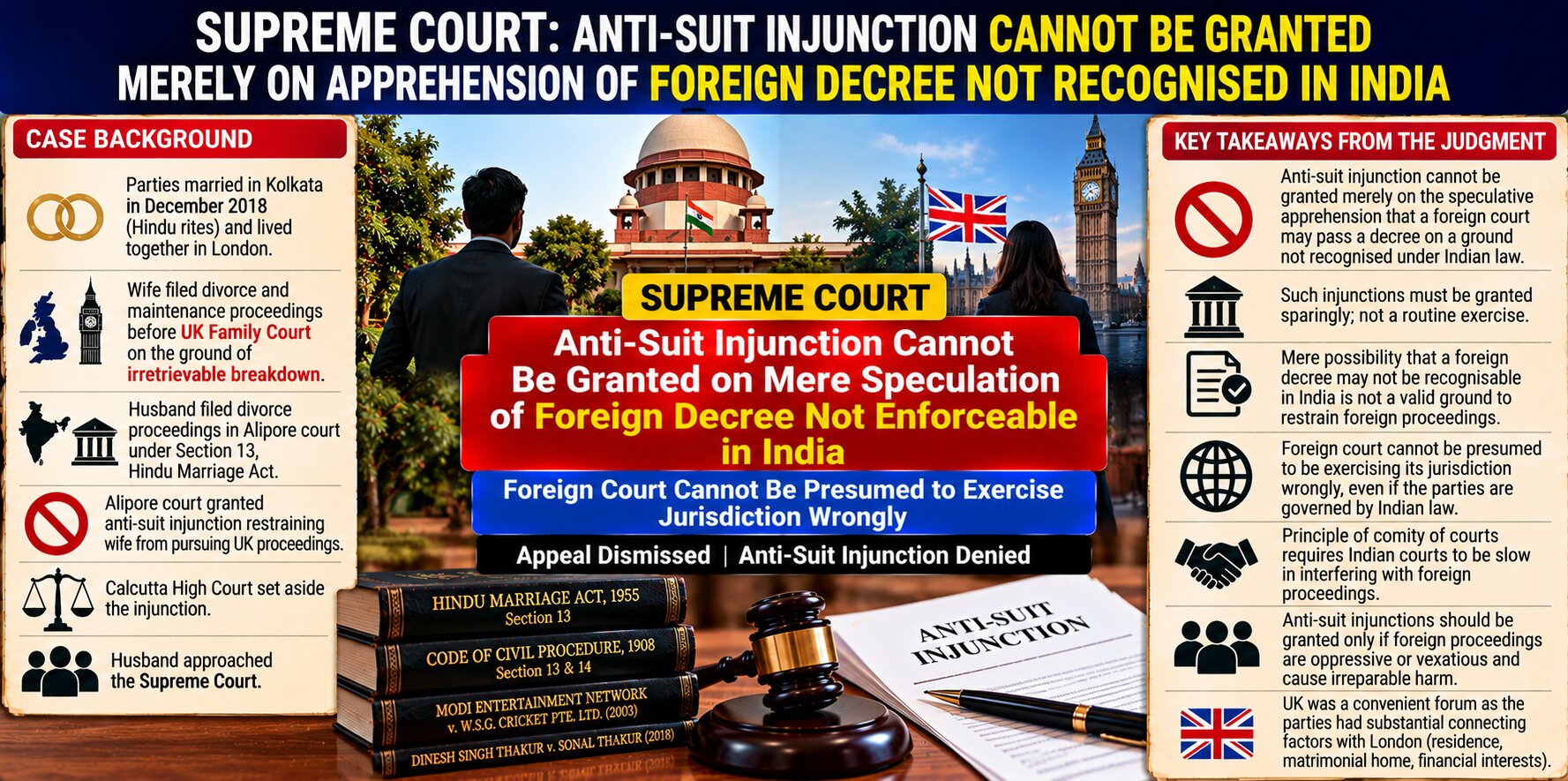
Anti-suit injunctions are an exceptional equitable remedy and cannot be granted as a matter of routine.
Judgement Details
Court
Supreme Court of India
Date of Decision
24 September 2026
Judges
Justice S.V.N. Bhatti and Justice N.V. Anjaria
Citation
Acts / Provisions
Facts of the Case
-
The parties' relationship began around 2014–2015, when the wife relocated to the United Kingdom for higher studies and subsequently lived with the husband in London.
-
The parties married in Kolkata on 15 December 2018 according to Hindu customs.
-
After marriage, they lived together in London during 2018–2020 and established matrimonial and financial interests there.
-
The wife subsequently spent periods in India and later returned to the UK with a spousal visa arranged by the husband.
-
In October 2023, both parties returned to India and stayed at the husband's family residence in Kolkata.
-
From November 2023, they began living separately, although initially under the same roof, and the wife subsequently moved to her parental home.
-
The husband instituted matrimonial proceedings before the Alipore court under Section 13 of the Hindu Marriage Act, seeking dissolution of the marriage.
-
The wife subsequently initiated proceedings before the UK Family Court, seeking dissolution of the marriage on the ground of irretrievable breakdown of marriage, along with ancillary financial relief.
-
The UK proceedings were treated as a complex case and questions concerning jurisdiction and the appropriate forum arose before the English court.
-
The husband then instituted proceedings before the Alipore court seeking, among other reliefs, a declaration that the UK proceedings were vexatious and without jurisdiction.
-
On 1 November 2025, the Alipore Trial Court granted an interim anti-suit injunction restraining the wife from prosecuting the proceedings before the UK Family Court.
-
One of the principal considerations of the Trial Court was that irretrievable breakdown of marriage was not an independent statutory ground for divorce under the Hindu Marriage Act and that a foreign decree based on such a ground might therefore face non-recognition in India under Section 13 CPC.
-
The Calcutta High Court subsequently set aside the anti-suit injunction.
-
The High Court held that questions concerning the jurisdiction of the UK court, forum non conveniens and the wife's residence were matters requiring consideration in the foreign proceedings themselves.
-
The husband challenged the High Court's decision before the Supreme Court.
-
During the pendency of the Supreme Court proceedings, the UK Family Court subsequently passed a conditional divorce decree on 17 June 2026, and the Supreme Court separately dealt with that development by an interim order.
-
The Supreme Court clarified that the present appeal remained concerned with the legality of the 2025 anti-suit injunction and that it was not deciding the validity or enforceability of any subsequent final order of the UK court.
Issues
-
Whether an Indian court can grant an anti-suit injunction merely on the apprehension that a foreign court may ultimately grant a matrimonial decree on a ground that is not independently available under Indian matrimonial law?
-
Whether the possibility that a future foreign decree may not be recognised or enforced in India is, by itself, sufficient to justify an anti-suit injunction?
-
Whether the Indian court should interfere with foreign matrimonial proceedings when questions concerning the foreign court's jurisdiction and forum conveniens remain pending before that court?
-
Whether the principles of comity of courts require Indian courts to exercise anti-suit jurisdiction sparingly and only upon established circumstances warranting such extraordinary relief?
-
Whether the substantial matrimonial, residential and financial connections of the parties with the United Kingdom constituted relevant factors against restraining the UK proceedings at an interlocutory stage?
Judgement
-
The Supreme Court dismissed the husband's appeal and upheld the Calcutta High Court's decision setting aside the anti-suit injunction.
-
The Court reiterated that Indian courts possess the power to grant anti-suit injunctions, but such jurisdiction is equitable and discretionary and must be exercised cautiously.
-
Referring to Modi Entertainment Network, the Court identified important considerations including the personal jurisdiction of the court over the party against whom the injunction is sought, whether refusal of the injunction would defeat the ends of justice, and the principle of comity of courts.
-
The Court emphasised that an anti-suit injunction is not an ordinary or routine injunction because it directly interferes with proceedings pending before another judicial forum, particularly a foreign court.
-
The Supreme Court relied upon Dinesh Singh Thakur v. Sonal Thakur, where it had cautioned that anti-suit injunctions should be granted sparingly because one court should not ordinarily interfere with the jurisdiction being exercised by another court.
-
The Court rejected the proposition that the wife's reliance on irretrievable breakdown of marriage was, at the preliminary stage, enough to justify restraining the UK proceedings.
-
The fact that a particular ground may not independently constitute a ground for divorce under the Hindu Marriage Act does not establish that the foreign court will necessarily grant a decree on that ground or exercise its jurisdiction improperly.
-
The Court held that the foreign court could not be presumed to be exercising its jurisdiction wrongly merely because the parties were governed by Hindu matrimonial law in India.
-
The possibility that a future foreign decree might ultimately fail the requirements of Section 13 CPC was therefore insufficient, by itself, to justify an anti-suit injunction.
-
The Court also attached significance to the fact that the UK proceedings were still at an inchoate stage when the Alipore court granted the injunction and that jurisdictional questions were still being considered by the UK Family Court.
-
The Court noted substantial connecting factors with the United Kingdom, including the parties' prolonged residence there, their matrimonial home in London and their financial and other established interests in that country.
-
In those circumstances, the UK could not simply be treated as an inappropriate or vexatious forum merely because Indian matrimonial law differed from the law potentially applicable before the foreign court.
-
The Supreme Court consequently found no legitimate basis for interfering with the UK proceedings through an anti-suit injunction at that stage.
-
The Court made clear that it was not deciding the ultimate validity, recognition or enforceability of any subsequent UK matrimonial decree in India.
-
The parties remained free to challenge any subsequent or final orders of the UK court before the competent forum in accordance with law.
Held
-
A court cannot restrain foreign matrimonial proceedings merely because it speculates that the foreign court may eventually grant a decree on a ground that is not available under Indian matrimonial law.
-
The mere possibility that a future foreign decree may not satisfy Section 13 CPC does not, by itself, establish the circumstances necessary for an anti-suit injunction.
-
A foreign court cannot be presumed to be exercising its jurisdiction improperly merely because the parties are governed by Indian matrimonial law.
-
Courts must consider the comity of courts and should be slow to interfere with proceedings pending before a foreign judicial forum.
-
The applicant seeking an anti-suit injunction must establish circumstances showing that continuation of the foreign proceedings is sufficiently oppressive or vexatious and that interference is necessary to prevent injustice.
-
Where the foreign proceedings are still pending and jurisdictional questions remain open before the foreign court, an Indian court should exercise particular caution before restraining those proceedings.
-
Substantial connecting factors such as the parties' residence, matrimonial home, financial arrangements and established interests in the foreign country are relevant when assessing whether the foreign proceedings should be restrained.
-
The Supreme Court did not determine whether any eventual UK decree would be recognised or enforceable in India; that question remained open for determination in appropriate proceedings if and when it arose.
-
The appeal was therefore dismissed, leaving the High Court's decision vacating the anti-suit injunction intact.
Analysis
-
The judgment reinforces the distinction between challenging the eventual recognition of a foreign judgment and preventing the foreign court from hearing the case in the first place. Section 13 CPC provides a framework for determining whether a foreign judgment is conclusive in India; it does not automatically authorise an Indian court to halt foreign proceedings before they conclude.
-
The Court's reasoning protects the principle of judicial comity, under which courts ordinarily avoid unnecessarily interfering with proceedings being conducted by courts of another jurisdiction.
-
The decision also recognises that matrimonial disputes involving internationally mobile spouses can have genuine connections with more than one legal system. The existence of an Indian marriage and the applicability of Hindu matrimonial law do not, by themselves, eliminate every legitimate connection with a foreign forum.
-
The Supreme Court placed importance on the parties' history in the UK, including their prolonged cohabitation, matrimonial home and financial arrangements. These factors supported the conclusion that the UK proceedings could not simply be characterised as an unconnected foreign action.
-
The ruling does not establish that Indian courts can never restrain foreign matrimonial proceedings. The principles governing anti-suit injunctions continue to permit such relief in appropriate cases where the demanding legal and equitable requirements are established.
-
Instead, the judgment establishes that the court must identify a real and legally sufficient basis for interference, rather than relying upon speculation about what the foreign court might decide in the future.
-
The decision is particularly important where the foreign proceedings are at an interlocutory or jurisdictional stage. Courts should ordinarily allow the foreign forum to address questions concerning its own jurisdiction before an Indian court concludes that the foreign proceedings should be stopped.
-
Dinesh Singh Thakur was particularly relevant because it involved a comparable matrimonial dispute in which a foreign divorce proceeding was based on irretrievable breakdown. The Supreme Court had previously rejected the proposition that merely invoking a ground unavailable under the Hindu Marriage Act established a sufficient likelihood of an impermissible foreign decree.
-
The judgment therefore continues a consistent line of authority requiring caution, restraint and case-specific assessment before an anti-suit injunction is issued.
-
The Court also carefully limited the scope of its ruling. During the appeal, a conditional divorce decree was passed by the UK court, but the Supreme Court expressly stated that it was not adjudicating the validity or enforceability of that subsequent order in the present appeal.
-
The broader legal significance lies in maintaining a balance between protecting a party from genuinely oppressive foreign litigation and respecting the jurisdiction of foreign courts where substantial connecting factors exist.
-
In matrimonial disputes involving multiple jurisdictions, the judgment indicates that the mere difference between Indian matrimonial grounds and foreign matrimonial law is not enough to obtain an anti-suit injunction. The applicant must satisfy the established equitable and jurisdictional principles governing that remedy.