
Metta Appana v. The State of Andhra Pradesh and Others, 2026
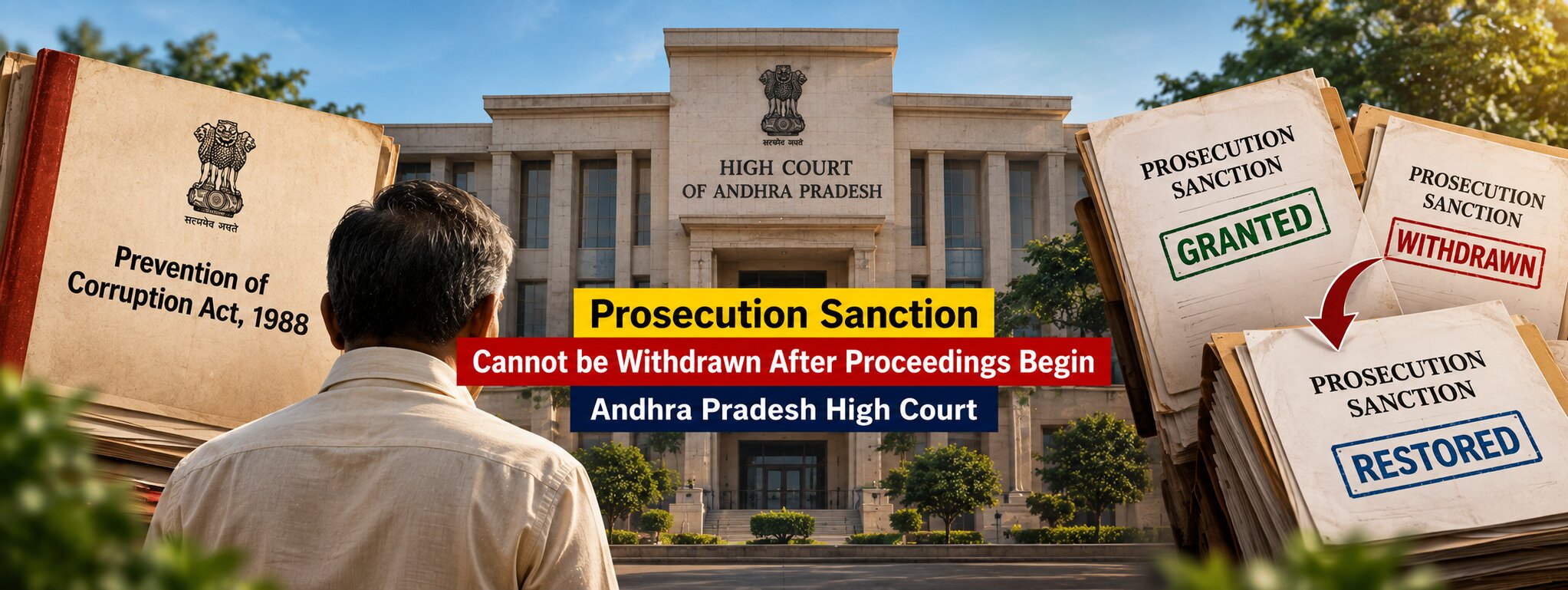
A mere change of opinion is not, by itself, a sufficient basis for reconsidering an earlier decision concerning prosecution sanction.
Judgement Details
Court
High Court of Andhra Pradesh
Date of Decision
2 September 2026
Judges
Justice Balaji Medamalli
Citation
Acts / Provisions
Facts of the Case
-
The petitioner, Metta Appana, joined the Municipal Administration and Urban Development Department on 8 June 1977 as an Engineering Supervisor and subsequently served in various capacities.
-
He ultimately retired as an Executive Engineer in 2017, after approximately 38 years of service.
-
The Anti-Corruption Bureau (ACB) registered FIR No.14 of 2010 on 27 September 2010, alleging that the petitioner possessed assets disproportionate to his known sources of income.
-
The alleged disproportionate assets were initially calculated at approximately ₹43.52 lakh and were subsequently enhanced to approximately ₹84.89 lakh.
-
After investigation, the ACB filed a charge sheet, which was taken cognizance of by the III Additional District Judge-cum-Special Judge for ACB Cases, Visakhapatnam, as C.C. No.15 of 2014. The Government had originally granted sanction for prosecution through G.O.Ms.No.200 dated 20 September 2014.
-
The petitioner later submitted representations claiming that several legitimate sources of income had not been properly considered while calculating his alleged disproportionate assets.
-
These allegedly omitted sources included bank loans, house rent, UTI bonds, agricultural income and proceeds from sale of properties.
-
The petitioner argued that after taking these sources into account, the alleged disproportionate assets would fall within the 20% permissible variation contemplated by the relevant Government memorandum.
-
Following reconsideration, the Government issued G.O.Ms.No.63 dated 16 May 2024, withdrawing the earlier prosecution sanction.
-
The Director General of ACB subsequently wrote to the Government on 12 August 2024, advising reconsideration of the withdrawal and pointing out the legal significance of the fact that sanction had already been acted upon, the charge sheet had been filed and the criminal court had taken cognizance.
-
Acting on that advice and the legal position placed before it, the Government issued G.O.Rt.No.763 dated 3 October 2024, cancelling G.O.Ms.No.63 and thereby restoring the earlier prosecution sanction.
-
The petitioner challenged G.O.Rt.No.763 before the High Court, arguing that the Government had relied on the same material that had already been considered when it withdrew the sanction.
Issues
-
Whether the Government could reconsider and restore a prosecution sanction after the earlier sanction had been withdrawn, when the criminal prosecution had already commenced?
-
Whether withdrawal of a prosecution sanction after filing of the charge sheet and taking of cognizance could be sustained in the absence of fresh material warranting such reconsideration?
-
Whether a mere change of opinion on the same material could constitute a valid basis for reviewing or reversing an earlier decision relating to prosecution sanction under Section 19 of the Prevention of Corruption Act, 1988?
-
Whether the dispute concerning the calculation of disproportionate assets and the alleged 20% permissible variation could be decided in the writ proceedings instead of being left for determination by the competent criminal court?
-
Whether G.O.Rt.No.763 dated 3 October 2024 suffered from illegality, arbitrariness or violation of Article 14 of the Constitution so as to warrant interference under Article 226?
Judgement
-
The Andhra Pradesh High Court dismissed the writ petition filed by Metta Appana and upheld the Government's decision contained in G.O.Rt.No.763 dated 3 October 2024.
-
The Court recognized that the Government possesses the power to grant, refuse or reconsider prosecution sanction, but such power cannot be exercised arbitrarily or mechanically.
-
The Court relied upon the principle that a mere change of opinion on the same material cannot ordinarily justify reconsideration of an earlier sanction decision.
-
At the same time, the Court held that reconsideration may be permissible where there is fresh material or a legally sustainable basis warranting reconsideration.
-
In the present case, the Government had initially granted sanction in 2014 and the prosecution had subsequently been launched before the competent criminal court.
-
The Court held that once a criminal prosecution has been set in motion pursuant to a valid sanction, the authorities cannot withdraw that sanction merely by reviewing the same material, unless new material warrants such reconsideration.
-
The Court found that the petitioner's argument concerning the 20% permissible variation in disproportionate assets was essentially a matter relating to the merits of the criminal case.
-
Such factual and evidentiary questions could be raised by the petitioner before the competent criminal court during trial.
-
The Court therefore declined to use the writ jurisdiction to undertake a detailed examination of the evidence or recompute the alleged disproportionate assets.
-
The Court noted that the ACB had subsequently submitted a detailed report dated 12 August 2024, referring to the relevant legal position and judicial precedents, which led the Government to reconsider the earlier withdrawal of sanction.
-
The Court concluded that there was no illegality or infirmity in G.O.Rt.No.763 warranting interference under Article 226.
-
Accordingly, the writ petition was dismissed, with no order as to costs, and the interim orders previously granted were vacated.
Held
-
A prosecution sanction granted under Section 19 of the Prevention of Corruption Act cannot be withdrawn after criminal proceedings have commenced merely on the basis of the same material that was previously considered.
-
Fresh material or a legally sustainable basis can justify reconsideration of a sanction-related decision.
-
Once a valid sanction has resulted in a charge sheet being filed and the criminal court taking cognizance, the merits of the underlying allegations should ordinarily be examined by the competent criminal court.
-
The question of whether the petitioner's alleged disproportionate assets were above or within the 20% permissible variation was a matter for determination during the criminal trial.
-
The Court found no illegality or infirmity in G.O.Rt.No.763 dated 3 October 2024.
-
The writ petition was therefore dismissed and the prosecution was allowed to proceed in accordance with law.
Analysis
-
Nature of sanction under Section 19: The judgment treats prosecution sanction as an important statutory safeguard for public servants, intended to prevent unnecessary or vexatious prosecution, while making clear that the safeguard cannot be used to frustrate an already instituted criminal proceeding.
-
Limits on review: The Court adopted the principle that the sanctioning authority cannot repeatedly reconsider the same material merely because its view has changed. This protects finality and consistency in administrative decision-making.
-
Fresh material principle: The important distinction is between a genuine reconsideration based on new material or a legally relevant development and a simple change of opinion on identical material.
-
Effect of commencement of prosecution: Once sanction has been acted upon, a charge sheet filed and cognizance taken, the dispute moves substantially into the judicial domain. The Government cannot use withdrawal of sanction as a mechanism to terminate an ongoing prosecution without a legally sustainable basis.
-
Separation between administrative and judicial functions: The Court refused to determine whether the alleged disproportionate assets actually crossed the applicable threshold. That question involves assessment of evidence and is appropriately determined by the trial court.
-
Role of Article 226: The High Court's writ jurisdiction was used to examine the legality of the Government's administrative decision, rather than to conduct a mini-trial on the allegations against the petitioner.
-
Application of judicial precedent: The Court relied upon principles from decisions including State of Punjab v. Mohd. Iqbal Bhatti and State of Himachal Pradesh v. Nishant Sareen, concerning reconsideration of sanction and the impermissibility of review based merely on the same material. It also considered subsequent judicial authorities cited by the parties.
-
Disproportionate-assets calculation: The judgment does not finally determine whether the petitioner's assets were actually disproportionate. It leaves that substantive factual question to the criminal court, preserving the petitioner's opportunity to present evidence and defences at trial.
-
Practical significance: The ruling reinforces that prosecution sanction cannot be treated as an administrative decision that can be repeatedly altered at will after criminal proceedings have begun. At the same time, it does not establish that sanction-related decisions are completely immune from reconsideration.
-
Key legal principle: The central principle is that review is not absolutely prohibited, but reconsideration cannot be founded merely on the same material and a change of opinion, particularly after prosecution has already been set in motion.