
Mashu @ Aman Joshi v. State of Uttar Pradesh, 2026
The decision underscores that proclamation proceedings under Section 82 CrPC are a significant indicator of deliberate evasion and weigh heavily against the grant of anticipatory bail.
Judgement Details
Court
Allahabad High Court
Date of Decision
14 July 2026
Judges
Justice Vivek Kumar Singh
Citation
Acts / Provisions
Facts of the Case
-
The applicant was accused of inducing the deceased woman into a physical relationship on the promise of marriage while allegedly concealing the fact that he was already married.
-
After the victim discovered his marital status, she confronted him regarding his promise to marry her.
-
The applicant allegedly refused to marry her, threatened her with serious consequences, and subjected her to continuous mental cruelty.
-
According to the prosecution, the applicant admitted that he had established physical relations with the victim on the false promise of marriage and clearly stated that he would never marry her regardless of the consequences.
-
Unable to bear the emotional trauma, the victim allegedly committed suicide on 31 January 2026.
-
An FIR was registered alleging commission of the offence of abetment of suicide under Section 108 of the Bharatiya Nyaya Sanhita, 2023.
-
The applicant initially approached the High Court seeking quashing of the FIR but was directed to surrender before the competent court and seek regular bail.
-
Instead of complying with the Court's direction, the applicant failed to surrender, resulting in initiation of proclamation proceedings under Section 82 CrPC.
-
Although the proclamation proceedings were once set aside on the applicant's assurance that he would cooperate with the investigation, he again failed to cooperate, leading to fresh proclamation proceedings.
-
Thereafter, the applicant filed the present application seeking anticipatory bail.
Issues
-
Whether an accused who has deliberately evaded investigation and court proceedings and has been declared a proclaimed offender is entitled to anticipatory bail?
-
Whether the applicant's conduct of repeatedly violating court directions and avoiding investigation disentitled him from seeking the extraordinary relief of anticipatory bail?
-
Whether the present case constituted a rare and exceptional circumstance warranting grant of anticipatory bail despite the applicant's abscondence?
Judgement
-
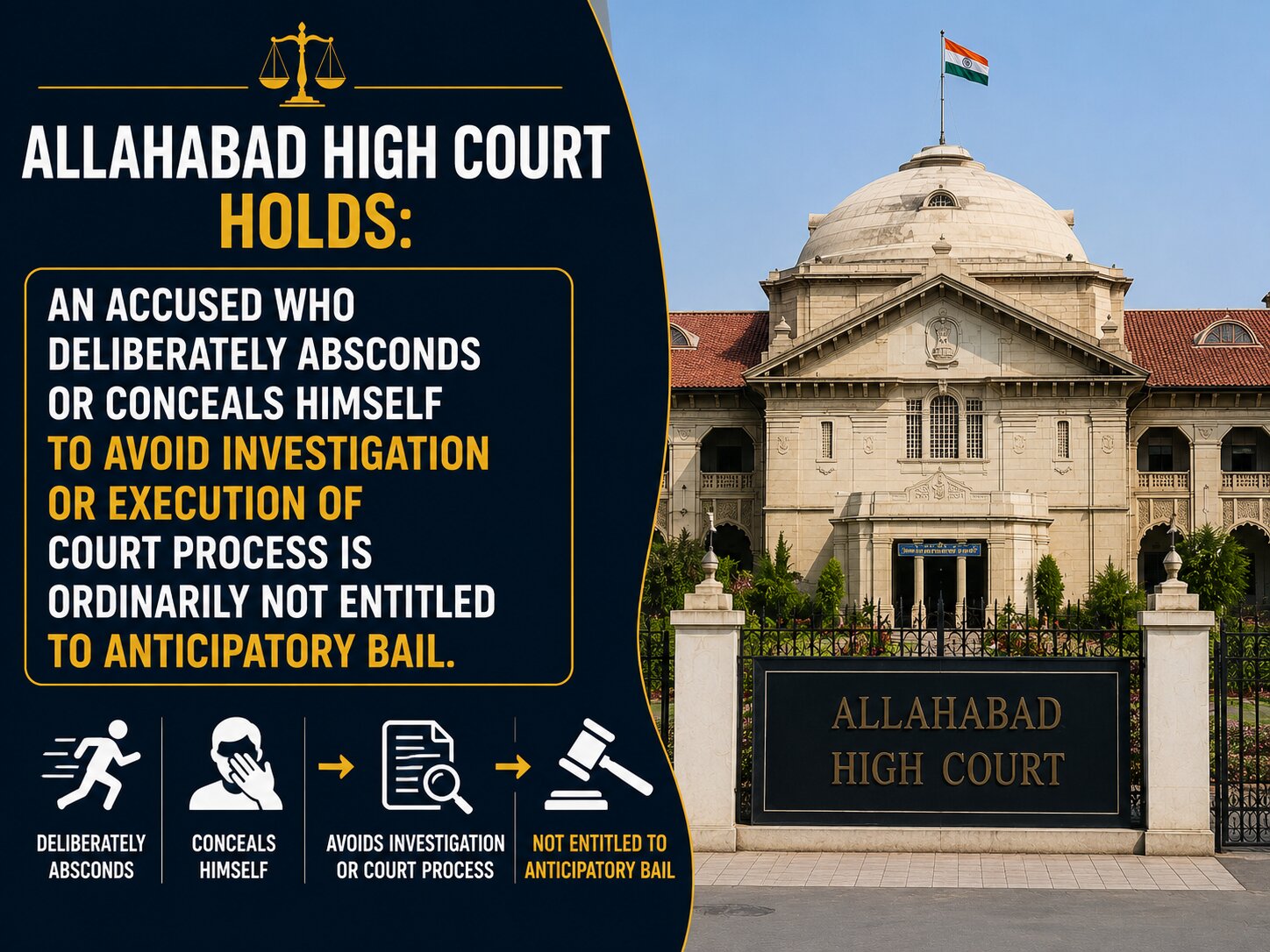
The High Court held that an accused who deliberately absconds or conceals himself to avoid investigation or execution of court process is ordinarily not entitled to anticipatory bail.
-
The Court observed that the applicant repeatedly failed to honour his assurance to cooperate with the investigating agency and intentionally remained beyond the reach of law.
-
The Court held that proclamation proceedings had rightly been initiated after the applicant failed to comply with the earlier directions issued by the High Court.
-
Relying upon Prem Shankar Prasad v. State of Bihar (2021), the Court reiterated that an absconder or proclaimed offender is generally disentitled to the relief of anticipatory bail.
-
The Court further relied upon Lavesh v. State (NCT of Delhi) (2012), wherein the Supreme Court held that once an accused is absconding and declared a proclaimed offender, anticipatory bail should ordinarily not be granted.
-
The Court also referred to Srikant Upadhyay v. State of Bihar (2024) and State of Haryana v. Dharamraj (2023), reaffirming the settled legal position governing anticipatory bail for absconding accused persons.
-
The Court observed that the applicant's deliberate disregard of judicial process deprived him of any claim that his case fell within the category of a rare and exceptional case deserving pre-arrest protection.
-
Accordingly, the anticipatory bail application was dismissed as not maintainable.
Held
-
An accused declared a proclaimed offender after deliberately evading investigation and court proceedings is ordinarily not entitled to anticipatory bail.
-
Failure to comply with court directions and repeated avoidance of investigation constitute strong grounds for refusing pre-arrest protection.
-
Anticipatory bail may be granted to a proclaimed offender only in rare and exceptional circumstances, which were absent in the present case.
-
The applicant's anticipatory bail application was dismissed.
Analysis
-
The judgment reinforces the principle that anticipatory bail is an extraordinary discretionary remedy intended to protect innocent persons from unjustified arrest, not to shield those who deliberately evade the administration of justice.
-
The Court emphasized that respect for judicial process and cooperation with investigation are essential considerations while exercising the discretionary jurisdiction relating to anticipatory bail.
-
By relying upon multiple Supreme Court precedents, the judgment consolidates the settled legal principle that absconding accused persons ordinarily forfeit their claim to pre-arrest protection.
-
The Court clarified that only rare and exceptional cases, supported by compelling legal justification, may warrant departure from the general rule against granting anticipatory bail to proclaimed offenders.
-
The judgment also highlights that repeated breaches of assurances given to the Court seriously undermine an applicant's credibility and equitable entitlement to discretionary relief.
-
Overall, the ruling strengthens judicial discipline by discouraging litigants from circumventing investigation while simultaneously seeking extraordinary relief from the courts.