
Maqbool Buhroo and Others v. Ahad Buhroo and Others, 2026
The Court's liberal interpretation of “sufficient cause” advances the objective of substantial justice.
Judgement Details
Court
High Court of Jammu & Kashmir and Ladakh
Date of Decision
3 June 2026
Judges
Justice Sanjeev Kumar
Citation
Acts / Provisions
Facts of the Case
- A Civil Second Appeal was pending before the High Court.
-
During the pendency of the appeal, Respondent No. 7 died.
-
No formal application was filed by the respondents' counsel informing the Court about the death of the respondent.
-
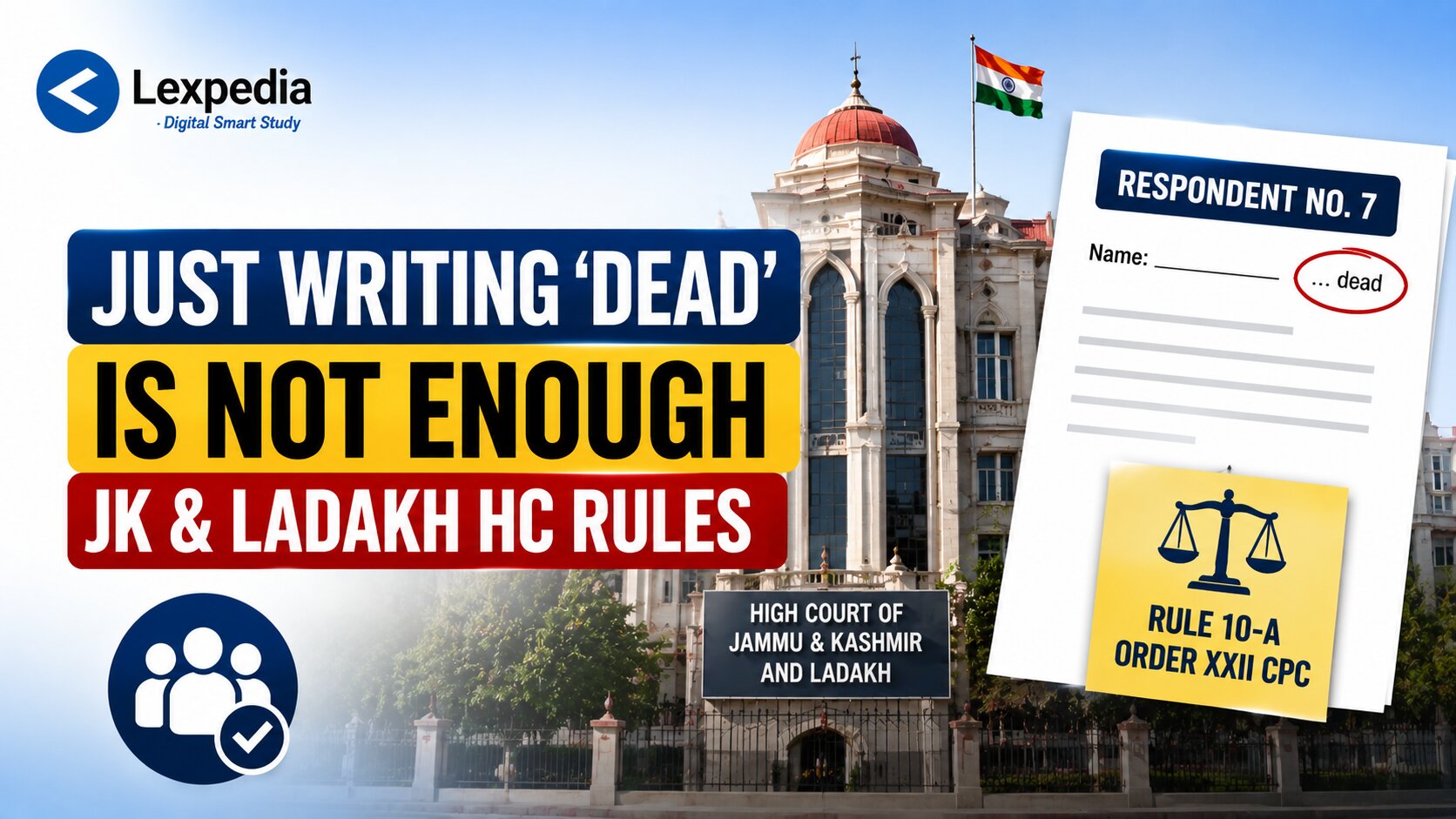
In one earlier application, the word “dead” was merely written against the respondent's name in a very small font.
-
The date, month, and year of death were not disclosed.
-
Subsequently, surviving respondents sought dismissal of the appeal on the ground that it had abated because the appellants failed to substitute the legal representatives within the prescribed limitation period.
-
The appellants filed applications seeking:
-
Condonation of delay,
-
Setting aside of abatement, and
-
Substitution of legal representatives.
-
-
The appellants contended that they became aware of the respondent's death only when an application seeking dismissal of the appeal as abated was filed.
-
They argued that the respondents' counsel had failed to discharge the statutory duty under Order XXII Rule 10-A CPC.
-
The respondents opposed the plea, contending that the parties belonged to the same village and therefore the appellants were aware of the death.
-
The High Court examined whether the respondents had properly complied with Rule 10-A CPC and whether sufficient cause existed for condoning the delay.
Issues
-
Whether merely mentioning the word “dead” against the name of a deceased respondent, without specifying the date of death, amounts to compliance with Order XXII Rule 10-A CPC?
-
Whether the counsel for a deceased party discharged the statutory obligation under Rule 10-A CPC by merely inserting the word “dead” in a previous application?
-
Whether the delay in filing applications for substitution of legal representatives and setting aside abatement should be condoned?
-
Whether knowledge of the death of a party by villagers can be equated with knowledge of the legal consequences arising from failure to substitute legal representatives within limitation?
-
Whether courts should adopt a liberal approach while considering applications for setting aside abatement?
Judgement
-
The High Court held that Rule 10-A CPC casts a statutory duty upon counsel to formally inform the Court about the death of the party represented by him.
-
The Court observed that counsel is generally the best person to know about the death of his client and must communicate the same to the Court.
-
The Bench found that merely writing the word “dead” in a very small font against the respondent's name did not amount to compliance with Rule 10-A.
-
It noted that the word was deliberately written in a manner that could easily escape attention.
-
The Court emphasized that the date, month, and year of death were not disclosed.
-
The Bench observed that such conduct appeared intended to keep the appellants unaware until the limitation period expired.
-
The Court rejected the argument that residents of the same village must necessarily be aware of the legal consequences arising from the death of a party.
-
It held that ordinary litigants cannot be expected to understand the technical legal consequences relating to abatement and substitution.
-
The Court reiterated that the expression “sufficient cause” under Section 5 of the Limitation Act should receive a liberal interpretation.
-
It emphasized that courts ordinarily prefer adjudication on merits rather than termination of proceedings on technical grounds.
-
Consequently, the Court condoned the delay and set aside the abatement.
Held
-
Mentioning the word “dead” in a small font without specifying the date of death does not constitute compliance with Order XXII Rule 10-A CPC.
-
Counsel has a statutory obligation to properly notify the Court regarding the death of a party.
-
The appellants successfully established sufficient cause for the delay.
-
The delay in filing substitution applications was condoned.
-
The abatement of the appeal was set aside.
-
The legal heirs of the deceased respondent were directed to be brought on record.
-
The appeal was allowed to proceed on merits.
Analysis
-
The judgment reinforces the mandatory nature of Order XXII Rule 10-A CPC and clarifies the obligations of advocates toward the Court and opposing parties.
-
The Court recognized that procedural fairness requires timely disclosure of a party's death so that the opposite side can take necessary legal steps.
-
By rejecting technical compliance through a cryptic notation, the Court emphasized substance over form.
-
The ruling protects litigants from being deprived of substantive rights due to procedural manoeuvres or lack of transparency.
-
The judgment promotes ethical litigation conduct and discourages strategic silence regarding material facts.
-
The Court's liberal interpretation of “sufficient cause” advances the objective of substantial justice.
-
The decision reflects the judicial preference for resolving disputes on merits rather than dismissing cases on technical procedural defaults.
-
The ruling is significant because it clarifies that awareness of a person's death does not automatically translate into awareness of the legal requirement to substitute legal representatives.
-
The judgment strengthens access to justice by preventing abatement from becoming a tool for defeating legitimate claims through procedural technicalities.