
MANNAN @ ABDUL MANNAN v. STATE OF U.P. AND ANOTHER, 2026
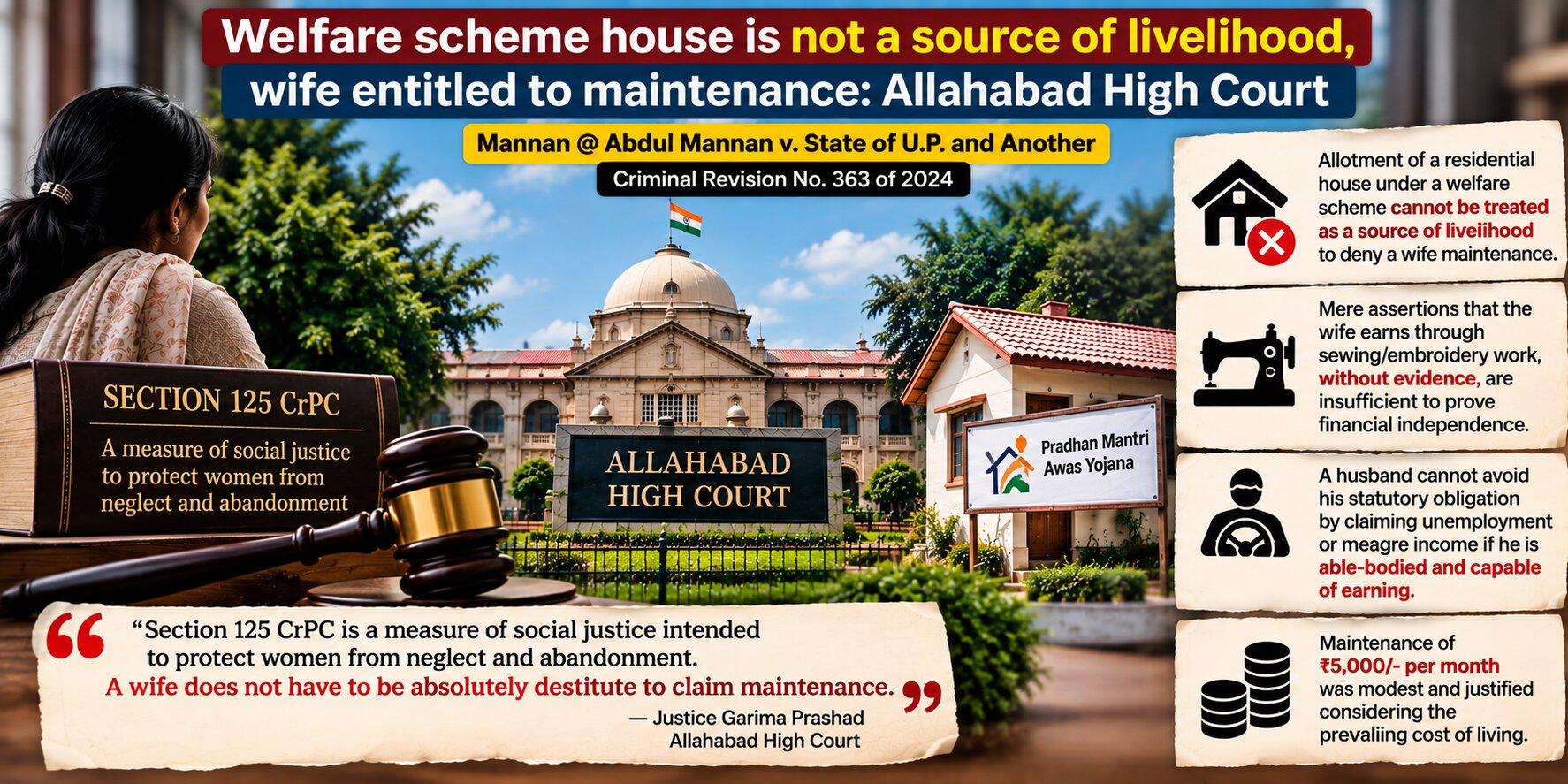
A welfare-scheme house provides shelter; it does not, by itself, establish livelihood or financial independence.
Judgement Details
Court
High Court of Allahabad
Date of Decision
9 September 2026
Judges
Justice Garima Prashad
Citation
Acts / Provisions
Facts of the Case
-
The revisionist, Mannan @ Abdul Mannan, was the husband of opposite party no. 2, the respondent-wife.
-
The parties were married on 3 December 2016 according to Muslim rites and customs.
-
The wife alleged that after marriage she was subjected to cruelty and harassment in connection with demands for additional dowry.
-
According to the wife, the matrimonial circumstances ultimately compelled her to leave the matrimonial home and reside with her parental family.
-
She further alleged that despite having sufficient means, the husband neglected and refused to maintain her.
-
On these grounds, she approached the Family Court under Section 125 CrPC seeking maintenance of ₹20,000 per month.
-
The husband admitted the marital relationship but disputed the allegations made by the wife.
-
He claimed that the wife had left the matrimonial home voluntarily.
-
He also contended that he had never neglected her and had made efforts towards reconciliation.
-
The husband claimed that he was an illiterate person who had worked as a driver and earned approximately ₹5,000 per month, but was subsequently unemployed.
-
He further alleged that the wife was earning money through sewing and embroidery work.
-
The husband also relied upon the fact that the wife had been allotted a residential house under the Pradhan Mantri Awas Yojana.
-
According to him, these circumstances demonstrated that the wife was capable of maintaining herself and that the maintenance awarded by the Family Court exceeded his financial capacity.
-
The Family Court examined the evidence and found that the wife had sufficient cause for residing separately.
-
The Family Court also found that there was no reliable evidence establishing that the wife possessed an independent and sufficient source of income enabling her to maintain herself.
-
The Family Court consequently directed the husband to pay ₹4,000 per month from the date of institution of the proceedings and ₹5,000 per month from the date of the Family Court's order.
-
The husband challenged the Family Court's order before the Allahabad High Court through the present criminal revision.
Issues
-
Whether the wife was entitled to maintenance under Section 125 of the Code of Criminal Procedure, 1973 despite the husband's allegation that she earned through sewing and embroidery work?
-
Whether allotment of a residential house to the wife under the Pradhan Mantri Awas Yojana could be treated as a source of livelihood disentitling her from claiming maintenance under Section 125 CrPC?
-
Whether the husband's assertion that he was unemployed and earning little income was sufficient to discharge him from his statutory obligation to maintain his wife?
-
Whether the maintenance awarded by the Family Court was excessive or beyond the financial capacity of the husband in the circumstances of the case?
-
Whether the High Court, while exercising revisional jurisdiction, could interfere with the Family Court's findings merely because another view of the evidence was possible?
Judgement
- The Allahabad High Court dismissed the husband's criminal revision and upheld the maintenance order passed by the Family Court.
-
The Court first explained that the purpose of Section 125 CrPC is to prevent destitution and vagrancy and to provide a swift and effective remedy to a wife who is unable to maintain herself.
-
Relying upon Chaturbhuj v. Sita Bai, the Court reiterated that the expression “unable to maintain herself” does not require the wife to be absolutely destitute before she can claim maintenance.
-
Referring to Bhuwan Mohan Singh v. Meena, the Court emphasized that maintenance proceedings are intended to enable a wife to live with dignity rather than be reduced to financial deprivation.
-
The Court also relied upon Shamima Farooqui v. Shahid Khan for the principle that an able-bodied husband cannot evade his maintenance obligation merely by asserting an inability or unwillingness to earn.
-
The husband had alleged that the wife earned through sewing and embroidery work.
-
The High Court found that no cogent evidence had been produced to establish that the wife had a regular and sufficient source of income capable of meeting her maintenance requirements.
-
The Court therefore held that mere assertions contained in pleadings cannot be treated as proof of financial independence.
-
The Court separately considered the husband's reliance upon the house allotted to the wife under a welfare scheme.
-
It held that allotment of a residential house under a welfare scheme cannot be treated as a source of livelihood so as to disentitle the wife from claiming maintenance.
-
The Court therefore distinguished between having a place to live and having an independent source of income sufficient to meet one's living expenses.
-
On the husband's alleged unemployment, the High Court relied upon the Family Court's finding that he was a skilled driver and an able-bodied person capable of earning.
-
The Court held that an able-bodied husband cannot avoid his statutory obligation merely by asserting that he is unemployed or earns a meagre amount.
-
The Court further found that the maintenance fixed by the Family Court—₹4,000 per month from the institution of the proceedings and ₹5,000 per month from the date of the order—was modest and justified considering the prevailing cost of living.
-
With regard to revisional jurisdiction, the High Court held that it does not function as an appellate court merely because another possible interpretation of the evidence exists.
-
The Court found no manifest illegality, perversity, material irregularity or jurisdictional error in the Family Court's findings.
-
Accordingly, the criminal revision was dismissed.
Held
-
A wife need not be absolutely destitute to claim maintenance under Section 125 CrPC.
-
The purpose of Section 125 CrPC is to prevent destitution and vagrancy and to provide a measure of social justice to a wife facing neglect or abandonment.
-
A mere allegation that the wife earns through sewing, embroidery or another activity, without cogent evidence establishing a regular and sufficient income, is insufficient to deny maintenance.
-
Allotment of a residential house under a welfare scheme is not, by itself, a source of livelihood.
-
Possession or allotment of a house does not establish that the wife possesses sufficient recurring income to maintain herself.
-
An able-bodied husband cannot ordinarily avoid his statutory maintenance obligation merely by claiming that he is unemployed or presently earning a meagre income, particularly where the evidence indicates that he possesses the capacity to earn.
-
The earning capacity of the husband is a relevant consideration in determining his maintenance obligation.
-
The maintenance awarded by the Family Court was not excessive or unreasonable in the circumstances.
-
Revisional jurisdiction cannot be used merely to substitute another possible appreciation of evidence for the findings of the subordinate court.
-
In the absence of manifest illegality, perversity, material irregularity or jurisdictional error, interference with the Family Court's findings was unwarranted.
Analysis
- Welfare housing is not equivalent to financial independence.
-
A government-allotted house cannot automatically be treated as a recurring source of income.
-
Allegations that a wife is earning independently must be supported by cogent evidence.
-
A wife need not establish absolute destitution to invoke Section 125 CrPC.
-
The husband's earning capacity can be relevant even where he claims to be unemployed.
-
An able-bodied husband cannot ordinarily defeat a maintenance claim through a bare assertion of unemployment.
-
Maintenance is intended to protect against destitution and financial deprivation and to facilitate a life of dignity.
-
The amount of maintenance must be considered in light of the circumstances and prevailing cost of living.
-
Revisional jurisdiction is limited and cannot ordinarily be used for wholesale reappreciation of evidence.
-
The judgment reinforces the distinction between shelter under a welfare scheme and actual financial means of livelihood.