
Manjula Kapoor v. The State of Himachal Pradesh & Anr., 2026
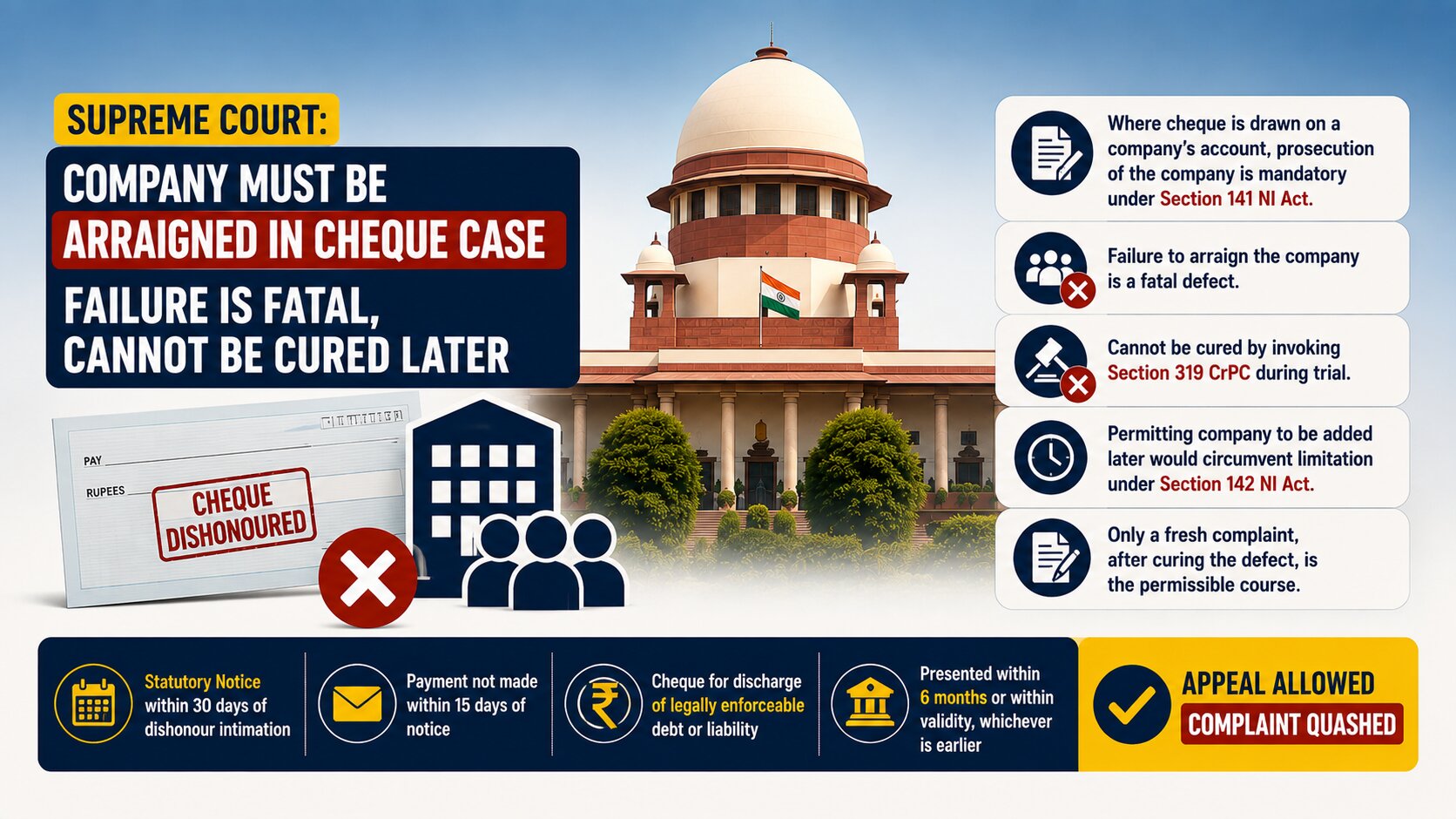
Failure to arraign the company constitutes a fatal defect where prosecution of the individual depends upon the company's liability.
Judgement Details
Court
Supreme Court of India
Date of Decision
4 August 2026
Judges
Justice Manoj Misra & Justice Vijay Bishnoi
Citation
Acts / Provisions
Facts of the Case
-
The case arose from a cheque dishonour complaint under Section 138 of the Negotiable Instruments Act.
-
The complaint alleged that M/s Cine Prime Entertainment owed the complainant ₹5 lakh.
-
A cheque was issued in connection with the alleged liability.
-
The cheque was signed by Manjula Kapoor, who was described as the company's authorised signatory.
-
The cheque was subsequently dishonoured by the bank.
-
The complainant initiated proceedings against Manjula Kapoor, but did not arraign the company as an accused.
-
The statutory demand notice was also allegedly not issued to the company.
-
The complaint therefore proceeded without the company being made an accused.
-
During the proceedings, an issue arose concerning the failure to implead the company.
-
The Himachal Pradesh High Court directed the Trial Court to invoke Section 319 CrPC and bring the company into the proceedings as an additional accused.
-
The High Court also directed that the Trial Court conduct a de novo trial after the company was joined.
-
Manjula Kapoor challenged the High Court's decision before the Supreme Court.
-
The Supreme Court considered whether a company, when it is the drawer of the cheque, must necessarily be arraigned as an accused for prosecution of its director or authorised signatory under Sections 138 and 141 of the NI Act.
-
The Court relied upon the principle laid down in Aneeta Hada, holding that prosecution of the company is a mandatory precondition for fastening vicarious criminal liability upon its directors or authorised signatories.
-
The Court further considered whether the failure to arraign the company could subsequently be cured by invoking Section 319 CrPC.
-
The Supreme Court held that where the original complaint suffers from such a fundamental and fatal defect, Section 319 cannot be used to cure the defect during the trial.
-
The Court also considered the limitation period applicable to taking cognizance of the offence against the company.
-
It found that allowing the company to be added later could effectively enable the complainant to overcome the statutory limitation period.
-
The Court clarified that the appropriate course is to file a fresh complaint after curing the defect, provided the complaint is within limitation or delay is properly condoned under Section 142 of the NI Act.
-
The Supreme Court consequently quashed the complaint and all consequential proceedings against Manjula Kapoor.
Issues
-
Whether a company must be arraigned as an accused where the dishonoured cheque is drawn on the company's bank account before criminal liability can be fastened upon its director or authorised signatory under Section 141 of the Negotiable Instruments Act?
-
Whether failure to arraign the company as an accused in a Section 138 NI Act complaint constitutes a fatal defect in the institution of the criminal proceedings?
-
Whether the Court can invoke Section 319 CrPC during trial to subsequently implead the company as an accused and thereby cure the original defect in the complaint?
-
Whether a fundamental defect in the institution of a cheque dishonour complaint can be cured during the course of the proceedings by invoking Section 319 CrPC?
-
Whether permitting the company to be arraigned subsequently would circumvent the limitation requirements prescribed under Section 142 of the Negotiable Instruments Act?
-
Whether the power to condone delay under the proviso to Section 142(1) of the Negotiable Instruments Act can be used to cure a fatal defect in the original complaint?
-
Whether the complaint and consequential proceedings against the appellant were liable to be quashed because the company had not been arraigned as an accused?
Judgement
-
The Supreme Court allowed the appeal filed by Manjula Kapoor.
-
The Court set aside the decision of the Himachal Pradesh High Court.
-
The Court held that where a cheque is drawn on a company's bank account, the company must be arraigned as an accused for prosecution of its director or authorised signatory under Section 141 NI Act.
-
The Court relied upon the principle established in Aneeta Hada that prosecution of the company is a mandatory precondition for fastening vicarious liability upon its directors.
-
Since the company was not made an accused in the original complaint, the proceedings against the appellant suffered from a fundamental defect.
-
The Court held that this defect could not be cured by subsequently invoking Section 319 CrPC.
-
Section 319 cannot be used to retrospectively validate a proceeding that was fundamentally defective from its inception.
-
The Court noted that cognizance against the company at the later stage would also raise a limitation issue.
-
Allowing the company to be added after the statutory limitation period could effectively permit the complainant to circumvent the limitation provisions of the NI Act.
-
Although Section 142 permits condonation of delay where sufficient cause is established, that power cannot be used to bypass a fundamental defect in the original complaint.
-
The Court held that the appropriate remedy is to file a fresh complaint after curing the defect, subject to limitation and the statutory provisions governing condonation of delay.
-
The High Court was therefore held to have exceeded its jurisdiction by directing the Trial Court to suo motu arraign the company.
-
The Supreme Court quashed the complaint and all consequential proceedings arising from it.
Held
-
Where the dishonoured cheque is drawn on a company's bank account, the company must ordinarily be arraigned as an accused before criminal liability can be imposed on its directors or authorised signatories under Section 141 NI Act.
-
Such a fundamental defect cannot be cured by subsequently adding the company as an accused under Section 319 CrPC during trial.
-
Subsequent arraignment of the company may also result in an attempt to circumvent the limitation period under Section 142 NI Act.
-
The power to condone delay under Section 142 cannot be used as a mechanism to cure a fatal defect in the original complaint.
-
The proper course is to institute a fresh complaint, after curing the defect, subject to the applicable limitation provisions and any legally permissible condonation of delay.
-
The High Court exceeded its jurisdiction by directing the Trial Court to suo motu add the company as an accused.
-
The complaint and consequential proceedings against the appellant were therefore quashed.
-
The Court also discussed the basic ingredients that a complainant must establish for a successful prosecution under Section 138.
-
The accused must have drawn a cheque on an account maintained with a banker.
-
The cheque must have been issued for payment of money towards the discharge, wholly or partly, of a legally enforceable debt or liability.
-
The cheque must have been presented within the prescribed period of six months from the date it was drawn or within its validity period, whichever is earlier, as stated in the supplied material.
-
The cheque must have been returned unpaid for the reasons specified under Section 138.
-
The payee or holder in due course must make a written demand for payment of the cheque amount.
-
The statutory notice must be issued within 30 days from receipt of information regarding dishonour from the bank.
-
The drawer must fail to make payment within 15 days of receiving the statutory notice.
Analysis
-
Company's arraignment is fundamental: The central principle is that where the company is the drawer of the cheque, the company itself occupies the primary position in the prosecution under Section 138 read with Section 141.
-
Vicarious liability depends upon company prosecution: Directors and authorised signatories do not become independently liable merely because they signed the cheque. The statutory framework requires the company's involvement where the company is the drawer.
-
Aneeta Hada principle: The judgment reinforces the rule that the company must be prosecuted before vicarious liability can ordinarily be imposed upon persons responsible for its conduct.
-
Fatal defect versus procedural defect: The Court drew an important distinction between an ordinary procedural irregularity and a defect going to the very foundation of the criminal proceeding. Non-arraignment of the company was treated as a fundamental defect, not a curable procedural omission.
-
Section 319 cannot create jurisdiction retrospectively: The Court rejected the attempt to use Section 319 CrPC as a mechanism to repair the original complaint. Section 319 is not a general power to cure a fundamentally defective prosecution.
-
Limitation safeguards: Allowing the company to be added only after the proceedings had progressed could have the practical effect of permitting the complainant to avoid the statutory limitation framework applicable to Section 138 complaints.
-
Section 142 does not provide unlimited discretion: Although courts have power to condone delay when sufficient cause is shown, that power cannot be transformed into a mechanism for overcoming a fundamental defect that existed when the complaint was instituted.
-
Fresh complaint as appropriate remedy: The Court clarified that the complainant is not necessarily without a remedy. A fresh complaint can be instituted after correcting the defect, provided the complaint satisfies the statutory limitation requirements or legally permissible delay is condoned.
-
Protection against procedural circumvention: The judgment prevents litigants from using procedural provisions to bypass substantive statutory requirements under the NI Act.
-
Importance for cheque litigation: Complainants dealing with corporate cheques must ensure that the company is properly arraigned and that statutory requirements are complied with from the beginning.
-
Significance for directors: The judgment provides protection against continuation of vicarious criminal proceedings where the statutory foundation for such liability has not been properly established.
-
Overall significance: The decision reinforces that a fundamentally defective Section 138 complaint cannot be retrospectively repaired by invoking Section 319 CrPC. Proper institution of the complaint and compliance with the NI Act's statutory framework are essential from the outset.