
MANIYAR ILIYAZ @ SHAIK RIYAZ & ANR. v. P. AYYAPPAN & ORS., 2026
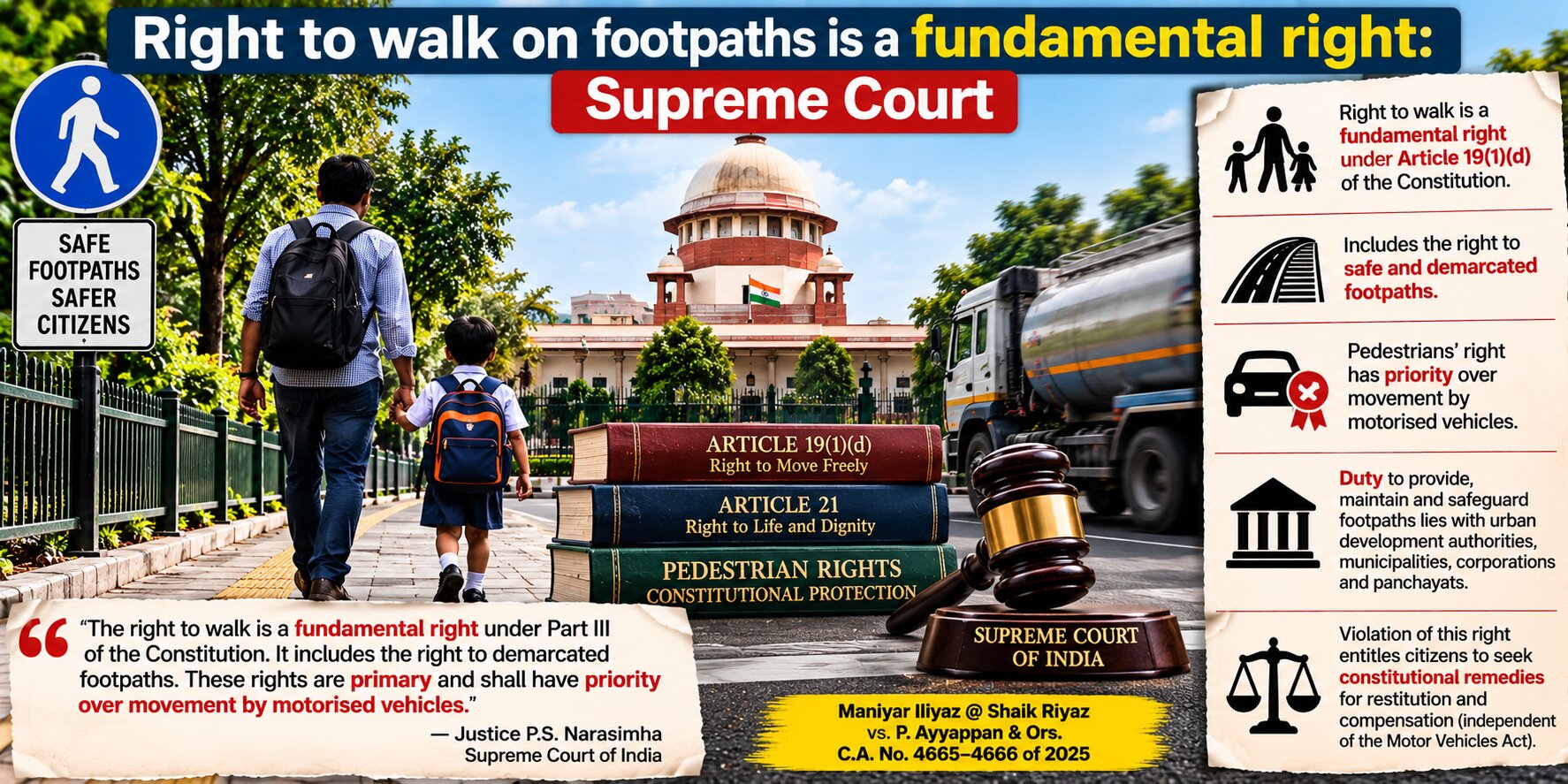
The Supreme Court held that the right to walk is a fundamental right under Part III of the Constitution.
Judgement Details
Court
Supreme Court of India
Date of Decision
2 September 2026
Judges
Justice Pamidighantam Sri Narasimha and Justice Atul S. Chandurkar
Citation
Acts / Provisions
Facts of the Case
-
The case arose out of a tragic motor accident involving a five-year-old child who was walking to school with his father.
-
The father and his five-year-old son were walking towards the neighbourhood school at around 9 a.m.
-
A tanker approached from behind and struck the child, causing devastating injuries to his waist and lower body.
-
The child ultimately succumbed to his injuries.
-
The Supreme Court noted that, at the place of the accident, there was neither a footpath nor a pedestrian crossing.
-
The father instituted a claim before the Motor Accident Claims Tribunal seeking compensation of ₹25,00,000.
-
The Motor Accident Claims Tribunal awarded ₹7,82,000 with interest at 6% per annum from the date of the claim petition until realisation.
-
Both sides approached the High Court in appeal.
-
The High Court dismissed the father's appeal and, while allowing the appeal filed by the respondent side, reduced the compensation substantially to ₹4,70,000.
-
The matter therefore reached the Supreme Court.
-
While considering the compensation dispute, the Supreme Court considered a larger constitutional question concerning the rights of pedestrians and the absence of safe and demarcated footpaths.
-
The Supreme Court observed that the constitutional concept of freedom of movement under Article 19(1)(d) cannot be restricted to movement through vehicles.
-
The Court held that walking is a fundamental form of movement and that the fundamental right to walk includes access to safe and well-demarcated footpaths.
-
The Court further held that this right has priority over the movement of motorised vehicles.
-
The Court identified urban development authorities, municipal corporations, municipalities and panchayats as duty bearers responsible for demarcating, constructing, maintaining and safeguarding footpaths and pedestrian infrastructure.
-
The Court also held that violation of the fundamental right to walk can give rise to constitutional and legal remedies for restitution and compensation, independently of remedies under the Motor Vehicles Act.
-
On the compensation issue, the Supreme Court relied upon its recent decision in Karuna Parmar v. Prakash Sinha, concerning the assessment of compensation for the death of a minor child.
-
Applying the relevant methodology, the Supreme Court recalculated the compensation payable to the appellants.
Issues
-
Whether the right to walk constitutes a fundamental right under Part III of the Constitution?
-
Whether the fundamental right to move freely under Article 19(1)(d) includes the right to walk on safe and demarcated footpaths?
-
Whether the fundamental right to walk on demarcated footpaths has priority over the movement of motorised vehicles?
-
Whether urban development authorities, municipal corporations, municipalities and panchayats have a corresponding constitutional duty to provide, maintain and safeguard demarcated footpaths?
-
Whether violation of the fundamental right to walk on demarcated footpaths gives citizens an independent constitutional or legal remedy for restitution and compensation?
-
Whether the remedies arising from violation of pedestrian rights are independent of the remedies available under the Motor Vehicles Act, 1988?
-
Whether the High Court was justified in reducing the compensation awarded by the Motor Accident Claims Tribunal from ₹7,82,000 to ₹4,70,000?
Judgement
-
The Court held that the right to walk forms an integral part of the freedom of movement guaranteed under Article 19(1)(d), read with Articles 19(1)(a), 19(1)(b), 19(1)(c) and Article 21.
-
The Court expressly recognised that the fundamental right to walk includes the right to access safe and well-demarcated footpaths.
-
The Court declared that the right of pedestrians to use demarcated footpaths is primary and must have priority over movement by motorised vehicles.
-
The Court held that where a road exists, there is a corresponding duty to ensure the availability of a demarcated and properly maintained footpath for pedestrians.
-
Urban development authorities, municipal corporations, municipalities and panchayats were identified as the principal duty bearers responsible for pedestrian infrastructure.
-
The Court held that violation of the fundamental right to walk on demarcated footpaths can entitle citizens to invoke constitutional and legal remedies for restitution and compensation.
-
The Court clarified that such remedies are independent of the remedies available under the Motor Vehicles Act, 1988.
-
The Court observed that the existing statutory framework does not adequately recognise and protect the fundamental right to walk and indicated the need for a dedicated statutory framework and regulatory mechanism.
-
The Registry was directed to re-number the matter as a petition under Article 32 and change the cause title to “Re: Fundamental Right to Walk and Footpath.”
-
The Government of India, through the Ministries of Housing and Urban Affairs, Rural Development, and Road Transport and Highways, was directed to be impleaded in the proceedings.
-
The Court held that the High Court had erred in reducing the compensation awarded by the Motor Accident Claims Tribunal.
-
Applying the methodology adopted in Karuna Parmar v. Prakash Sinha, the Court recalculated the compensation at ₹11,44,628.
-
The amount was directed to be paid within two months from the date of judgment.
-
The appeals were accordingly disposed of without an order as to costs.
Held
-
Duty of local authorities: Urban development authorities, municipal corporations, municipalities and panchayats have duties concerning demarcation, construction, maintenance and safeguarding of footpaths.
-
Independent constitutional remedy: Violation of the right to walk can justify constitutional and legal remedies for restitution and compensation.
-
Motor Vehicles Act is not the exclusive remedy: A pedestrian's constitutional remedies are independent of remedies available under the Motor Vehicles Act, 1988.
-
Need for legislative framework: The Court recognised the need for legislation and institutional mechanisms specifically designed to protect and implement pedestrian rights.
-
Compensation restored and enhanced: The Supreme Court set aside the High Court's reduction and awarded ₹11,44,628 to the appellants.
Analysis
-
Right to walk is a fundamental right: The Supreme Court expressly recognised walking as a fundamental right under Part III of the Constitution.
-
Article 19(1)(d) includes walking: Freedom of movement cannot be understood only in terms of vehicular movement. Walking is itself a constitutionally protected form of movement.
-
Footpaths form part of the right: The fundamental right to walk includes access to safe, well-demarcated and properly maintained footpaths.
-
Pedestrian rights have priority: The right of pedestrians to use demarcated footpaths is primary and has priority over the movement of motorised vehicles.
-
Corresponding governmental duty: The recognition of the right necessarily creates a corresponding duty upon relevant public authorities to provide and maintain pedestrian infrastructure.