
Manisha Jain v. State of Rajasthan & Ors., 2026
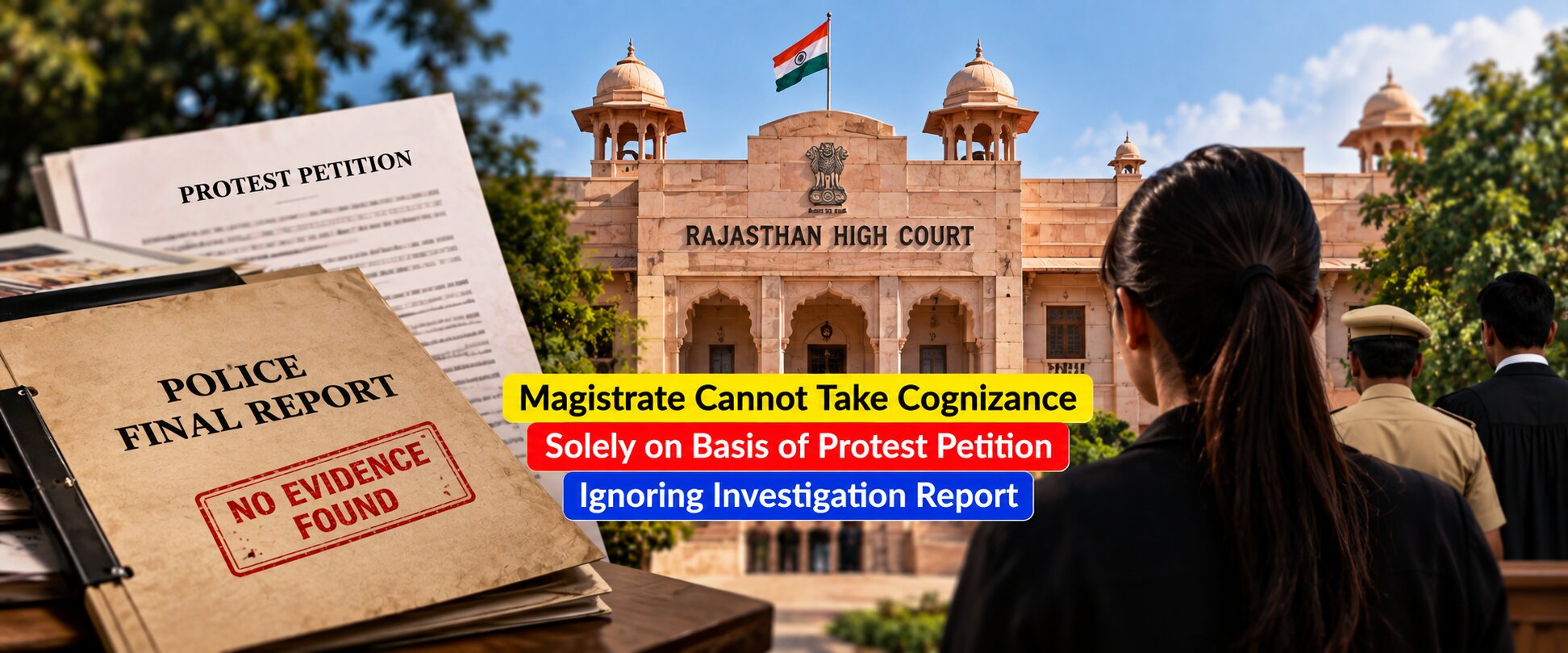
A Magistrate is not bound to accept a negative final report submitted by the Investigating Officer.
Judgement Details
Court
High Court of Rajasthan
Date of Decision
3 September 2026
Judges
Justice Farjand Ali
Citation
Acts / Provisions
Facts of the Case
-
The case arose out of an FIR registered at Police Station Kotgate, Bikaner.
-
The complainant, Manisha Jain, alleged that the accused persons, Nawla Ram and Dr. Manohar Lal, had committed offences punishable under Sections 366, 376 and 384 IPC.
-
Nawla Ram was employed as a Manager at the SBBJ Regional Office, Bikaner, while Dr. Manohar Lal was an Assistant Professor at a medical college in Bikaner.
-
After completing the investigation, the police submitted a negative final report, concluding that the material collected during investigation did not establish the alleged offences against the accused.
-
The complainant was dissatisfied with the police conclusion and filed a protest petition before the Chief Judicial Magistrate, Bikaner.
-
The Chief Judicial Magistrate, by order dated 28 May 2011, disagreed with the police's negative final report.
-
The Magistrate proceeded to take cognizance of offences under Sections 366, 376 and 384 IPC against the accused.
-
The Magistrate also issued warrants of arrest against the accused.
-
The accused challenged the cognizance order before the Additional Sessions Judge (Women Atrocities Cases), Bikaner.
-
By order dated 9 September 2014, the Additional Sessions Judge maintained the cognizance order but modified the process by directing issuance of bailable warrants instead of warrants of arrest.
-
The accused thereafter approached the Rajasthan High Court challenging the cognizance order and the consequential appellate order.
-
The principal contention before the High Court was that the Magistrate had rejected the negative final report without meaningfully examining the investigation record.
-
It was argued that the Magistrate had substantially relied upon the allegations contained in the protest petition without explaining why the Investigating Officer's conclusions were wrong or legally unacceptable.
-
The complainant, on the other hand, contended that the Magistrate possessed jurisdiction to disagree with the Investigating Officer and take cognizance if the material before the Court justified such action.
-
The High Court accepted the legal proposition that a Magistrate is not bound by a police final report.
-
However, the Court distinguished between the existence of jurisdiction and the proper exercise of that jurisdiction.
-
The Court found that the Magistrate had not adequately considered the investigation material before departing from the negative final report.
Issues
-
Whether a Magistrate is legally entitled to disagree with a negative final report submitted by the Investigating Officer and take cognizance of the alleged offences?
-
Whether a Magistrate, while disagreeing with a negative final report, is required to meaningfully consider the material collected during investigation?
-
Whether a Magistrate can reject a negative final report and take cognizance solely on the basis of the allegations contained in a protest petition without recording cogent reasons for disagreeing with the Investigating Officer?
-
Whether the failure of the Magistrate to identify the errors, perversity or legal shortcomings in the Investigating Officer's conclusions amounts to non-application of judicial mind?
-
Whether an order taking cognizance can be sustained where the Magistrate exercises jurisdiction to disagree with the final report but fails to record adequate reasons supporting such disagreement?
-
Whether the consequential order of the Additional Sessions Judge could survive after the foundational order taking cognizance was found to be legally unsustainable?
Judgement
-
The Rajasthan High Court allowed the petition filed by the accused challenging the order taking cognizance.
-
The Court clarified at the outset that a Magistrate is not bound by the conclusion reached by the Investigating Officer.
-
Therefore, submission of a negative final report does not prevent the Magistrate from independently considering the material and taking cognizance where the law permits.
-
However, the Court emphasized that the Magistrate must exercise that jurisdiction judicially and with application of mind.
-
Where the Magistrate disagrees with the Investigating Officer, the order must demonstrate meaningful consideration of the investigation material.
-
The Magistrate must indicate why the conclusions reached by the Investigating Officer are unacceptable.
-
The Court found that the Magistrate's order did not adequately identify any particular finding of the Investigating Officer that was erroneous, perverse, unsupported by the record or otherwise legally unacceptable.
-
Instead, the Magistrate substantially accepted the version contained in the protest petition.
-
The Court held that a protest petition cannot simply substitute for an examination of the investigation record.
-
The filing of a protest petition does not “eclipse” the investigation conducted by the police.
-
The Magistrate remains under an obligation to consider the material collected during investigation before deciding whether to depart from the final report.
-
The Court found that the Magistrate had virtually ignored the investigation record while accepting the protest petition version.
-
The High Court emphasized the importance of reasons in judicial orders.
-
A judicial order must disclose the reasoning process by which the Court reaches its conclusion.
-
The Court observed that jurisdiction and its lawful exercise are distinct concepts.
-
Possessing jurisdiction to disagree with the police report does not mean that the Magistrate may exercise that power mechanically.
-
The High Court independently considered the circumstances highlighted in the investigation and found that they deserved serious judicial consideration.
-
According to the Court, those circumstances had a direct bearing upon the allegations and the conclusion reached by the Investigating Officer.
-
The Magistrate had failed to deal adequately with those circumstances before taking a contrary view.
-
This failure rendered the cognizance order legally vulnerable.
-
The High Court consequently quashed the order dated 28 May 2011 passed by the Chief Judicial Magistrate, Bikaner.
-
The consequential order dated 9 September 2014 passed by the Additional Sessions Judge was also set aside.
-
The negative final report submitted by the Investigating Agency was accepted.
-
The warrants of arrest issued against the accused were directed to be recalled.
-
The petition filed by the complainant was dismissed, while the accused's connected petition was allowed.
Held
-
A Magistrate has jurisdiction to disagree with the Investigating Agency and take cognizance where the material on record justifies such action.
-
However, disagreement with the police final report must be based upon judicial consideration of the investigation material.
-
A protest petition does not eliminate or override the investigation conducted by the police.
-
Mere repetition of allegations contained in a protest petition cannot, by itself, justify rejection of a negative final report.
Analysis
- The order must demonstrate application of judicial mind to the relevant material collected during investigation.
-
An order taking cognizance without considering relevant investigation material and without explaining the reasons for rejecting the final report is legally vulnerable.
-
The existence of jurisdiction does not justify its mechanical or unstructured exercise.
-
Reasons are an essential component of a judicial order because they demonstrate that relevant material and competing contentions have been considered.
-
The cognizance order in the present case was unsustainable because of non-consideration of relevant material and failure to record adequate reasons.
-
The negative final report was accepted and the proceedings arising from the impugned cognizance order were set aside.