
Manish Bansal v. Jagdish Prasad Mittal & 7 Others, 2026
A third party asserting an independent title does not automatically become a necessary or proper party to a Small Causes Suit.
Judgement Details
Court
Allahabad High Court
Date of Decision
18 August 2026
Judges
Justice Dr. Yogendra Kumar Srivastava
Citation
Acts / Provisions
Facts of the Case
-
The dispute concerned a shop situated on the ground floor of a two-storey construction.
-
According to the pleadings, the property had belonged to late Jagdish Prasad Mittal.
-
A Small Causes Suit was pending before the Additional District Judge, Court No. 1, Bulandshahr.
-
The revisionist, Manish Bansal, sought to be impleaded as a party to the Small Causes Suit.
-
He claimed an independent title in the property.
-
His claim was based upon an unregistered Will dated 22 November 2019.
-
He alleged that the Will had been executed in his favour by the deceased in the presence of two witnesses.
-
He contended that the plaintiff was wrongly asserting exclusive rights on the basis of another Will.
-
The plaintiff opposed the impleadment application.
-
The plaintiff described the revisionist as a stranger to the family.
-
The plaintiff alleged that the Will relied upon by the revisionist was a fabricated document intended to delay the proceedings.
-
The plaintiff relied upon a registered Will dated 23 September 2019.
-
The court below rejected the revisionist's application for impleadment.
-
The court noted that the revisionist did not possess a declaration from a competent court recognising his alleged rights under the Will.
-
Before the High Court, the revisionist argued that the court below could not effectively treat his Will as forged without giving him an opportunity to lead evidence.
-
He also argued that an unregistered Will is not invalid merely because it is unregistered.
-
He further contended that a testator may lawfully exclude natural heirs and therefore his claim could not be rejected merely on that basis.
-
The revisionist argued that he should therefore be impleaded under Order I Rule 10 CPC.
-
He alternatively argued that the Small Causes Court should return the plaint under Section 23 of the Provincial Small Cause Courts Act, 1887, because the dispute involved title.
-
The High Court examined whether the revisionist's independent title claim was actually necessary for determining the plaintiff's entitlement to the relief sought in the Small Causes Suit.
Issues
-
Whether a third party claiming an independent title in the suit property becomes a necessary or proper party to a Small Causes Suit merely by asserting such independent title?
-
Whether a person claiming rights under an independent Will is required to be impleaded under Order I Rule 10 CPC when determination of his title is not necessary for deciding the plaintiff's claimed relief?
-
Whether the mere existence of a dispute concerning title requires the Small Causes Court to return the plaint under Section 23 of the Provincial Small Cause Courts Act, 1887?
-
Whether Section 23 applies where the plaintiff's entitlement to the relief claimed can be determined without finally adjudicating the independent title asserted by a third party?
-
Whether the revisionist's claim under the unregistered Will dated 22 November 2019 was necessary for adjudication of the landlord-tenant dispute before the Small Causes Court?
-
Whether the court below committed a jurisdictional error or material irregularity in refusing to implead the revisionist under Order I Rule 10 CPC?
Judgement
-
The Allahabad High Court dismissed the revision.
-
The Court held that a person does not become a necessary or proper party merely by asserting an independent interest or title in the suit property.
-
The determining consideration is whether the person's presence is necessary for the court to effectively and completely adjudicate the controversy before it.
-
The Court held that the revisionist's independent claim under the Will was not necessary for deciding the relief sought by the plaintiff.
-
The Small Causes Suit concerned the dispute forming the basis of the plaintiff's claimed relief, whereas the revisionist sought to introduce an independent title dispute.
-
Determining the revisionist's Will would require examination of its genuineness, execution and legal effect.
-
Those questions were not necessary to determine the plaintiff's entitlement in the Small Causes Suit.
-
The Court therefore held that the independent title dispute could not be introduced into the proceedings through an Order I Rule 10 CPC application.
-
The Court relied upon its earlier decision in Murti Markandeshwar Ji Maharaj Gopal Ki Bagiya City Jhansi v. Smt. Jyoti Gangwani & Another.
-
The Court explained that landlord-tenant or small causes proceedings cannot ordinarily be enlarged into proceedings for adjudication of an independent claim of title.
-
The Court also clarified the scope of Section 23 of the Provincial Small Cause Courts Act.
-
The mere fact that some question concerning title arises incidentally does not automatically make the Small Causes Suit incompetent.
-
Section 23 applies where the plaintiff's right to the relief itself depends upon determination of a title that the Small Causes Court cannot finally decide.
-
The Court specifically declined to make any finding regarding the genuineness, execution or legal effect of the Will dated 22 November 2019.
-
The observations of the court below regarding the nature of the Will were therefore not to be treated as a final determination of its validity.
-
The Court noted that the revisionist had already instituted a separate Original Suit seeking declaration of his rights under the Will.
-
That separate suit provided an appropriate forum for determining his independent title claim.
-
The existence of that separate proceeding did not, however, create a right to impleadment in the Small Causes Suit.
-
The Court found no jurisdictional error, material irregularity or perversity in the order of the court below warranting interference under Section 25 of the Provincial Small Cause Courts Act.
-
The revision was therefore dismissed.
Held
-
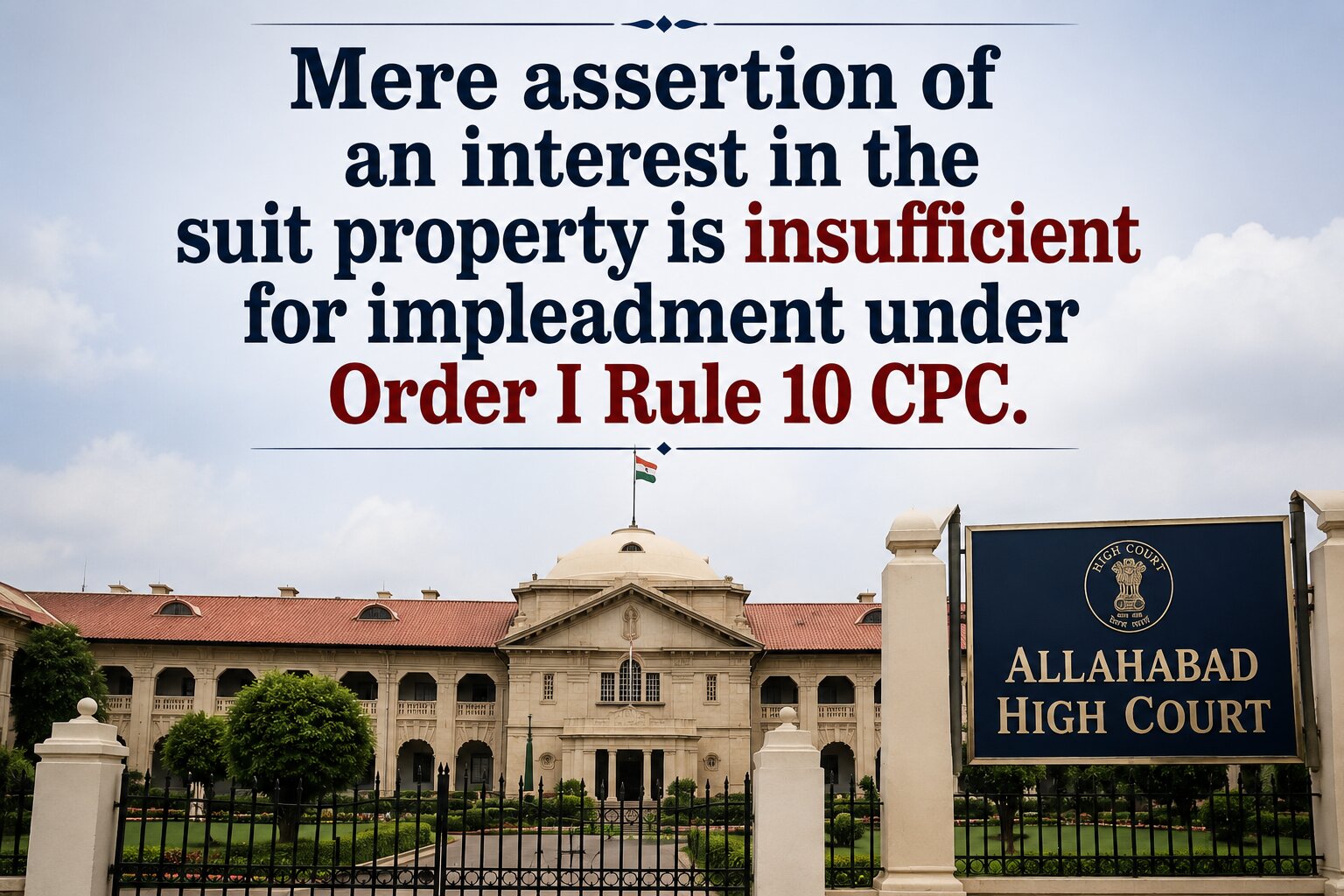
Mere assertion of an interest in the suit property is insufficient for impleadment under Order I Rule 10 CPC.
-
Impleadment depends upon whether the person's presence is necessary for effective and complete adjudication of the controversy.
-
An independent title dispute cannot be introduced into a Small Causes Suit merely because it conflicts with the plaintiff's asserted title.
-
Section 23 of the Provincial Small Cause Courts Act is attracted when the plaintiff's own right and relief depend upon determination of a title that the Small Causes Court cannot finally decide.
-
The mere existence of a title dispute concerning the property does not automatically require return of the plaint.
-
The revisionist's independent claim under the Will could be adjudicated in his separate declaratory suit.
-
The court below committed no jurisdictional error or material irregularity.
-
The revision was consequently dismissed.
Analysis
-
Necessary party versus independent claimant: The judgment draws an important distinction between someone whose presence is essential for deciding the plaintiff's claim and someone who merely asserts a separate right in the same property.
-
Order I Rule 10 is not a vehicle for expanding litigation: The Court emphasised that impleadment provisions exist to facilitate effective adjudication, not to transform a limited proceeding into a completely different title dispute.
-
Nature of Small Causes jurisdiction: Small Causes Courts are designed to deal with matters within their limited statutory jurisdiction. They cannot be converted into forums for finally adjudicating complex independent title claims that fall outside that jurisdiction.
-
Section 23 has a specific trigger: The provision is concerned with the foundation of the plaintiff's own right and relief, rather than every title dispute that happens to arise in relation to the property.
-
Incidental title questions: A Small Causes Suit does not automatically become incompetent simply because a title-related question arises incidentally. The crucial question is whether the plaintiff's entitlement necessarily depends upon final determination of that title.
-
Independent Will claim: The revisionist's case depended entirely upon his own Will. Establishing that claim would require examination of its execution, genuineness and legal effect, which was unnecessary for deciding the plaintiff's relief.
-
No adjudication of Will validity: Importantly, the High Court did not determine whether the Will relied upon by the revisionist was genuine or valid. It only held that its validity was not required to be determined in the Small Causes proceedings.
-
Separate declaratory suit: The revisionist already had a separate Original Suit in which his title claim could be fully adjudicated. This demonstrates the distinction between having a valid forum for a claim and having a right to intervene in another proceeding.
-
Avoidance of procedural enlargement: Allowing every third-party title claimant to enter a Small Causes Suit could substantially delay proceedings and defeat the purpose of the limited jurisdiction.
-
Balance between efficiency and rights: The judgment does not extinguish the third party's independent title claim. Instead, it directs that such a claim be pursued before the competent forum.
-
Broader significance: The ruling provides useful guidance on the interaction between Order I Rule 10 CPC and Section 23 of the Provincial Small Cause Courts Act, particularly where third parties attempt to introduce independent ownership disputes into limited-jurisdiction proceedings.