
Mani @ Subramaniyam v. State, 2026
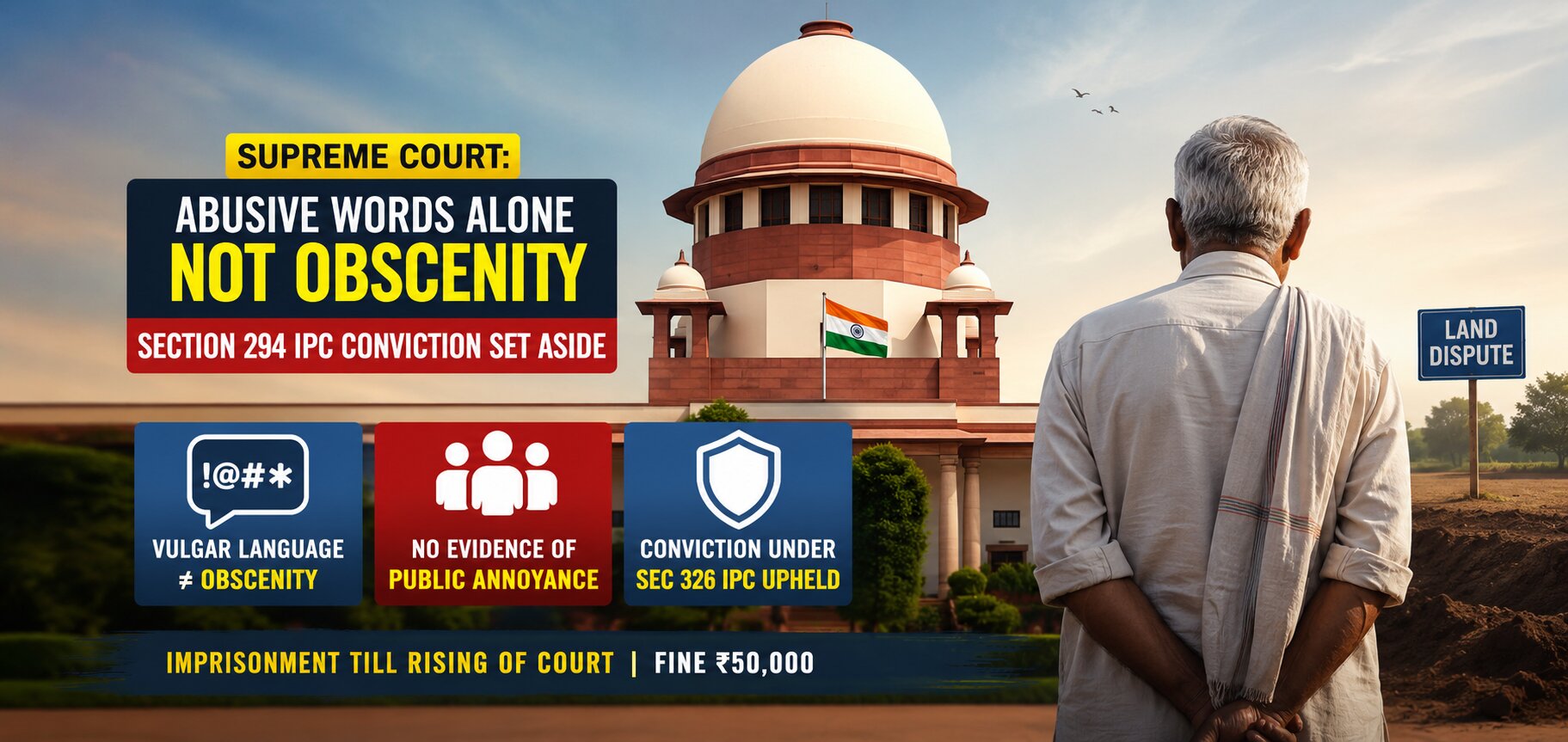
The conviction under Section 294(b) IPC was set aside because vulgar or abusive language alone does not constitute legal obscenity.
Judgement Details
Court
Supreme Court of India
Date of Decision
20 July 2026
Judges
Justice Sanjay Karol & Justice Vipul M. Pancholi
Citation
Acts / Provisions
Facts of the Case
-
The dispute originated from a long-standing land dispute between the appellant and the complainant's family in Tamil Nadu.
-
During an altercation in August 2017, the appellant allegedly abused the complainant using vulgar and offensive language.
-
The appellant further assaulted the complainant with a billhook, a dangerous cutting weapon.
-
The assault resulted in multiple injuries, including a fractured nasal bone, which was medically certified as grievous hurt.
-
The Trial Court convicted the appellant under Sections 294(b), 326 and 506(ii) IPC, along with provisions of the SC/ST (Prevention of Atrocities) Act.
-
On appeal, the Madras High Court acquitted the appellant of the offences under the SC/ST Act but upheld the convictions under Sections 294(b), 326 and 506(ii) IPC.
-
Aggrieved by the High Court's judgment, the appellant approached the Supreme Court challenging his convictions under the IPC.
Issues
-
Whether the use of abusive, vulgar and profane language, without any sexually explicit or lascivious element, constitutes obscenity under Section 294(b) of the Indian Penal Code?
-
Whether the prosecution proved all the essential ingredients required to establish an offence under Section 294(b) IPC, including annoyance to others in a public place?
-
Whether the threatening words allegedly used during the altercation amounted to criminal intimidation punishable under Section 506(ii) IPC?
-
Whether the prosecution successfully established the offence of voluntarily causing grievous hurt by a dangerous weapon under Section 326 IPC?
-
Whether the facts and circumstances of the case justified interference with the sentence imposed upon the appellant?
Judgement
-
The Supreme Court partly allowed the appeal filed by the appellant.
-
The Court held that abusive or vulgar expressions, by themselves, do not amount to obscenity under Section 294(b) IPC unless they are lascivious, appeal to prurient interests and possess the tendency to deprave and corrupt susceptible minds.
-
The Court observed that obscenity in law is distinct from vulgarity, profanity or abusive language.
-
It found that the prosecution failed to prove that the alleged utterances caused annoyance to members of the public, which is an essential ingredient of Section 294 IPC.
-
Consequently, the conviction under Section 294(b) IPC was set aside.
-
The Court further held that mere threatening words uttered during a quarrel are insufficient to constitute criminal intimidation unless they are intended to cause alarm or compel a person to act or refrain from acting.
-
Since no such evidence existed, the conviction under Section 506(ii) IPC was also quashed.
-
The Court upheld the conviction under Section 326 IPC after finding that the complainant suffered grievous hurt in the form of a fractured nasal bone caused by a dangerous weapon, namely a billhook.
-
The Court noted that the medical evidence completely corroborated the eyewitness testimony regarding the assault.
-
Considering the appellant's advanced age, poor health and the fact that the incident arose from a land dispute, the Court modified the sentence to imprisonment till the rising of the court.
-
The Court enhanced the fine to ₹50,000, directing that it be paid within two months.
Held
-
The conviction under Section 506(ii) IPC was set aside because the prosecution failed to prove intention to cause alarm.
-
The conviction under Section 326 IPC was affirmed as grievous hurt caused by a dangerous weapon was proved beyond reasonable doubt.
-
The sentence was reduced to imprisonment till the rising of the court with an enhanced fine of ₹50,000.
Analysis
-
The judgment reinforces the distinction between obscenity and mere vulgarity, preventing an overly broad interpretation of Section 294 IPC.
-
The Court reaffirmed that criminal statutes must be interpreted strictly and that every statutory ingredient must be proved before a conviction can be sustained.
-
By emphasizing the requirement of lasciviousness, prurient appeal, and the tendency to deprave and corrupt, the Court aligned its reasoning with established constitutional jurisprudence on obscenity.
-
The decision reiterates that the prosecution must independently establish that the alleged obscene act caused annoyance to others in or near a public place.
-
The Court clarified that offensive language used during a quarrel does not automatically become criminal merely because it is unpleasant or insulting.
-
In relation to criminal intimidation, the Court reaffirmed that the prosecution must establish an intention to cause alarm and not merely prove that threatening words were spoken.
-
The judgment demonstrates judicial restraint by refusing to criminalize ordinary verbal altercations in the absence of statutory requirements.
-
At the same time, the Court maintained accountability for violent conduct by affirming the conviction for grievous hurt where the evidence was clear and convincing.
-
The sentencing approach reflects the Court's willingness to balance deterrence with humanitarian considerations such as the offender's age, health and the background of the dispute.
-
The decision strengthens legal certainty by consolidating earlier Supreme Court precedents distinguishing obscenity from abusive language, thereby limiting misuse of Section 294 IPC (and its equivalent provision under the Bharatiya Nyaya Sanhita, 2023).