
Manash Kamal Bezboruah v. M/s Bokahola Tea Company Private Limited & Others, 2026
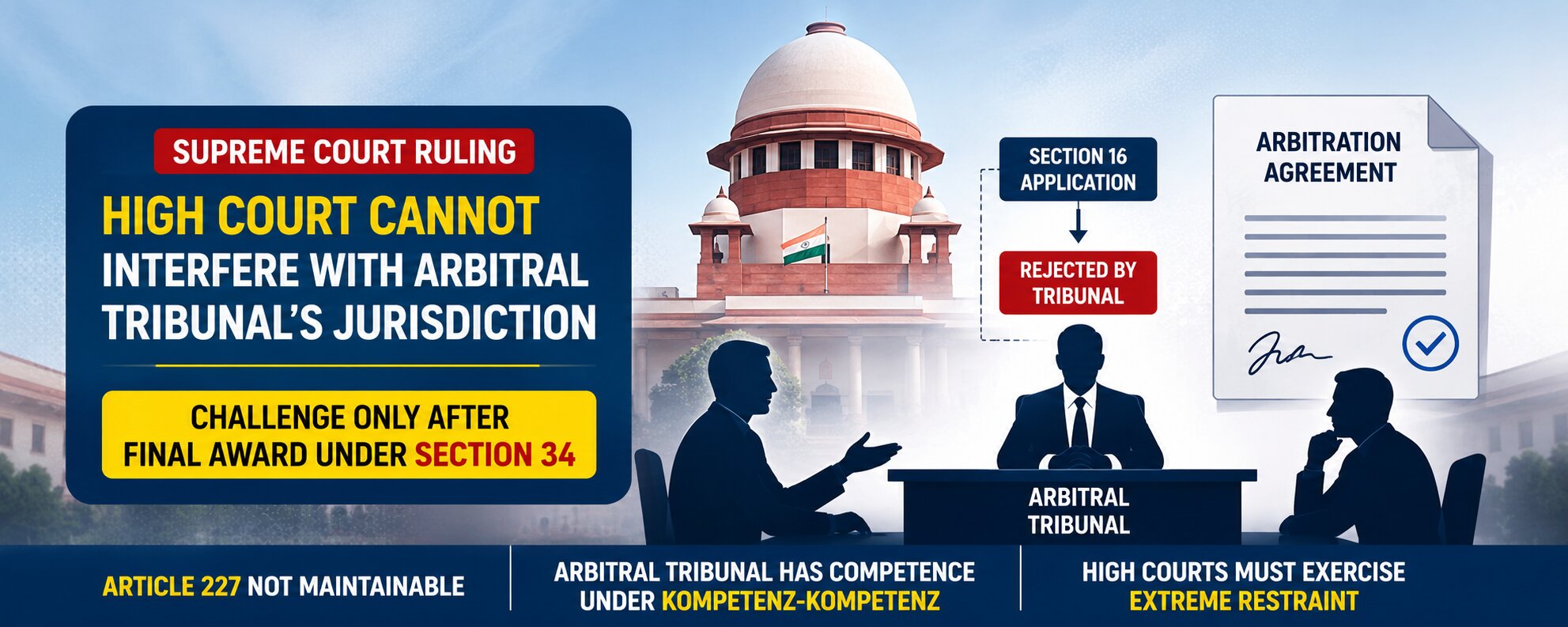
Orders rejecting applications under Section 16 are ordinarily not amenable to challenge under Article 227.
Judgement Details
Court
Supreme Court of India
Date of Decision
14 July 2026
Judges
Justice K.V. Viswanathan & Justice Vijay Bishnoi
Citation
Acts / Provisions
Facts of the Case
-
The dispute arose from a partnership firm constituted in 1948 by members of the Bezboruah family.
-
A partnership deed executed on 16 November 1976 contained an arbitration clause.
-
Earlier, the Trial Court and the Gauhati High Court had refused to refer the dispute to arbitration.
-
Subsequently, the Supreme Court, with the consent of the parties, appointed a Sole Arbitrator.
-
During the arbitral proceedings, Respondent Nos. 1 to 3 sought deletion of their names, contending that they were non-signatories to the arbitration agreement and therefore not bound by it.
-
They filed applications under Section 16 of the Arbitration and Conciliation Act, challenging the tribunal's jurisdiction over them.
-
The Arbitral Tribunal rejected their applications on 4 August 2025.
-
Aggrieved, they approached the Gauhati High Court under Article 227 of the Constitution.
-
The High Court entertained the revision petition, stayed the arbitral proceedings, and held that the petition was maintainable.
-
The appellant challenged the High Court's orders before the Supreme Court.
Issues
-
Whether the High Court could exercise jurisdiction under Article 227 to interfere with an arbitral tribunal's order rejecting an application under Section 16 of the Arbitration Act?
-
Whether non-signatories challenging the tribunal's jurisdiction could directly invoke Article 227 instead of awaiting the final arbitral award?
-
Whether the arbitral tribunal possesses the competence to determine whether non-signatories are bound by the arbitration agreement?
Judgement
-
The Supreme Court allowed the appeal.
-
It set aside both orders of the Gauhati High Court.
-
The Court held that the Arbitration and Conciliation Act is a self-contained code, and Section 5 mandates minimal judicial intervention.
-
It reiterated the doctrine of kompetenz-kompetenz, under which an arbitral tribunal has the authority to determine its own jurisdiction, including whether non-signatories are bound by the arbitration agreement.
-
The Court observed that rejection of an application under Section 16 is ordinarily challengeable only under Section 34 after the arbitral award is rendered.
-
The Bench held that entertaining petitions under Article 227 against such interlocutory orders defeats the legislative objective of expeditious arbitration.
-
The Court clarified that supervisory jurisdiction under Article 227 may be invoked only in exceptional situations involving a patent lack of inherent jurisdiction.
-
It further directed that before entertaining any Article 227 petition challenging a Section 16 order, High Courts must:
-
Record a prima facie finding of patent lack of inherent jurisdiction; and
-
Provide an opportunity of hearing to all rival parties.
-
Held
- The proper remedy is to challenge such orders under Section 34 after the arbitral tribunal renders its final award.
-
High Courts should exercise extreme restraint while invoking Article 227 in arbitration matters.
-
The arbitral tribunal is competent to decide whether non-signatories are bound by the arbitration agreement.
-
Judicial interference at the interlocutory stage is permissible only where there is a patent lack of inherent jurisdiction.
Analysis
-
The judgment strongly reinforces the pro-arbitration policy underlying the Arbitration and Conciliation Act by emphasizing the principle of minimal judicial intervention.
-
It strengthens the doctrine of kompetenz-kompetenz, affirming that questions relating to arbitral jurisdiction—including the binding effect of arbitration agreements on non-signatories—should ordinarily be determined by the arbitral tribunal itself.
-
The Supreme Court clarified that Article 227 cannot be used as an alternative appellate remedy against procedural or jurisdictional orders passed during arbitration.
-
The decision narrows the scope of supervisory jurisdiction by limiting intervention to rare cases involving a patent absence of jurisdiction, thereby preventing delays caused by interlocutory challenges.
-
The Court also issued practical guidance to High Courts by requiring them to record a prima facie finding of jurisdictional error and hear all affected parties before entertaining such petitions.
-
Overall, the ruling promotes the objectives of arbitration—speed, efficiency, party autonomy, and finality—by discouraging premature judicial interference.