
Maksood & Ors. v. State of Rajasthan,2026
Bail may be granted in a cyber-fraud case where the Court considers the circumstances of the case, including the absence of similar criminal antecedents.
Judgement Details
Court
Rajasthan High Court
Date of Decision
4 September 2026
Citation
Acts / Provisions
Facts of the Case
-
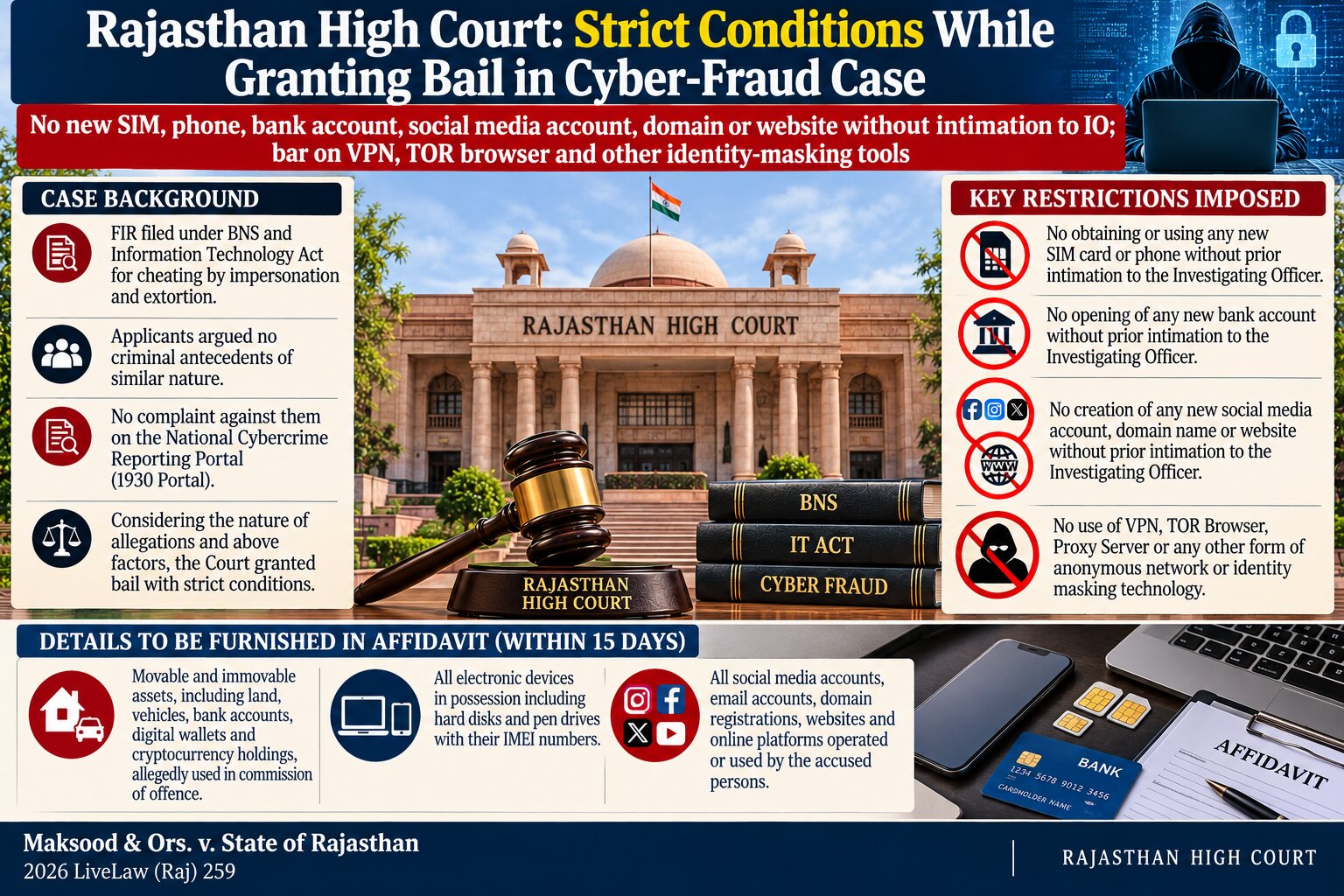
The applicants were accused in an FIR involving allegations of cyber fraud, cheating by impersonation and extortion.
-
The FIR invoked provisions of the BNS and Information Technology Act.
-
The applicants approached the Rajasthan High Court seeking bail.
-
On behalf of the applicants, it was submitted that they had no criminal antecedents of a similar nature.
-
It was also submitted that no complaint against them had been registered on the National Cybercrime Reporting Portal, commonly known as the 1930 Portal.
-
The Court considered the nature of the allegations as well as the absence of similar criminal antecedents.
-
The absence of a complaint against the applicants on the 1930 Portal was also taken into consideration while deciding the bail applications.
-
The Court ultimately granted bail, but imposed several stringent conditions designed to prevent the applicants from engaging in further cyber-related activity or concealing their digital identity.
-
The applicants were directed to furnish an affidavit within 15 days containing detailed information concerning their assets, electronic devices, digital accounts and online activities.
-
The Court required disclosure of movable and immovable assets, including land, vehicles, bank accounts, digital wallets and cryptocurrency holdings allegedly connected with the offence.
-
The applicants were also required to disclose all electronic devices in their possession, including hard disks and pen drives, along with their IMEI numbers wherever applicable.
-
Details of their social-media accounts, email accounts, domain registrations, websites and other online platforms were also required to be disclosed.
-
As an additional bail condition, the applicants were prohibited from obtaining or using any new SIM card or phone without prior intimation to the Investigating Officer.
-
They were similarly prohibited from opening a new bank account without prior intimation to the Investigating Officer.
-
They could not create a new social-media account, domain name or website without informing the Investigating Officer beforehand.
-
The Court further prohibited them from using VPNs, TOR Browser, Proxy Servers or other technologies intended to mask their identity or location.
-
Subject to these conditions and other bail conditions, the bail applications were disposed of.
Issues
-
Whether the applicants were entitled to bail considering the nature of the alleged cyber-fraud offences and the absence of similar criminal antecedents?
-
Whether the absence of any complaint against the applicants on the National Cybercrime Reporting Portal could be considered while determining their entitlement to bail?
-
Whether stringent restrictions on the applicants' use of SIM cards, phones, bank accounts, social-media accounts and online platforms could be imposed as conditions of bail in a cyber-fraud case?
-
Whether the applicants could be directed to disclose their assets, electronic devices, digital accounts, cryptocurrency holdings and other online activities as a condition of bail?
-
Whether restrictions against VPNs, TOR Browser, Proxy Servers and other identity-masking technologies were justified in the circumstances of the case?
Judgement
-
The Rajasthan High Court granted bail to the applicants.
-
The Court took into account the nature of the allegations against the applicants.
-
The Court also considered the fact that the applicants did not have similar criminal antecedents.
-
The absence of any complaint against them on the 1930 cybercrime portal was also considered relevant.
-
While granting bail, the Court imposed detailed conditions aimed at ensuring the applicants' cooperation with the investigation and preventing possible misuse of digital technology.
-
The applicants were directed to submit an affidavit within 15 days containing comprehensive information concerning their assets and digital resources.
-
The affidavit was required to disclose movable and immovable properties, bank accounts, digital wallets and cryptocurrency holdings allegedly used in the commission of the offence.
-
The applicants were required to provide information concerning electronic devices in their possession, including hard disks and pen drives and their relevant identification details.
-
Details of social-media accounts, email accounts, domain names, websites and other online platforms operated or used by them were also required to be furnished.
-
The Court prohibited the applicants from obtaining or using a new SIM card or phone without prior intimation to the Investigating Officer.
-
They were also prohibited from opening any new bank account without prior intimation.
-
Creation of any new social-media account, domain name or website was similarly restricted without prior information to the Investigating Officer.
-
The Court specifically directed the applicants not to use VPN, TOR Browser, Proxy Server or other identity-masking technologies.
-
The bail applications were accordingly disposed of subject to the imposed conditions.
Held
-
The absence of complaints on the 1930 Portal was a relevant circumstance considered by the Court.
-
Bail conditions can be structured to address the particular risks associated with alleged cyber-enabled offences.
-
The Court may require disclosure of relevant physical and digital assets as part of bail conditions.
-
Disclosure can extend to bank accounts, digital wallets, cryptocurrency holdings, electronic devices, social-media accounts, email accounts, domain registrations and websites.
-
Restrictions may be imposed on obtaining new SIM cards, phones and bank accounts where considered necessary for the investigation.
-
The Court imposed restrictions on creating new online identities or platforms, including social-media accounts, websites and domain names.
-
The applicants were specifically prohibited from using VPNs, TOR Browser, Proxy Servers and other identity-masking technologies.
-
The conditions were directed toward maintaining investigative oversight and preventing misuse of digital infrastructure during the period of bail.
Analysis
-
The judgment demonstrates how bail conditions can be tailored to the technological characteristics of the alleged offence. In an ordinary criminal case, conventional conditions may focus primarily on appearance before the investigating agency and non-interference with witnesses. In a cyber-fraud investigation, the Court addressed digital access, online identities, financial accounts and electronic devices as well.
-
The Court's conditions appear designed to prevent the applicants from creating new digital identities or financial channels that could potentially complicate the investigation.
-
The requirement to disclose cryptocurrency holdings and digital wallets is particularly relevant to modern cybercrime investigations because financial transactions may occur through both conventional banking systems and digital assets.
-
The requirement to disclose electronic devices and their identifying details can assist investigators in identifying the technological infrastructure potentially relevant to the alleged offence.
-
The restriction on VPNs, TOR Browser and Proxy Servers reflects the Court's concern with technologies capable of masking the user's IP address or online identity. The condition is specifically connected to the allegations and investigative concerns in the cyber-fraud context.
-
The Court did not deny bail merely because the allegations involved cybercrime. Instead, it considered the applicants' criminal antecedents and the absence of similar complaints, and then balanced the grant of liberty with investigative safeguards.
-
The decision illustrates the distinction between granting bail and imposing conditions on bail. The Court permitted the applicants to remain at liberty while simultaneously placing restrictions intended to protect the investigation.
-
The affidavit requirement creates a formal record of the applicants' physical assets and digital footprint, potentially making subsequent investigation and verification easier.
-
The judgment is significant because cybercrime investigations can involve rapidly changing digital identities, multiple communication platforms, online financial accounts and anonymisation tools. The conditions directly address these characteristics.
-
At the same time, such conditions operate as case-specific bail conditions. The judgment, as described in the supplied material, should not be read as establishing that every accused person in every cybercrime case must automatically comply with identical restrictions.
-
The decision therefore reflects a broader judicial approach of attempting to reconcile personal liberty with the practical requirements of investigating technology-enabled offences.