
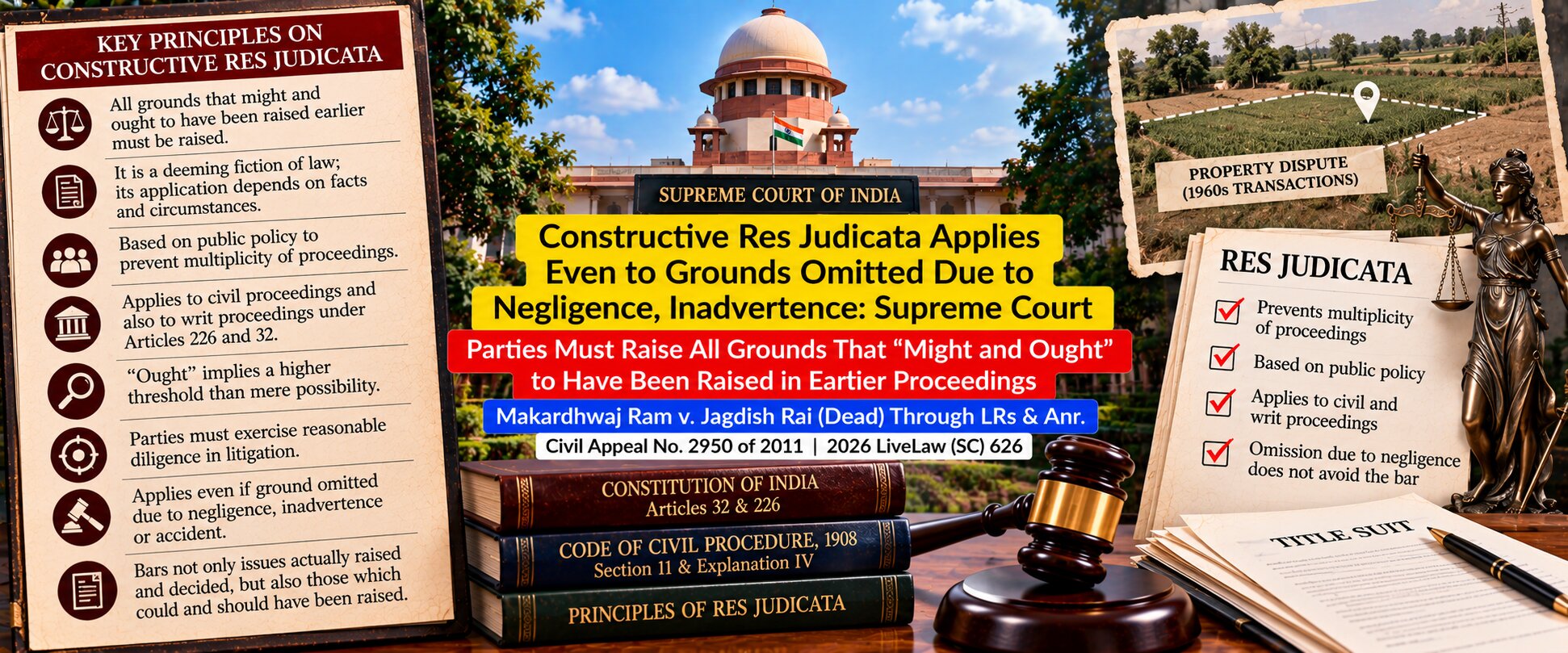
Makardhwaj Ram v. Jagdish Rai (Dead) Through LRs & Anr., 2026
The Court particularly cautioned against applying procedural doctrines in family property disputes without understanding the surrounding circumstances and the history of the transactions.
Judgement Details
Court
Supreme Court of India
Date of Decision
2 September 2026
Judges
Justice Sanjay Karol and Justice N. Kotiswar Singh
Citation
Acts / Provisions
Facts of the Case
-
The dispute concerned agricultural land originally belonging to Mahabir Rai.
-
In July 1960, Mahabir Rai transferred 95.80 acres of land to his mother Raj Mohani alias Roopjhari and his son Makardhwaj Ram.
-
Subsequently, in April 1962, Mahabir Rai, his wife Gulmati and his mother executed a General Power of Attorney in favour of Mahabir's cousin, Rambhajan.
-
Acting under the authority of that power of attorney, Rambhajan executed two separate sale transactions in 1969.
-
In January 1969, Rambhajan sold 21.43 acres of land to Prem Prakash.
-
In February 1969, Rambhajan sold another 33.76 acres to Chandra Sao.
-
The power of attorney in favour of Rambhajan was subsequently cancelled in June 1969.
-
Two separate suits were instituted challenging the two sale deeds executed by Rambhajan.
-
Those earlier suits were dismissed.
-
Subsequently, Rambhajan sought mutation of his name in the revenue records in respect of land beyond the specific portions covered by the disputed sale transactions.
-
At that stage, Makardhwaj Ram instituted a fresh suit seeking declaration of title and possession.
-
The trial court partly decreed the suit in May 1993, holding that Makardhwaj Ram was entitled to 43.69 acres out of the claimed 95.80 acres.
-
Rambhajan's son, Jagdish, challenged the decision.
-
In second appeal, the High Court reversed the trial court's judgment and dismissed the suit on the ground that it was barred by constructive res judicata.
-
The High Court reasoned that Makardhwaj Ram could have relied upon the 1960 transfer deed and asserted his title in the earlier proceedings.
-
Since he had not done so, the High Court concluded that he was barred from raising that claim in the subsequent litigation.
-
Makardhwaj Ram approached the Supreme Court challenging the High Court's application of constructive res judicata.
-
Before the Supreme Court, he argued that the earlier litigation concerned specific sale transactions, whereas the subsequent suit concerned his title and possession over the larger parcel of land.
-
The respondents argued that the appellant could and should have asserted his ownership under the 1960 deed during the earlier proceedings and therefore could not subsequently rely upon that ground.
-
The Supreme Court was consequently required to examine the scope of constructive res judicata and, in particular, whether the appellant's claim of title was something that “might and ought” to have been raised in the earlier suits.
Issues
-
Whether the subsequent suit seeking declaration of title and possession was barred by constructive res judicata under Section 11 and Explanation IV of the CPC?
-
Whether the appellant's title arising from the 1960 transfer deed was a ground that “might and ought” to have been raised in the earlier suits challenging the specific sale deeds?
-
Whether omission of a ground in earlier litigation automatically attracts constructive res judicata even where the nature and scope of the earlier proceedings did not require determination of that ground?
-
Whether the fact that a litigant could theoretically have raised a particular claim in earlier proceedings is sufficient to satisfy the “ought to have been raised” requirement?
-
Whether constructive res judicata can be applied where doing so would effectively deprive the plaintiff of property rights that were not directly in controversy in the earlier proceedings?
-
Whether the High Court was justified in dismissing the appellant's subsequent title suit on the basis of constructive res judicata?
Judgement
-
The Supreme Court allowed the appeal filed by Makardhwaj Ram.
-
The Court set aside the judgment of the Chhattisgarh High Court which had dismissed the suit on the ground of constructive res judicata.
-
The Supreme Court reiterated that constructive res judicata requires a party to raise all grounds which “might and ought” to have been raised in the earlier proceedings.
-
However, the Court clarified that the doctrine cannot be applied mechanically merely because a particular ground was theoretically available to the litigant.
-
The expression “ought” imposes a higher threshold than mere possibility.
-
Courts must examine whether, considering the nature and scope of the earlier proceedings, the particular ground was one that reasonably ought to have been raised.
-
The Court emphasised that the application of constructive res judicata depends upon the facts and circumstances of each case.
-
The Court must consider the ambit of the earlier proceedings and the nexus between the omitted matter and the controversy actually involved in those proceedings.
-
In the present case, the earlier suits specifically challenged the two sale transactions executed by Rambhajan.
-
The appellant's title to the larger parcel of land was based upon the 1960 transfer deed.
-
That larger title was not the subject of controversy in the earlier suits.
-
The Court therefore found that there was no occasion for Makardhwaj Ram to seek a declaration of title over the larger parcel during those earlier proceedings.
-
The need to assert his broader title arose only later when Rambhajan sought mutation of his name over land beyond the portions covered by the disputed sale transactions.
-
The Supreme Court therefore rejected the High Court's assumption that the appellant had necessarily abandoned his stronger title claim merely because he had earlier chosen to challenge the specific sale deeds.
-
The Court observed that applying constructive res judicata in these circumstances would produce an unduly harsh and unjust consequence.
-
Such an interpretation would effectively deprive the appellant of property that had already been transferred to him under the 1960 deed.
-
The Court also stressed that constructive res judicata is intended to prevent multiplicity of litigation, but it must not be applied in a manner disconnected from the actual controversy in the earlier proceedings.
-
The Court reiterated that negligence, inadvertence or accident ordinarily does not save a ground which genuinely might and ought to have been raised earlier.
-
However, that principle did not assist the respondents because the Court found that the appellant's broader title claim did not fall within the matters that he ought to have raised in the earlier suits.
-
The Court also emphasised that legal principles must be applied with sensitivity to the surrounding circumstances in family property disputes.
-
The High Court's judgment was therefore set aside and the appeal was allowed.
Held
-
Constructive res judicata bars not only matters actually decided but also matters which might and ought to have been raised in the earlier proceedings.
-
The words “might and ought” operate cumulatively; mere possibility of raising a ground is insufficient.
-
The expression “ought” requires consideration of reasonable diligence and the legitimate scope of the earlier litigation.
-
The application of constructive res judicata is fact-specific and depends upon the ambit of the earlier proceedings and the connection between the omitted matter and the controversy.
-
Negligence, inadvertence or accident does not ordinarily excuse a litigant from the consequences of failing to raise a ground that genuinely ought to have been raised earlier.
Analysis
- However, the doctrine cannot be invoked merely because a claim could theoretically have been raised in earlier proceedings.
-
In the present case, the earlier suits concerned specific sale deeds, whereas the later suit concerned declaration of title and possession over a substantially larger parcel.
-
The appellant's title under the 1960 deed was not the controversy requiring adjudication in the earlier suits.
-
Therefore, the subsequent suit was not barred by constructive res judicata.
-
Applying constructive res judicata in the circumstances would have resulted in an unjust deprivation of the appellant's property rights.
-
The High Court's judgment was accordingly set aside.