
Mahinder & Ors. v. Puran Singh, 2026
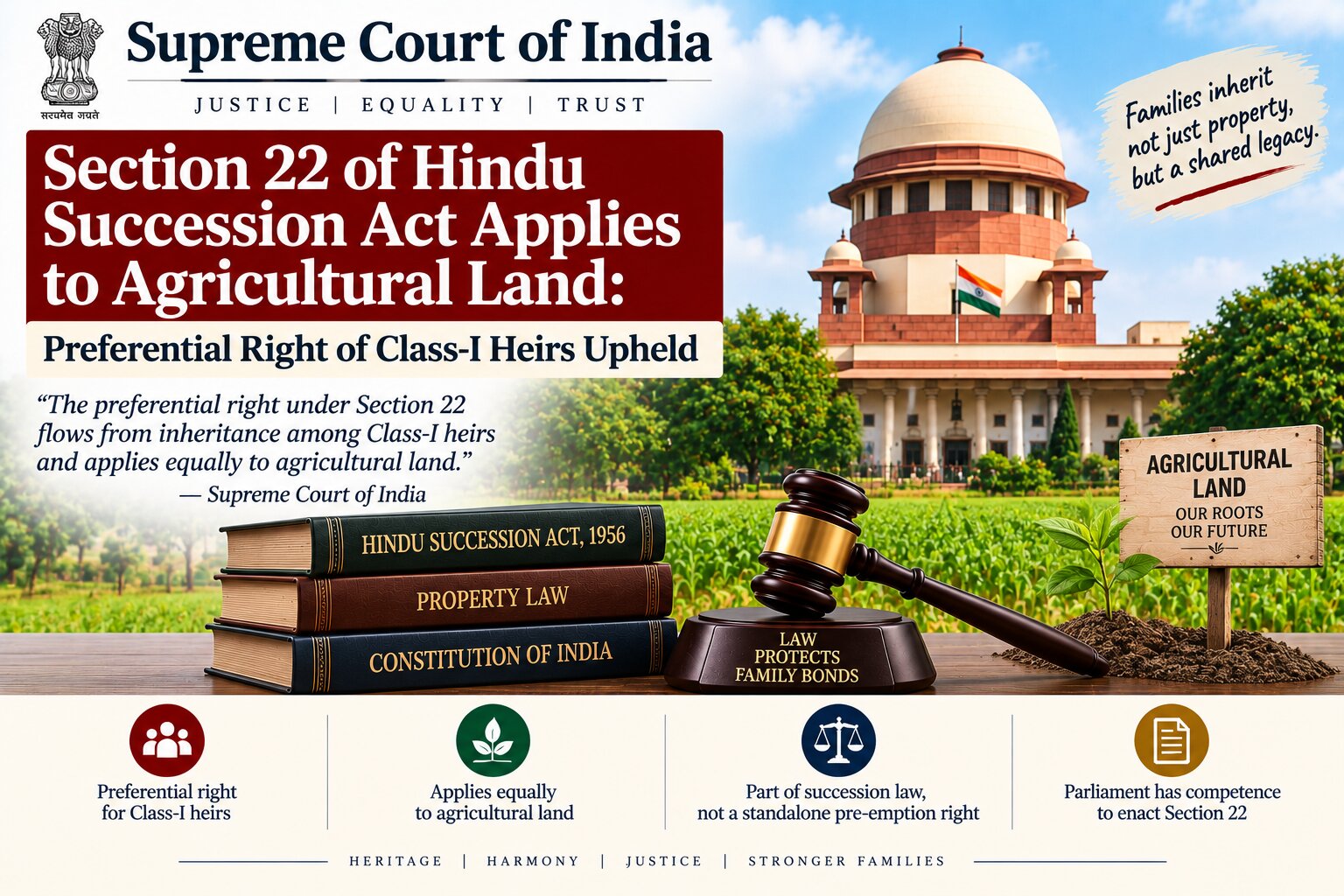
Section 22 of the Hindu Succession Act applies to agricultural land.
Judgement Details
Court
Supreme Court of India
Date of Decision
1 September 2026
Judges
Justice Sanjay Karol and Justice Nongmeikapam Kotiswar Singh
Citation
Acts / Provisions
Facts of the Case
-
The parties were siblings who had inherited agricultural land from their father as Class-I heirs under the Hindu Succession Act.
-
Some of the siblings decided to sell their inherited shares to a third party through a sale deed dated 28 December 2011.
-
One sibling invoked Section 22 of the Hindu Succession Act, claiming a preferential right to purchase the property before it was transferred to an outsider.
-
The Trial Court dismissed the claim, relying upon the Constitution Bench judgment in Atam Prakash v. State of Haryana.
-
The First Appellate Court reversed the Trial Court's decision, relying upon Babu Ram v. Santokh Singh and holding that Section 22 applies to agricultural land.
-
The High Court affirmed the Appellate Court's view.
-
The appellants approached the Supreme Court challenging the applicability and constitutional competence of Section 22 in relation to agricultural land.
Issues
-
Whether Section 22 of the Hindu Succession Act applies to agricultural land inherited by Class-I heirs?
-
Whether the preferential right under Section 22 is an incident of succession or an independent law regulating transfer of agricultural property?
-
Whether Atam Prakash v. State of Haryana invalidates or restricts the preferential right created under Section 22 of the Hindu Succession Act?
-
Whether Parliament had legislative competence to enact Section 22 in respect of agricultural land?
-
Whether the preferential right under Section 22 can be exercised by Class-I co-heirs against a proposed transfer of inherited property to an outsider?
Judgement
-
The Supreme Court dismissed the appeal and upheld the judgments of the First Appellate Court and the High Court.
-
The Court held that Section 22 of the Hindu Succession Act applies to agricultural land inherited by Class-I heirs.
-
The preferential right under Section 22 is fundamentally connected with succession and inheritance, rather than being an independent law regulating transfers of agricultural land.
-
The Court distinguished Section 22 from Section 15 of the Punjab Pre-emption Act considered in Atam Prakash.
-
Section 22 operates only among Class-I heirs who have inherited property from the same intestate, whereas the Punjab legislation created a much wider category of persons entitled to claim pre-emption.
-
The Court rejected the argument that Atam Prakash made the concept of pre-emption itself unconstitutional.
-
Justice Nongmeikapam Kotiswar Singh, in his concurring judgment, applied the doctrine of pith and substance and held that the true character of Section 22 is succession.
-
The Court concluded that Parliament was competent to enact Section 22 and that its application to agricultural land was constitutionally valid.
Held
-
The right granted by Section 22 is a succession-based preferential right available to Class-I co-heirs.
-
Section 22 cannot be treated as a standalone or general law of pre-emption.
-
The right arises only where persons have inherited property together as Class-I heirs.
-
Atam Prakash does not invalidate Section 22 because it dealt with a substantially different statutory scheme under the Punjab Pre-emption Act.
-
Parliament possesses the necessary legislative competence to enact Section 22 even where the inherited property is agricultural land.
-
The challenge to the validity and applicability of Section 22 failed.
-
The appeal was dismissed.
Analysis
-
The judgment is significant because it settles the controversy over whether the preferential right under Section 22 HSA can operate when the inherited property is agricultural land.
-
The Supreme Court focused on the source and nature of the right, rather than merely on the fact that its exercise ultimately affects a transfer of land.
-
Section 22 does not create a general right of pre-emption for neighbours, tenants, ordinary co-owners or distant relatives. It is specifically confined to Class-I heirs who inherited the property together.
-
This limitation was crucial in distinguishing Section 22 from the provision struck down in Atam Prakash.
-
The Court clarified that Atam Prakash did not declare the entire concept of pre-emption unconstitutional. The constitutional problem in that case concerned the particular classification created by the Punjab Pre-emption Act.
-
The judgment therefore prevents a broad reading of Atam Prakash that would effectively invalidate every statutory preferential right merely because it resembles pre-emption.
-
Justice Kotiswar Singh's concurring judgment strengthens the reasoning through the pith and substance doctrine. Although Section 22 is triggered when an heir proposes to transfer property, its dominant character remains connected with succession.
-
The preferential right is therefore treated as an incident of inheritance. The right comes into existence because of the succession relationship and disappears when that succession relationship is absent.
-
The Court also rejected the argument that Parliament was constitutionally barred from legislating on agricultural land in this context. The provision does not primarily regulate agricultural land transfers; rather, it determines a consequence attached to property inherited under the Hindu Succession Act.
-
The judgment maintains a balance between an heir's ability to transfer inherited property and the statutory interest of other Class-I heirs in preventing an outsider from entering the inherited family property.
-
Importantly, the decision does not create a general pre-emption right over agricultural land. Its operation remains strictly confined to the circumstances prescribed by Section 22.
-
The decision therefore provides a clear distinction between general pre-emption laws and succession-based preferential rights.
-
The central principle emerging from the judgment is that the nature of a statutory right must be determined by its true legislative character, not merely by the mechanism through which that right is exercised.