
Maharaj Saran v. State of Punjab & Ors., 2026
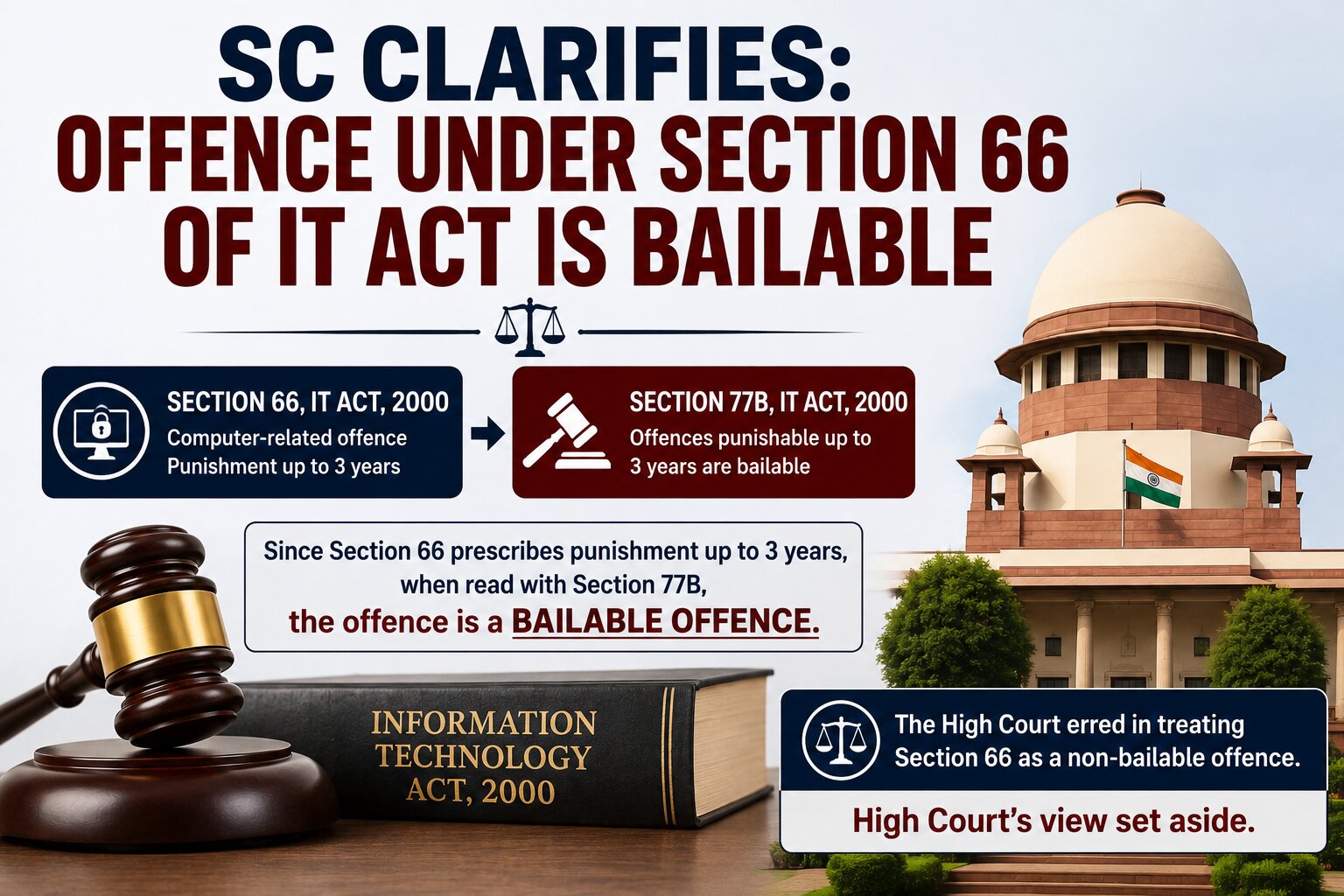
Section 66 of the Information Technology Act, 2000, which prescribes punishment up to three years, is a bailable offence when read with Section 77B of the Act.
Judgement Details
Court
Supreme Court of India
Date of Decision
11 August 2026
Judges
Justice M.M. Sundresh and Justice Prasanna B. Varale
Citation
Acts / Provisions
Facts of the Case
-
The case arose from the alleged detention of the appellant's son at an airport.
-
A Look Out Circular (LOC) had been issued against him.
-
The LOC was connected with an FIR alleging offences under Sections 66, 72 and 84-C of the Information Technology Act, 2000.
-
The FIR also invoked Section 78(1)(ii) of the Bharatiya Nyaya Sanhita, 2023.
-
The appellant approached the Punjab & Haryana High Court through a habeas corpus petition, alleging illegal detention of his son.
-
While disposing of the writ petition, the High Court made a prima facie observation that an offence under Section 66 of the IT Act was non-bailable.
-
The appellant challenged this particular aspect before the Supreme Court.
-
The Supreme Court examined the relationship between Section 66 and Section 77B of the IT Act.
-
Section 66 provides punishment of imprisonment up to three years.
-
Section 77B provides the statutory framework for determining whether offences under the IT Act are bailable.
-
The Supreme Court concluded that the High Court had failed to properly consider Section 77B.
-
The Court therefore set aside the High Court's observation regarding the non-bailable nature of Section 66.
Issues
-
Whether an offence punishable under Section 66 of the Information Technology Act, 2000 is a bailable offence when Section 66 is read with Section 77B of the Act?
-
Whether the Punjab & Haryana High Court was justified in treating an offence under Section 66 of the Information Technology Act as non-bailable?
-
Whether Section 77B of the Information Technology Act must be considered while determining the bailable or non-bailable character of an offence under Section 66?
Judgement
-
The Supreme Court set aside the High Court's observation that an offence under Section 66 of the IT Act was non-bailable.
-
The Court held that Section 77B must be read together with Section 66 to determine the nature of the offence.
-
Section 66 prescribes punishment of imprisonment for a term extending up to three years.
-
Applying Section 77B, the offence is treated as bailable.
-
The Supreme Court held that the High Court had erred by failing to take Section 77B into consideration.
-
The Court clarified that the fact that Section 66 itself does not expressly label the offence as "bailable" does not make it non-bailable.
-
The plea was accordingly disposed of after correcting the legal position.
Held
-
An offence punishable under Section 66 of the IT Act is bailable.
-
Section 66 must be read along with Section 77B to determine its classification.
-
The punishment under Section 66 extends up to three years.
-
The High Court therefore erred in treating Section 66 as a non-bailable offence.
-
The Supreme Court set aside that finding.
Analysis
-
Core issue: The case primarily concerned statutory interpretation rather than the merits of the allegations against the appellant's son.
-
Importance of Section 77B: The Supreme Court stressed that Section 66 cannot be considered in isolation. Section 77B provides the relevant classification mechanism.
-
Three-year punishment: Because Section 66 carries imprisonment up to three years, the statutory scheme under Section 77B results in the offence being treated as bailable.
-
High Court's error: The High Court focused on the absence of an express declaration within Section 66 itself and failed to consider the effect of Section 77B.
-
Statutory reading: The judgment illustrates the principle that related provisions forming part of the same statutory scheme should be read together rather than interpreted in isolation.
-
Bail consequences: Classification as a bailable offence has important consequences for personal liberty because bail in a bailable offence operates on a fundamentally different legal footing from bail in a non-bailable offence.
-
Protection of liberty: The clarification is particularly significant because the dispute arose in the context of alleged detention at an airport and a habeas corpus petition.
-
Limited scope of ruling: The Supreme Court's decision concerned the classification of Section 66. It did not amount to an adjudication on the guilt or innocence of the accused or the legality of every aspect of the detention.
-
Practical significance: Investigating agencies and courts must consider Section 77B when determining the bail classification of offences under the IT Act.
-
Overall impact: The judgment provides clarity on the statutory treatment of Section 66 and prevents the provision from being incorrectly treated as non-bailable merely because Section 66 itself does not expressly use the word "bailable."